


More than 100,000 vulnerability identifiers have been published so far this year, by VulnCheck’s count, over twice as many as in all of 2025. VulnCheck says AI-driven bug hunting is behind most of them.
VulnCheck, which is itself a CVE Numbering Authority, counted 100,222 CVEs as of late Friday morning Eastern time, Josh Bressers, its director of coordinated vulnerability disclosure, told The Register. “There’s no denying the fact that vulnerability hunting with AI is driving a majority of what we’re seeing,” he said.
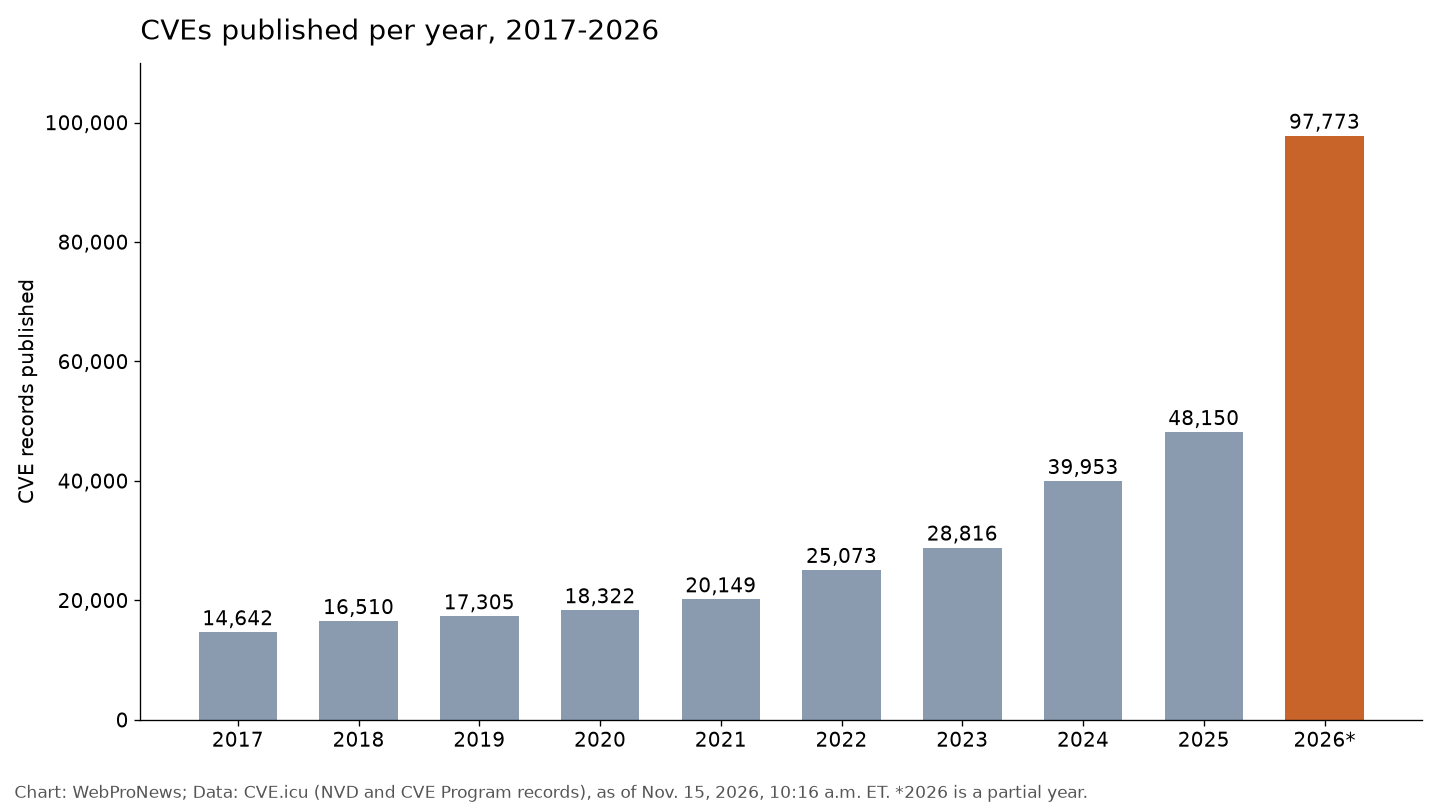
The climb got steeper as the year went on. CVE.icu, an open tracker built on NVD and CVE Program data, logged 4,302 new CVEs in January and 17,051 in October. Its busiest day of the year was Oct. 13, with 2,303. All of 2025 produced 48,150 on the same count, and its 2026 total stood at 97,773 as of 10:16 a.m. ET Sunday. That is below VulnCheck’s figure, but more than double 2025 either way. Big vendors are part of the surge: Microsoft fixed more than 1,000 flaws in each of its last two monthly releases, including a November Patch Tuesday whose only exploited bug was found with help from Claude.
Exploitation hasn’t kept pace with the count
Attackers are not using a growing share of these bugs. About 1.4% of this year’s CVEs, or 1,363, have landed in VulnCheck’s Known Exploited Vulnerabilities catalog, Bressers said, though he noted that 1% of 100,000 is far more than 1% of 1,000. The company’s first-half exploitation report, published in July, found that the ratio of newly exploited bugs to newly published ones peaked at 2.7% in the second half of 2023 and fell to 1.4% in the first half of 2026. Of 1,061 flaws VulnCheck attributed to AI-assisted discovery in the first six months, 14 had been confirmed as exploited, or 1.3%, close to the rate for everything else.
The flaws attackers do pick up get used sooner. VulnCheck measured the median time from CVE publication to known exploitation at 120 days in 2025 and 80 days in the first half of 2026. A disclosure it published on Friday shows how short the gap can get. One of 14 flaws it reported in Copeland’s XWEB EVO refrigeration supervisors had no public exploit code, only a brief NVD entry that went live at 3:18 p.m. ET on Thursday. VulnCheck’s sensors logged attacks on it an hour and 40 minutes later.
Bressers argues the industry now has “a data problem” and needs to stop treating every critical score the same way. Federal agencies already have to. CISA’s Binding Operational Directive 26-04, issued June 10, replaced flat patch deadlines with four questions: whether the asset is publicly exposed, whether the bug is in CISA’s KEV catalog, whether an attacker can automate the exploit, and whether exploitation gives partial or total control. “It’s telling people to figure out the vulnerabilities that actually affect you, and then put those at the top of the list, instead of just saying we’re going to fix all the criticals,” Bressers said.
Open-source maintainers are making their own adjustments. The curl project began handling low- and medium-severity reports in public GitHub issues on Oct. 26 and kept only high and critical ones private on HackerOne. Lead developer Daniel Stenberg wrote that the change “is entirely triggered by the current avalanche of vulnerability reports that keep pouring in,” and that over 90% of submissions in recent years rated below high. AI labs, meanwhile, are selling defenders agents that test and patch code, as OpenAI did with its Daybreak products on Thursday.
Bressers doesn’t expect the count to level off. “While 100K sounds like a lot, in a couple years we’re going to say, remember when it was only 100K?” he said.


 WebProNews is an iEntry Publication