
Quantcast
Read WebProNews
With Friends!

Google Changes Display URLs for AdWords Ads

Says Move to Standardized Look Can Improve Clickthrough Rates

Get the WebProNews Newsletter:

Google will be changing the way display URLs look in AdWords ads in the next week or so. The domain portion of the display URL will always be showing in lowercase letters.  For example, Subdomain.Example.com/Subdirectory will appear as subdomain.example.com/Subdirectory. Google suggests that the move can actually boost clickthrough rates. 

"In any given month, we experiment with hundreds of subtle variations of the Google search results page, testing everything from font sizes and colors to layouts and spacing, as well as dozens of other variables," says Lisa Shieh of Google’s Inside AdWords Crew. "Recently, we found that by standardizing the look of the URLs on the page, we were able to improve many of our user metrics, including ad clickthrough rates."

"As you’ve probably figured out by now, we believe that regular website testing is the best way to ensure an optimal user experience, and we encourage you to test variations of your own website," she says.

More specifically, Google suggests using its own Website Optimizer tool for such testing. 

Advertisers need not worry about editing their own ads. Uppercase letters in display URL domains will automatically be changed to lowercase when the change goes into effect. 

Google also introduced a new way to manage negative keywords across multiple campaigns in negative keywords lists.
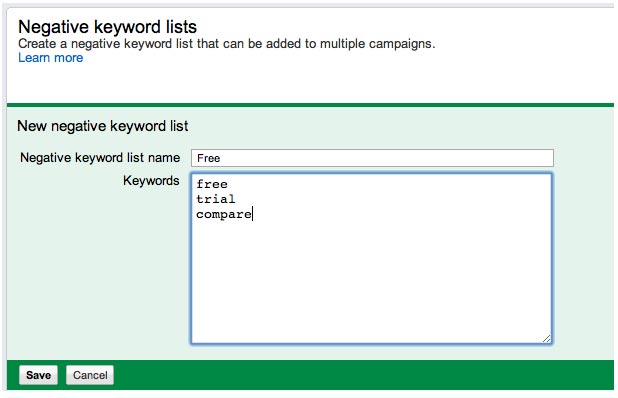
Negative Keywords Lists

With the lists, advertisers can manage groups of negative keywords in their account’s Control Panel and Library, and associate them with multiple campaigns. 

"For example, say you have a set of negative keywords you always add to any campaign running on the Search Network," explains Google’s Dan Friedman. "Previously, you’d need to copy that set to every new search campaign you created in your account. Now, with shared lists, you can simply create a single negative keyword list and associate it with each search campaign. If there’s a new negative keyword you’d like to add to all of those campaigns, just add it to your list and it will automatically update across each campaign. Similarly, if you create a new campaign, you can add your negative keyword list to exclude all of the necessary terms with just a few clicks."

More on this here.

Top Rated White Papers and Resources
There are 20 Comments. Add Yours.
  1. I think this is a good move by Google. I always thought it was strange to see capital letters in the ads URLs since real URLs are always lowercase. Now they will look more legitimate.

    Reply
  2. I disagree that it is a good move. I think capitalization improves readability. That was one of the reasons that CTR for capitalized domains in display URL was higher. Obviously, only testing can make or break the case. I am sure marketers will share their observations soon enough. It is somewhat surprising for me, that out of all possible changes, domain de-capitalization was the top priority.

    Reply
    • Like (0) Dislike (0)
      Chris Crum

      I agree that capitalization can improve readability.

      Reply
  3. Like (0) Dislike (0)
    Frank Okun

    I agree with Lyena Solomon in that display URLs should include capitalization for better readability. It doesn’t make sense that going back to all lowercase would yield improvements in CTR, but then again, who’s to argue with Google? I would think the ad title and call to action would be the main factors in affecting CTR statistics, no so much the display URLs. However, I believe having Capitalization would only help, not negate, the CTR.

    Reply
  4. Well, I think that Google really made a lot of tests before making this step and we shouldn’t be worried about.

    Even if we will have to wait a few weeks to gather some data and check out the real result of this move, I’m quite confident.

    Reply
  5. I agree with the first commenter. By making the url lowercase allows the ad to be more natural and in my opinion, more acceptable. Like Lyena said though, as individual advertisers, we will need to test against the high case version. But Google must have done testing before maing this change, after all they are also in the make money business too.

    Steve

    Reply
  6. Google is again imposing something without even consulting their customers. Being the leader, we are left with no choice with their decisions.

    To give the benefit of a doubt, I think they have a basis for doing so. So, let’s wait and see if it will deliver as stated.

    Reply
    • Like (0) Dislike (0)
      Chris Crum

      Keep in mind, that advertising is Google’s ads are the company’s own bread and butter. It’s in their best interest to keep people clicking.

      Reply
  7. Like (0) Dislike (0)
    Adsense Publisher

    I think they should let people use upper and lowercase.

    http://www.MyProductSite.com should not be displayed as http://www.myproductsite.com unless the advertiser meant for it to display that way. I think in my first example, http://www.MyProductSite.com reads better.

    Google should give people options if they think a different way might perform better than dictate how things will be in all areas of everything.

    Reply
    • Like (0) Dislike (0)
      Adsense Publisher

      I do think that the full url should display tho.
      So I think they are spot on with that.

      Reply
  8. Like (0) Dislike (0)
    Vladimir

    Just wanted to thank you for this helpful information…
    Thanks :)

    Reply
  9. I incorporated mixed case URLs in my ads years ago and saw a definite improvement in click through for the mixed case.

    Google has become like the government with the “We know what is best for you” attitude. How about simply advising advertisers about their research and let those that believe it make their own choice.

    Reply
  10. Right from the start, my eyes always get attracted to domain url with all lowercases, I think that is a fantastic move by Google. Somehow, those domain URL with upper and lowercases look more Spam to me.

    Cheers!

    Reply
  11. Thank you for the news, yes it may be a good idea as i mentioned in my subject, but for sure we have to wait a lot of time to see how effective this new idea will work.

    Reply
  12. I think it’s wonderful news. Uppercase has been abused too much and to huge irritation for the users – that’s why I welcome the new lowercase.
    However, I see the points of a higher readiness of http://www.YourSite.com than http://www.yoursite.com.
    Maybe Google should test that there must not be two UPpercase letters in succession, avoiding http://www.YOURSITE.com.

    Next step is to eliminate the possibility of Uppercase on each word in the description. It Is Unnatural For Users And Is An Irritation.

    Reply
  13. I agree – How dumb! It’s very hard to read a web address that is all together. I thought the Caps were a good thing. Wonder why they’re keeping caps on the Subdomain? Must be something that’s beneficial to them – again. . .

    Reply
  14. Like (0) Dislike (0)
    Dusan

    Presumably Google will benefit. Presumably because click through rates for low caps are higher than for the rest. I wonder what else they’ve tested and rejected.

    Reply
  15. In my opinion lowercase is a better choice for URLs . Regarding ROI, since all the ads are affected it won’t make a big difference.

    Reply

What do you think? Respond.

Your email address will not be published. Required fields are marked *

*

You may use these HTML tags and attributes: <a href="" title=""> <abbr title=""> <acronym title=""> <b> <blockquote cite=""> <cite> <code> <del datetime=""> <em> <i> <q cite=""> <strike> <strong>