Read WebProNews
With Friends!

Google’s Really Taking This Speed Thing Seriously

Google Launches New Image File Format, WebP

Get the WebProNews Newsletter!
Top Rated White Papers and Resources
There are 50 Comments. Add Yours.
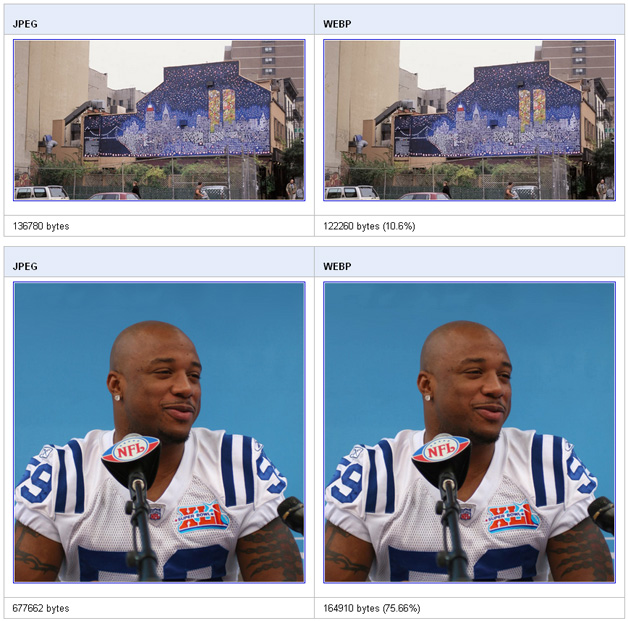
  1. When you drag both images to the desktop the webp one saves as a png that is 592kb big and the jpg is 20kb. I guess this is just a hypothetical mockup because the format doesn’t exist? Or is it only compressed when on the web?

  2. Adsense Publisher

    Ok, so does everybody really think that Google is doing this to benefit people or themselves?

    Caffeine was supposed to speed up the time it took to index pages, and any online publisher I’ve talked to is showing the same thing, Caffeine, while having some very nice features for the end user, for the publisher it’s actually indexing the pages slower.

  3. hey can significantly slow down a user

  4. We have a lot of photos, art work, illustrations and dog cartoons that would benefit from the new program. Speeding the website up without loss of image quality would be an advantage. Go for it, Google!

    • ….and I don’t care if Google benefits from the new program. Why shouldn’t they..it’s their idea? I don’t see any of us out here busting our asses to come up with this idea, which would benefit us also. But then, I only speak for myself.

  5. As the new format will not work in old browers you surely will loose visitors.

    And do you need xxl-quality on a mobile screen ?
    For speeding up you have so much tools like Opera Turbo that are much more helpful than the some bites scratched with the new format.

  6. If the image retains its quality and increases the speed of the download, then yes, I will use it, hope it has the facility for batch processing of images

  7. Yes, I will certainly use it for some sites. As has been mentioned here, older browsers will not be able to see WebP images. so I will have to take into consideration the demographic of the viewing audience of a website. This will be largely guesswork. But if I am doing a site for someone who is selling scrap booking supplies, I might not. If I am doing a website for someone who is designing incredible new clothing for young people, I would.

  8. jsrobo

    If you save their jpg’s @ 70% compression which is common practise on the web, they are smaller than the WebP file.
    Utter waste of time. No point in changing something that isn’t broken.

  9. We have been optimizing all of our product images using firebug, but will not switch to this new format until they are viewable on all browsers.

    • Guest

      On ALL browsers?

      I wish I was your competition!

  10. It looks fine but most of my website pictures are about 10Kb, my biggest picture is about 240Kb and reducing 10% of it will not change anything, moreover I do not think that google people developed something new when you save a picture the software you use compresses it as bmp,jpg,png and so on, now, no matter what google did to those pictures, at the moment you save it as png then the compression is as png compression.

    I downloaded their samples and all png’s are BIGGER that the jpg’s, so this is i presume… a joke.

    You can save the same 135Kb first saple jpg picture at 20% quality and get it weight only 95Kb and still looks good.

  11. Ron, I’m curious when you would ever use JPEG on a website? I use just gif and png, mostly gif but png when the graphic has rounded corners or other shape necessitating a transparent background. Unless webp has a dramatic increase in compression over gif / png (something north of 25%), I don’t see the point unless you are putting an abnormally large graphic on your site.

  12. There are some very good pro’s and con’s to this subject.

    1. The need for speed is an insatiable desire – however, it does stimulate innovation and in the medical field that is a must as every second counts!

    2. It will leave the weary who do not upgrade their browsers behind. As a result anyone running a web store (ours has 150,000+ medical images) will have to lag behind the technology for a few years not to loose customers.

    3. However, like Adobe Air and from a users perspective – give me all that you have got! I am a consumer of data and I like it as fast as I can get it.

    So, like any new technology there will be early, normal and late adopter growing pains. But, like everything else it will work itself out over time.

    I say go for it!!!

    • I like Adobe Air. it works a whole lot better than microsoft’s installer.

      I do NOT like anything Google’s done lately, however.

      Every time they make a change, they break a bunch of things and worse than that, the more they change things, the harder it is to use simple tools… like gmail.

      I can’t stand the new search. I do NOT want the hits list changing while I search. But to stop it from happening I have to disable java. That breaks everything else I’m doing.

      They just destroyed the USEFUL google keyword tool interface and forced everyone to go to their “improved” version, which now returns worthless results.

      Now they’re going to force the entire web to toe their line for something else.

      Google is following in Microsoft’s footsteps, thinking that they make the rules. Unfortunately they don’t make the rules and as more and more people become disgusted with them, other options are coming online that’ll first give them a serious run for their money and then replace them.

      The saying “if it’s not broke, don’t fix it” is something google needs to pay attention to.

  13. Frank

    I am all for smaller size pics, but if Google has a hand in it, watch out, their must be ….

  14. this is a good idea but why does not a ISP provide this as standard since they are hosting the files?

  15. BMD

    Just more of Google noodling around and sticking their noses where it doesn’t need to be.
    Site relevancy is much more important to me than load time, if Google wants to put a little note or warning symbol on search results letting us know the site may take extra time to load due to images that would be OK, but for a search engine company to come up with an entirely new image format and then have it crammed down our throats is insane.
    It is becoming way to easy for this company to force their will upon us and we are letting it happen.

    • Guest

      So the Internet is ALL about what is important for YOU?

      What about people who have to pay for the bandwidth they use? Screw them because you only care about the rankings of your site for which you likely don’t pay the bandwidth costs for?

  16. I’m currently in the battle between using new CSS3 techniques like border-image that can really make sites look great and are easy to maintain and customize.

    IF there were an image format that could compress like JPEG yet have an accurate alpha channel mask like PNG then I’m interested, otherwise I’d say JPEG works well enough for lossy situations. PNG works great but they’re generally too large in file size for larger areas/images.

    I say, Google, go for it but get that accurate semi-transparency working first before pushing it on others, otherwise you really don’t have a lot to sell, at least to those of us that craft custom sites.

    • It would be nice to choose quality of compression in the image and also in the transparency data, that way you can really finesse the image to your needs whether that be image quality, transparency quality or speed.

    • I think it has advantages for anyone who pays for bandwidth and we all pay for bandwidth one way or another.

      It would be way cool though if it had higher compression AND alpha-channel transparency! What would be even cooler would be the ability to use CSS to set or modify which alpha channel is transparent and to what degree. Imaging the possibilities of that! Even if not supported in CSS for years to come, if it could be accessed via javascript, that would get us half way there although if it is in the DOM for js to access, there’s no reason it wouldn’t be available to the css parser as well.

      Definitely agree though that higher compression AND transparency would be killer but I don’t agree that it would be worthless without both.

  17. It is likely that since Google favours pages using new technologies it is likely if only in a small way to promote sites using their picture format as an indication of a forward looking site

  18. I commend Google for trying to do something to speed up the web.

    As a provider of hosting and working with many different graphic designers; where I am seeing the real size problems on websites, is in the Javascript and new CSS being used.

    One of the biggest data consumers out there are sites using Font Replacement supported by Javascript. The site looks great, but only after a 75 – 100k font has downloaded, with a 50+k support file to control it all. Add to that a “general” CSS file which a designer uses on many of their sites (so is 30+k in size); we suddently have a page load of over 150k even before the images are downloaded.

    That size is not a big problem if you are connected via ADSL2+ at 12,000mb/s but what about many of the places around the world where they are lucky to see 1,500mb/s on a good day. Up until about 3 years ago, it was normal to try and keep the main entry page load to under 100k. Now I visit bank websites and many other places where the front page load is closer to 300k.

    The websites don’t look that much different; so where is the extra 200k of download coming from? From what I can see, it appears to be Javascript. Used for tracking you throughout the website (to provide a more meaningful visit….); and crafting square corners into round corners. With all that extra download, I can put up with square corners.

    I hope Google helps bring the focus back onto speed; but not at the expense of creating more turmoil in the graphic world. For all of you using .png files out there; remember IEv6 does not see them at all; and we are still showing an average of 20% of visitors across our servers still using the old workhorse.

    My 2 cents worth.

  19. Guest

    What a truly inspiring article.

    After reading two awful sentences and a swift introduction of what may be for many people their first introduction to WebP, we are invited to share our thoughts. What would you have us say?

    Then a “sample of the announcement”. Yes, just a copy-and-paste job.

    And to finish the article nicely, as if you were in a hurry to leave – “If Google can gain enough support for WebP, will you use it for your web images? Will they gain the support?”. Another inane question you have no intention of investigating.

    Please, give us some decent journalism.

  20. Why can’t search engines and service providers compress all the photos on the Internet on their end? This would be the real and final solution to the problem of large files.

  21. I don’t really agree with Google’s idee to force us designers to change to their new graphic format. Not only do we now have to edit all our projects, which will be very time consuming, and we really don’t have time to it. But what Google now actually say is that if we don’t use it they will down grade the page ranking of these websites, because of the “Speed” factor!

    First of all will a site with JPEG images now be down graded because of speed, but a site with flash would not be effected! One of the biggest SEO aspects of Google is not to use flash! What now?

    Secondly, what impact will this new format have on browser. Will they all support this new format, or is this again one of those back door Microsoft brain storms to boost their new operating system, that will put IE back on the map?

    A good designer will ensure that his websites are opening fast and if Google really know what they are doing, they would not come up these tricks. There are many, and I mean millions of utilities that can compress a standard JPEG file to much smaller byte size than their WebP compression, without loosing resolution. I use it with great success!

    I think that the “Engineers” should rather do some serious graphic designing courses and some hands on with web designers that has SEO skills and whom is doing a great job, than to waist Googles time and money with this so called WebP idee! Just another already existing utility!

    • Guest

      Where did it say Google was forcing you to do anything?

      If you want to pay more for bandwidth, go for it.

      Will browsers support the new format? You think all image formats instantly appeared out of nowhere on Internet Day #1?

      I think “Engineers” should use ALL available tools to the best of their abilities and learn about and adopt as fitting any new technology made available. Still lighting fires by rubbing two sticks together? If that is your preference, go for it but don’t tell other engineers what they can’t use just because you don’t see the benefit of it.

    • OMG!

      You talk about ‘Engineers’ and yet don’t seem to know how create valid HTML? A graphics designer using Fusion to generate pages does not an engineer make.

  22. Guest

    If they can make a truly significant difference, such as 50% smaller, then go for it. Otherwise it just adds complexitiy for no real reason.

    Somone new to building a site won’t necessarily know the difference between a jpg, gif, bmp or png – why confuse them further with a “webp”?

    To me it sounds like Google will wait until many sites are using it, then suddenly decide you need to pay…

    Worse, I can imagine them deliberately ranking sites higher than use it, which is an abuse of their power really.

    • Guest

      Google already ranks sites higher that load quicker so you have already been pawned! Muahahaha!

      Beyond that, too many people, new to web design or old can’t build a page without a page-bloating html generator so what difference does it make.

      Would you rather be limited to only being able to use what people who don’t know what they are doing are able to use? Or, would it not make much difference for you?

  23. Manohar Bhatia

    Sir,
    Speed and reduction are the 2 new innovations of google.I think persons having large data will certainly bless google for this step.Thanks.

    Manohar Bhatia.

  24. will it be recognised & editable backwardly compatible with all older packages, could the later versions have some sort of tracking code in them?
    This is the search engines big problem not being able to see picture files unless there is a html link to them. just think an executable graphic file when right code is sent to it

    • The ultimate in paranoia, imagine something no one would have a need to do let alone a wish to do and then consider the ‘ultimate’ conclusion based on that. Why would anyone ever create an executable image file format?

  25. This would of been helpful to fledgling webmasters 10 or so years ago when internet speeds were S-L-O-W.

    Professional webmasters have been optimizing graphics for years because of the speed issue. Since building websites has become a push button technology, most amateur webmasters have no clue about optimization for graphics or SEO. Once the site is up, they’re done. And with faster internet speeds, who cares.

    • So, because the internet speeds are faster now means we should use more bandwidth if we don’t need to?

      Are you also one of the many on here who seem to think we should freeze all web based technology at its current level of development?

  26. Aubrey

    Call me jaded but I dont see what all the excitement is about with regard webp images.
    Main reason is that because it did not come out of and is not owned by the Bill Gates Gang, it is not going to appear in a version of Internet Explores any time soon.
    The CSS2 “border-radius” tag is STILL not implemented and that is 8 years after the CSS2 spec was initially released.
    Yes, I know that the latest press releases from Microsoft claim that IE9 will be able to handle it but I think we heard the same spin with 6.5 and 7 so I personally will not be holding my breath. The way they are now spinning it, one would swear that the border-radius was their idea.
    Unfortunately the IE family is a fact of life (like tooth ache and cancer) for developers.
    Maybe Google and Facebook should not serve the more complex content to the IE range and put in a “Please install a decent browser” type message.
    Microsoft will go nuts and run to the courts but they will loose because if IE does not support a 10 year old CSS spec, that is Microsofts own fault.
    Web developers have battles long enough.
    Take a well coded page and screw things up royally just so that it can be handled by the most inferior and, unfortunately, most used browser family. NOT COOL!!!
    Just imagine if all the Googlers and Facebook junkies (Youtube too) could not get there using IE! Chrome and Firefox download servers would really take strain but would survive as they are not running a Windows server package.

  27. I don’t think I’ll be rushing to use it until browsers support it.

    Google’s WebP page says:
    “Since this is a new image format, you won’t be able to view your WebP images in browsers or image viewers until support for the format has been provided for those programs. However, you can view WebP images by converting them into PNG format and using your favorite PNG viewer. Since PNG is a lossless compression, it will produce an exact rendition of the WebP image content.”
    http://code.google.com/speed/webp/docs/using.html

  28. No, I will not be changing my graphics to fit Google. They/it is not the only avenue I use for marketing, so why change just to fit them? Haven’t we given them too much power already and now they want us to change jpegs to fit their whatever? Nope, won’t ever do it and couldn’t care less about it.

    • So I’m guessing you weren’t around when jpg wasn’t even available yet or CSS hadn’t been created yet or before any of the countless other technologies we take for granted now weren’t available yet?

      No one forced anyone to use jpgs either. A standard was made available and people who saw the benefit used it and those who didn’t, simply didn’t.

      Of course those who don’t don’t usually last very long in a technological world that is constantly changing but that is the essence of Technological Darwinism.

      By definition, those at the end of an evolutionary scale are bound for extinction.

      You likely won’t have to worry though because using any new format that someone comes up with will eventually become drag and drop for people who don’t write their own code so you likely won’t even know or have to know you are using it.

  29. They buy the worlds largest video streaming website then tell us about we should decrease image sizes? Also most web masters are wary of image size. Its content managed websites that everyday users try to upload huge files – so this will never get around that issue.

    I cant see the file size being that much of a saving anyway – the second example jpg isnt really compressed. So all you may save is 5% here or there. Big deal. Everything from software to cameras and phones would need to be adapted to save the new format. I really dont see it working.

    • But the ‘everyday’ user is likely using a free hosting or blogger service in which case the service can convert images to whatever format they want for storage and transmission and just add it to their ToS as being a requirement for use of the service.

      If file size savings isn’t an issue, why not just go back to what there was before jpg? Do you remember what it was like before jpg was standardized and how long it took for jpg to be adopted widely enough to be commercially viable? Maybe we should just stop progress in its tracks?

  30. It’s a png because current browsers don’t support webp. The png is a lossless format so you can see the exact quality of the png. If it was re-saved as a jpg, new artifacts would be introduced.

    As far as smaller images taking up less space and being indexed faster by Google’s servers, sure, that’s true. But even if that’s their “real” reasoning, it still benefits everyone if pages load faster. Especially now that we’ve got to worry about sites being accessed on mobile handsets, which are not as fast as broadband yet.

What do you think? Respond.

Your email address will not be published. Required fields are marked *

*

You may use these HTML tags and attributes: <a href="" title=""> <abbr title=""> <acronym title=""> <b> <blockquote cite=""> <cite> <code> <del datetime=""> <em> <i> <q cite=""> <strike> <strong>