
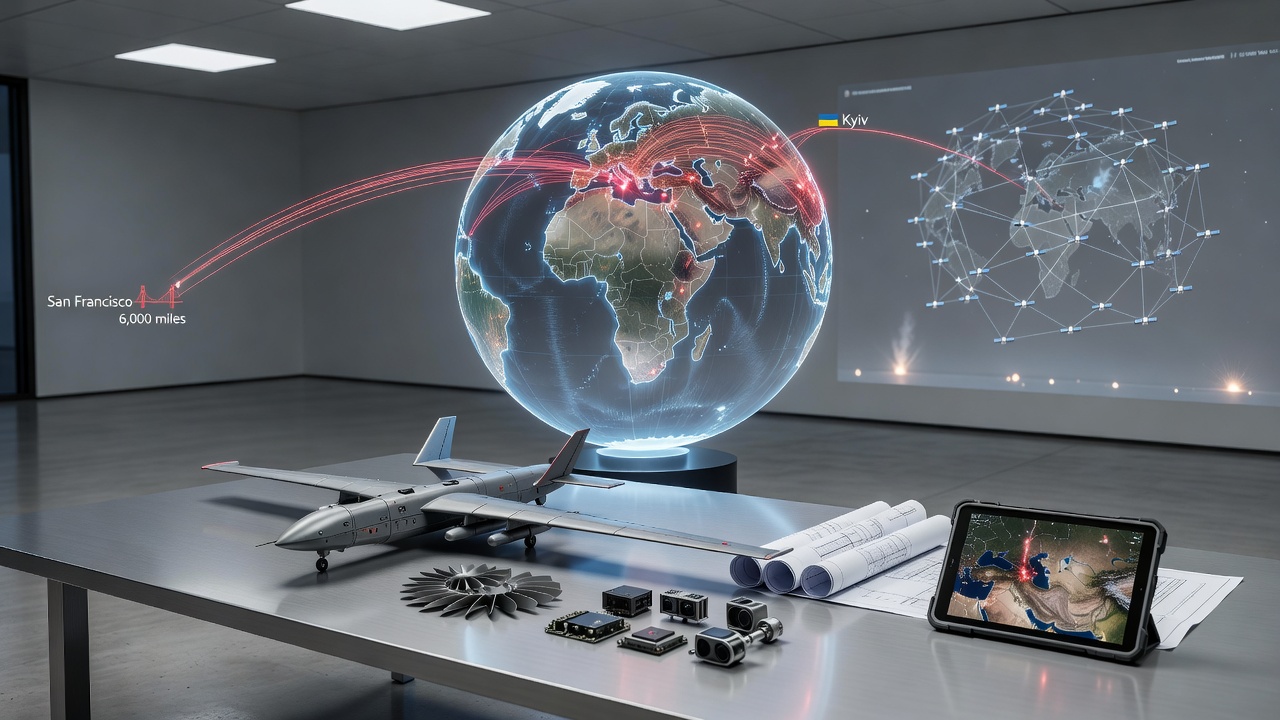
Volodymyr Zelensky didn’t mince words. In a fresh interview, the Ukrainian president laid out plans for drones that could one day fly 6,000 miles. That’s enough to blanket every inch of Russia. From Kyiv, such a craft could theoretically touch down near San Francisco. The claim, made public just days ago, signals a sharp escalation in Kyiv’s long-range strike strategy. But it also spotlights the engineering puzzles and diplomatic maneuvers needed to make it real.
Ukraine has already shown what small, cheap drones can do. They have sunk warships in the Black Sea. They have hit oil refineries hundreds of miles inside Russia. Yet those operations rely on systems with far shorter legs. Current deep-strike drones top out around 1,000 miles at best, analysts say. Zelensky now projects a leap to more than 4,000 kilometers in 2026. By 2027, the goal stretches to between 5,000 and 10,000 kilometers. The numbers come straight from his remarks to American commentator Laura Loomer. TechRadar reported the details.
From Battlefield Improvisation to Industrial Ambition
The jump won’t happen in isolation. Ukraine has spent the past three years honing drone tactics under fire. That experience now feeds talks with Washington. Zelensky described early agreements already signed. They clear the way for Ukrainian systems to be tested on American soil. Aerial models. Naval variants. Other high-tech gear. Further pacts are in draft form. “We’re going to build a great factory,” he said. The line points to joint production lines inside the U.S., a move that would tap American manufacturing muscle while keeping sensitive technology under allied control.
Discussions also touch on technology sharing. Testing protocols. Even potential production facilities stateside. Similar overtures have gone to European partners. The pattern is clear. Kyiv wants to move beyond garage-built prototypes. It seeks scale. Reliability. The ability to launch dozens of long-endurance craft without depending solely on Western missile supplies that often arrive late or in limited batches.
But talk of 6,000-mile flights brings immediate questions. Propulsion systems must sustain flight for days. Communications links have to survive electronic jamming across continents. Navigation cannot falter even when satellite signals are spoofed or blocked. One failure at that distance. And the mission collapses. Military observers have stressed this point for months. Range is only part of the equation. The full system must deliver a warhead accurately after flying through contested airspace for hours on end.
Recent operations hint at progress. In late July 2026, Ukrainian forces struck vessels in the Caspian Sea. One target was an Iranian-linked ship suspected of ferrying drone and missile components to Russia. The strike, carried out with long-range assets, drew sharp protests from Tehran. It also showed Kyiv’s willingness to hit supply lines far from the front. Reuters covered the incident and Iranian reaction. Such actions test the current generation while engineers race toward the next.
Zelensky has tied the drone push to broader defense needs. In recent White House talks with President Trump, he raised the idea of using Starlink to guide strikes on mobile Russian ballistic-missile launchers inside Russia. SpaceX currently bars such use over Russian territory. The request highlights a gap. Ukraine’s alternative navigation methods work but lack the precision satellite networks could provide. Trump reportedly agreed to discuss the matter with Elon Musk. No commitment followed. The episode, shared widely on X in recent days, underscores how commercial technology now sits at the center of battlefield decisions.
Russia has responded with its own barrages. On July 29-30, Moscow sent 74 missiles and hundreds of drones against Ukrainian cities. At least eight civilians died. Dozens more were injured in Kyiv and Lviv. One stray missile crossed into Poland, prompting NATO jets to scramble. Russian officials claimed the strikes hit drone and engine factories. Ukrainian tallies showed many intercepts but also residential damage. The pattern repeats. Russia leans on ballistic weapons that Ukraine struggles to stop in volume. Kyiv answers with asymmetric drone raids on energy sites, warehouses and logistics hubs. BBC detailed the latest exchange.
These tit-for-tat strikes have altered the war’s geography. Ukrainian drones now regularly reach Moscow suburbs and deep into Siberia. Russian forces have pulled some air defenses back to protect refineries and command posts. Yet the Kremlin still launches nightly attacks on Ukrainian infrastructure. The imbalance in interceptor stocks remains a sore point. Western supplies of advanced systems have not kept pace with Russian production. That reality drives Zelensky’s push for homegrown long-range options.
Analysts caution against assuming instant success. Even if the 2027 target is met, operational squadrons will take time to field. Payloads matter. A drone that flies 6,000 miles but carries only a few kilograms of explosives may not justify the cost. Survivability against layered Russian air defenses poses another hurdle. And then there are the diplomatic ripples. Strikes that reach deep into Russia have already prompted threats from Moscow and, more recently, from Iran. Tehran has positioned long-range missiles that could target Ukraine if it escalates attacks on Iranian soil or assets. Coordination between Moscow and Tehran adds another layer of risk.
Still, the trajectory is set. Ukraine’s drone industry has grown from a handful of volunteers in 2022 to a sector producing thousands of units per month. Many are simple first-person-view craft used for tactical strikes. Others are heavier, longer-range models built for strategic effect. The planned U.S. partnership could accelerate the shift toward the latter. It could also give American firms valuable combat data. Lessons learned in Ukrainian skies often translate quickly into updated designs for NATO inventories.
So the announcement carries weight beyond the headline range figure. It reflects a nation betting its defense on autonomous systems. It signals to Moscow that impunity at distance is fading. And it challenges Western capitals to decide how deeply they will support technologies that blur the line between defensive aid and offensive reach. Zelensky’s words were measured. The implications are not. Ukraine is building the capacity to hit anywhere in Russia. The only question left is how quickly the hardware can catch up to the promise.


 WebProNews is an iEntry Publication