
Somewhere in a living room in a quiet suburb, a robot vacuum hums along its programmed route, dutifully sweeping beneath the couch and around the kitchen island. Its onboard camera maps the room, its microphone listens for voice commands, and its sensors build a detailed floor plan of the home. Now imagine a stranger on the other side of the world watching the live feed, listening in, and remotely steering the device through your hallway. That scenario, it turns out, was not hypothetical.
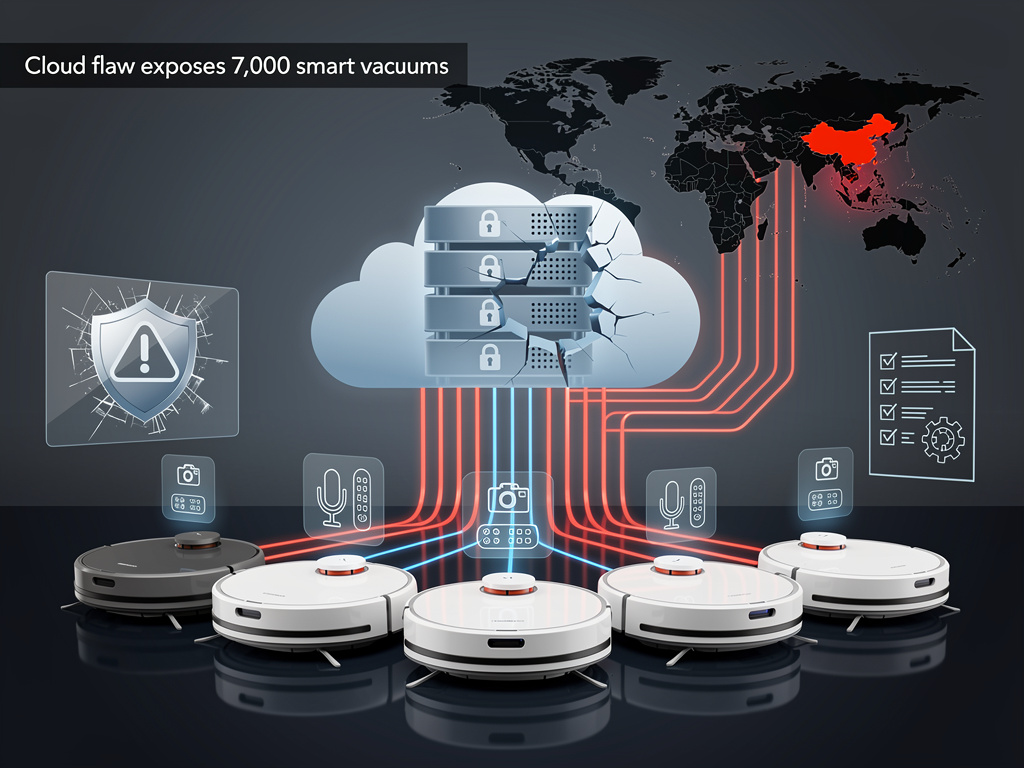
A recently disclosed cloud security vulnerability exposed approximately 7,000 Ecovacs Deebot X2 robot vacuums worldwide to potential remote hijacking, according to reporting by MSN News. The flaw allowed malicious actors to gain unauthorized access to the devices’ cameras, microphones, and movement controls — transforming an innocuous household appliance into a surveillance tool.
From Cleaning Tool to Spy Device: What Went Wrong
The vulnerability was rooted not in the physical hardware of the Ecovacs Deebot X2, but in the cloud infrastructure that connects the vacuum to its companion mobile app and the broader internet. Security researchers found that the authentication mechanism governing communication between the device and Ecovacs’ cloud servers contained a critical weakness. Specifically, attackers could intercept or spoof credentials to gain control of any connected vacuum, without needing physical access to the device or the owner’s Wi-Fi network.
Once inside, the attacker could activate the vacuum’s camera to stream live video, turn on the microphone to eavesdrop on conversations, access stored maps of the home’s interior, and even drive the robot remotely. The implications are staggering: a device designed to clean floors could be weaponized to conduct real-time surveillance of private residences, offices, or any space where the vacuum operates.
The Incidents That Brought the Flaw to Light
Reports of bizarre behavior from Ecovacs robot vacuums began surfacing in mid-2024. In several documented cases across the United States and other countries, owners reported their vacuums suddenly moving on their own, with unfamiliar voices emanating from the device’s built-in speaker. In one widely reported incident, a Minnesota lawyer named Daniel Swenson described his Ecovacs vacuum shouting racial slurs while his family was at home, according to reporting by ABC News Australia. Other owners reported similar experiences, with hackers taunting pets and family members through the device’s speaker system.
These incidents were not isolated pranks. Security researchers Dennis Giese and Braelynn Luedtke, who had been studying Ecovacs devices, presented their findings at the Def Con security conference in August 2024. They demonstrated that the Bluetooth connectivity on Ecovacs models could be exploited from a distance of over 100 meters, and that the cloud-based API had fundamental authentication flaws that could be exploited remotely. Their research, as reported by TechCrunch, revealed that the PIN protecting the vacuum’s camera feed was checked only on the client side — meaning it could be bypassed entirely by an attacker communicating directly with the server.
Ecovacs’ Slow and Uneven Response
Ecovacs, a Chinese-headquartered company that has become one of the world’s largest manufacturers of robotic home appliances, initially drew criticism for its response to the vulnerability disclosures. According to TechCrunch, the researchers who discovered the flaws contacted Ecovacs months before their Def Con presentation but received no meaningful acknowledgment or response from the company.
After the public disclosure and the wave of real-world hacking incidents drew media attention, Ecovacs issued a statement acknowledging the issue and promising a firmware update. The company said it had identified the credential vulnerability and would push an over-the-air update to affected Deebot X2 units. However, the timeline and completeness of that patch remained subjects of concern among security professionals. As of early 2025, Ecovacs stated it had addressed the primary vulnerability, but independent verification of the fix has been limited. The company also noted that the attacks required “unusual conditions” — a characterization that security researchers have disputed, arguing that the cloud-based nature of the flaw made it exploitable from anywhere with an internet connection.
A Broader Problem: IoT Devices and the Trust Deficit
The Ecovacs incident is far from an isolated case in the growing catalog of Internet of Things security failures. Smart home devices — from cameras and doorbells to thermostats and, yes, robot vacuums — have repeatedly been shown to have serious security shortcomings. The fundamental problem is structural: manufacturers race to bring connected products to market, often treating security as an afterthought rather than a foundational design requirement.
Robot vacuums are particularly sensitive because modern models are equipped with cameras, LiDAR sensors, microphones, and sophisticated mapping software. They move through every room of a home, building detailed spatial models that could reveal the layout of a residence, the location of valuables, daily routines of occupants, and more. When these devices are connected to cloud services with weak authentication, the risk profile becomes severe. A report from Bitdefender noted that the Ecovacs vulnerabilities extended beyond just the Deebot X2 to other models in the company’s lineup, including robotic lawn mowers, suggesting a systemic rather than isolated engineering failure.
What This Means for Consumers and the Industry
For the estimated 7,000 owners of affected devices, the immediate advice from security experts has been straightforward: update firmware immediately, disable the vacuum’s camera and microphone when not actively needed, segment IoT devices onto a separate Wi-Fi network from computers and phones, and monitor for unusual device behavior such as unexpected movement or sounds.
But the larger question is one of accountability and regulation. The United States and European Union have both been moving toward stronger IoT security standards. The U.S. Cyber Trust Mark program, announced by the Federal Communications Commission, aims to create a labeling system for smart devices that meet baseline security requirements — analogous to the Energy Star label for appliances. The European Union’s Cyber Resilience Act, which is being phased in, will impose mandatory cybersecurity requirements on manufacturers of connected products sold in EU markets. Whether these regulatory frameworks would have prevented the Ecovacs vulnerability is debatable, but they represent a recognition that voluntary industry self-policing has been insufficient.
The Chinese Manufacturing Question
The fact that Ecovacs is headquartered in Suzhou, China, has added a geopolitical dimension to the security discussion. While there is no public evidence that the Ecovacs vulnerability was exploited by state actors, the incident has fueled broader concerns about the security of Chinese-manufactured IoT devices in Western homes. These concerns echo ongoing debates about Huawei telecommunications equipment, TikTok’s data practices, and Chinese-made surveillance cameras installed in sensitive government facilities.
Australian media have been particularly attentive to this angle. ABC News Australia reported extensively on the hacking incidents, noting that Australian consumers were among those affected. The Australian government has previously taken action against Chinese technology companies on national security grounds, and the Ecovacs situation has prompted calls for closer scrutiny of smart home devices imported from China.
Lessons for an Industry Under Pressure
The robot vacuum market is projected to exceed $15 billion globally by 2028, according to industry forecasts, with Ecovacs, iRobot (now owned by Amazon), Roborock, and others competing aggressively on features, price, and smart-home integration. That competitive pressure often translates into faster product cycles and more internet-connected features — each of which expands the potential attack surface.
Security researchers have long warned that the incentive structure in consumer electronics is misaligned: companies are rewarded by the market for adding features and penalized for delays, while the costs of security failures are largely borne by consumers. The Ecovacs episode illustrates this dynamic with uncomfortable clarity. A device that retails for several hundred dollars and is marketed as a convenience product became, through a cloud authentication flaw, a potential vector for home invasion of the most intimate kind.
For industry insiders, the takeaway is not that robot vacuums are uniquely dangerous, but that any internet-connected device with sensors, cameras, or microphones represents a potential liability if its cloud infrastructure is not engineered with security as a primary concern. The 7,000 exposed Ecovacs units are a rounding error in the billions of IoT devices now deployed worldwide. The question is how many other devices harbor similar flaws — and how long it will take before they are discovered, disclosed, and fixed.


 WebProNews is an iEntry Publication