
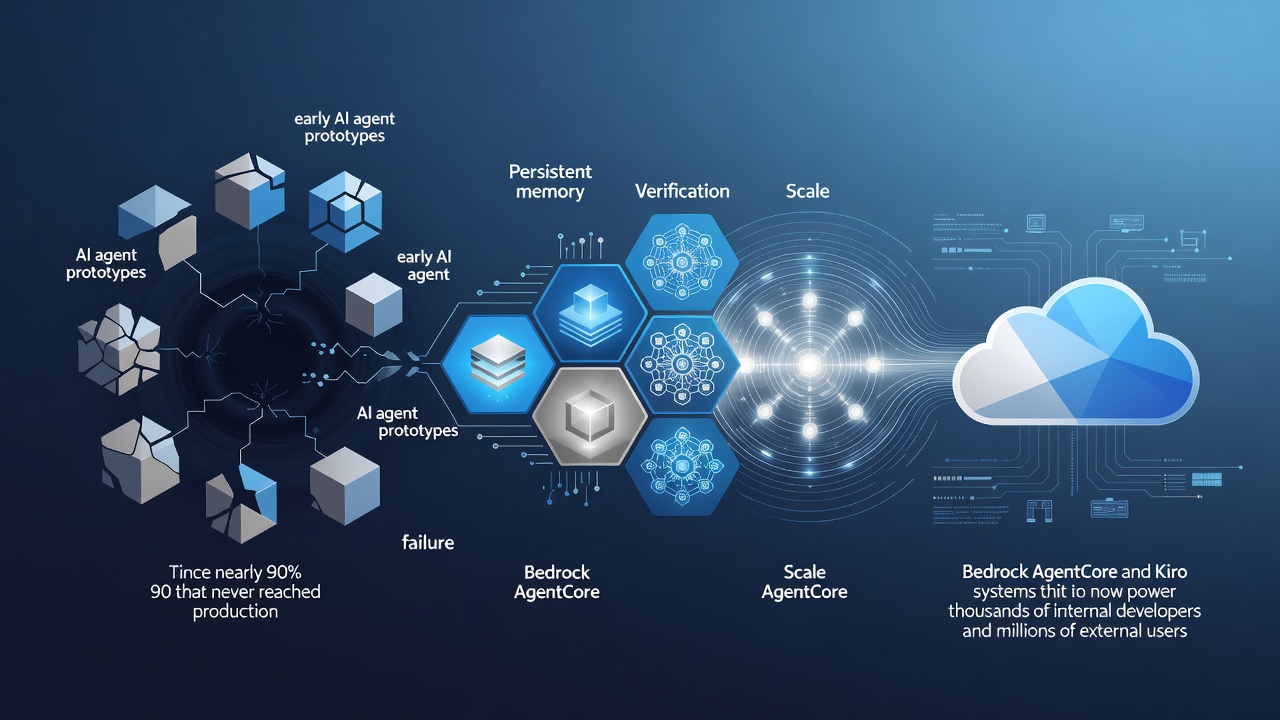

Almost 90% of the AI agent prototypes Amazon teams built two years ago never reached production, AWS vice president of agentic AI Swami Sivasubramanian said Wednesday at HumanX in Amsterdam, The Next Web reported. Amazon was just starting to invest heavily in agents at the time.
Amazon isn’t alone. Citing analysts, Sivasubramanian said 17% of organizations have successfully deployed AI agents and only 7% can measure the return. He relayed what customers’ technology leaders tell him: “I have 15 prototypes for very similar projects. I can’t tell which one to back up.”
The causes he described were mostly organizational, not technical. AWS’s forward deployed engineers, who build alongside customers on site, spent six months tracing failed projects and found five root causes. Teams work on the wrong problem and can’t measure whether it works. Governance comes as an afterthought, leaders freeze between fear of missing out and fear of committing, and nobody redesigns the organization for AI. Without a defined business outcome, he said, teams keep polishing a proof of concept and never exit. He compared it to circling a Paris roundabout four or five times on his first drive in Europe, except that in AI the fuel is tokens and budget.
Amazon’s own fix was to let many projects start and then measure which ones worked. One came from Bolin Chen, an engineer on the personalization team for Amazon’s stores, who built an always-on assistant called MeshClaw on Kiro, Amazon’s agentic coding tool, on nights and weekends. It ran through Slack. After he shared it internally it grew from one person to four founders to thousands of contributors. Amazon’s measurement systems flagged it, and because the Kiro team had separately been prototyping always-on agents, persistent memory and multi-agent coordination, the groups merged. The result, the open-source Kiro Crew, drew close to 39,000 Amazon employees within 30 days of its internal launch and now has 500 external contributors, Sivasubramanian said.
Kiro itself is used by more than 100,000 Amazon engineers and millions of developers outside the company. He gave one example of it improving itself: a system inside Kiro noticed the agent was rereading files that hadn’t changed since the previous run, then diagnosed the problem, wrote a fix and validated it, cutting that waste by 83%. “No human diagnosed the problem. The system itself found it,” he said.
Infrastructure sprawl was part of the story. Amazon teams had built agents on EC2, EKS, SageMaker and other services, which strained security and infrastructure teams, so Amazon consolidated on Bedrock for inference and AgentCore for hosting agents, one path approved by security. AWS’s open-source agent framework, Strands, now can put an agent “in a box,” a deterministic layer outside the agent that controls which tools it can call and can widen as the agent proves itself. “It’s not probabilistic. It’s always deterministic and mathematically provable that the agent cannot exceed its boundaries,” he said.
He also argued for small teams on uncertain projects. Nearly 80% of the Fortune 100 use Bedrock, which he called the fastest-growing AWS service, and when demand surged, six developers re-engineered it in 76 days, work he said would have taken 30 developers 18 months.
His advice to the audience was to ask two questions of every AI project: what outcome is it tied to, and is it compounding at every layer? “Knowing was never the problem,” he said. “The question is whether you have the rigor and the discipline to go execute it.”


 WebProNews is an iEntry Publication