
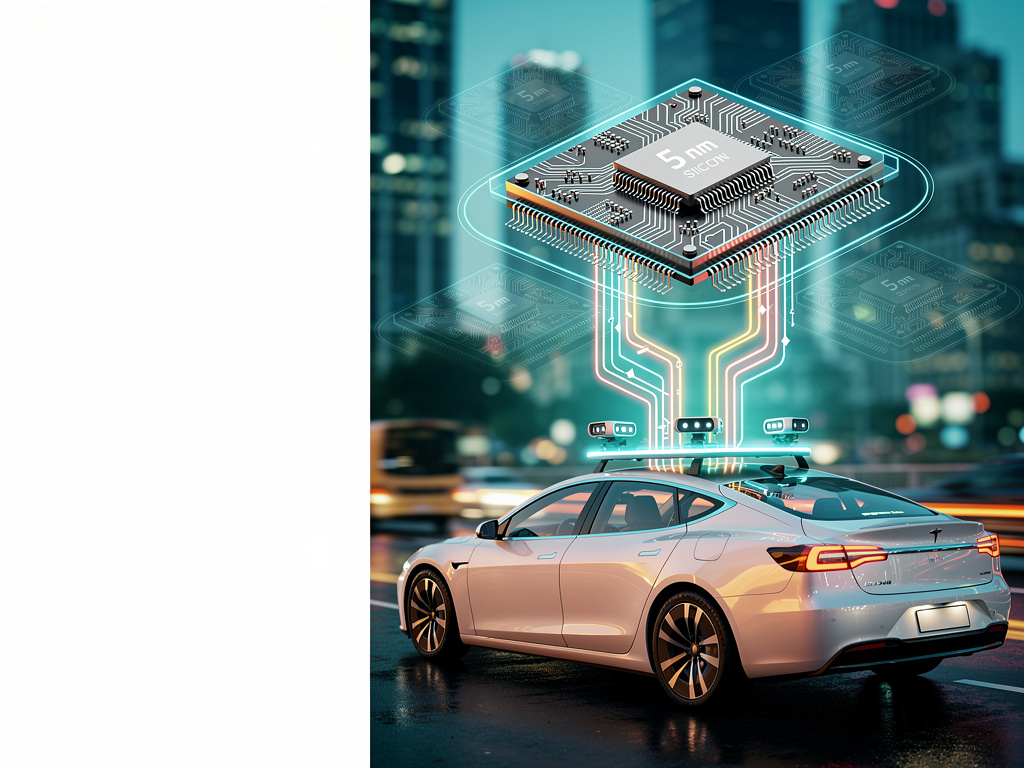

Waymo has given its first detailed look at the computer inside its robotaxis, including a custom 5nm chip designed to handle raw sensor data. In a blog post, Waymo vice president of engineering Satish Jeyachandran and compute lead Daniel Rosenband said the company has co-designed its hardware, sensors and algorithms over the past decade to meet the demands of driving with no human backup.
A Front End for Sensor Data
The new ASIC sits in front of the Waymo Driver’s core ML system and is built to process, fuse and run neural networks on raw sensor data in real time. Its specialized accelerators extract information from lidar, radar and camera streams, including temporal denoising for better low-light perception, and feed a purpose-built inference engine that runs sensor fusion models. Waymo says the ASICs alone deliver more than 1,000 TOPS of ML performance for front-end processing, and that its latest system processes data from 13 high-resolution cameras simultaneously.
Waymo described the chip as “just one of several exciting custom components we’re developing.” It pairs its own silicon with CPUs, GPUs and accelerators from partners including AMD, Micron, Nvidia, Samsung, Sandisk, Socionext and TSMC.
Responsive, Ruggedized, Redundant
The company said its compute is built around three requirements drawn from more than 200 million miles of fully autonomous driving. It must be responsive, running entirely onboard with minimal delay from “first pixel to action,” and Waymo says it has scaled raw compute 20x in eight years. It must be ruggedized to handle vibration, shock and extreme temperatures, with the computer tied into the vehicle’s liquid cooling system. And it must be redundant, designed “like two independent engines” that normally share the workload but can each take over if the other fails.
Waymo also said the integrated design preserves trunk space, runs silently and improves battery efficiency compared with off-the-shelf components. The company is presenting more details at the Hot Chips conference.
Custom silicon has become a competitive edge in autonomy, as it has in AI data centers. Designing the chip alongside its sensors and models lets Waymo tune for the low-latency, low-batch workloads of real-time driving rather than adapting general-purpose hardware, an advantage that will matter more as it expands its fleet and cities.


 WebProNews is an iEntry Publication