
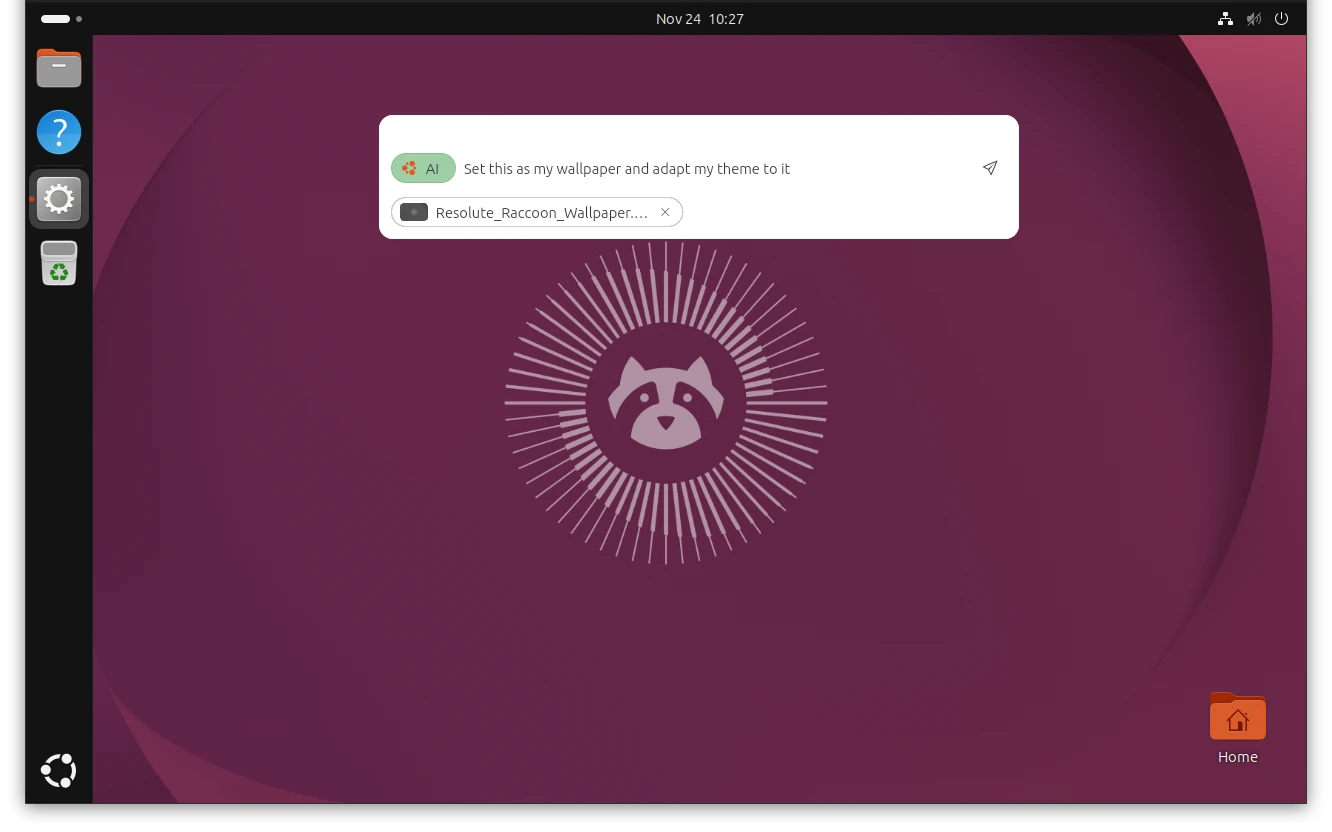

Canonical took the wraps off its upcoming plans for the Ubuntu desktop, outlining plans for an AI-powered launcher for the desktop.
Ubuntu has been slowly but surely embracing AI, with Canonical positioning itself as a company that is implementing features in a safe, responsible way that keeps the user in control. A perfect example is its Myna speech-to-text feature that preserves privacy while delivering an important accessibility feature.
In a post on the company’s forums, Desktop Team Member Didier Roche outlined Canonical’s plans:
Seeing all the curiosity, healthy skepticism, and thoughtful questions it sparked made one thing clear: it’s time to share a bit more context on what we are actually building, why we are taking a careful, step-by-step approach, and how you will be able to help us shape it.
At first glance, warty-prototype looks like a classic quick-launcher – and yes, finding files and launching applications instantaneously is right at the core of what we are building. But our goal goes further than replacing an app grid: we want to explore a new way to interact with your Ubuntu desktop.
Over the past few months, we’ve been discussing how intelligence and modern workflows should fit into Ubuntu – both in our ongoing Discourse thread on the future of AI in Ubuntu (particularly around explicit vs. implicit AI capabilities) and during our recent Ubuntu Summit sessions (if you missed them, you can catch the discussions here and here). Rather than scattering disconnected AI widgets across the desktop, we want a unified, keyboard and speech-friendly entry point that bridges your apps, your local context, and smart assistance only when you explicitly ask for it.
Roche emphasizes Canonical’s commitment to make sure users have a choice:
We also know that bringing AI anywhere near the desktop raises legitimate questions around user control, resource usage, and privacy. From day one, we are building this around four non-negotiable principles:
- Strictly optional: It is your machine. All AI capabilities are strictly opt-in. If you want a pure, ultra-fast advanced launcher without enabling any AI features, that experience is first-class out of the box (and we aren’t shipping gigabytes of models in the default install).
- Local-first: Our priority is on-device inference running against local models on your own hardware, rather than sending your queries to external cloud services by default.
- Privacy-first: Because processing happens locally, your files, local context, and daily habits stay where they belong: on your disk.
- Security-first: Leveraging Ubuntu’s confinement and sandboxing architecture, the components powering these features are designed to run with strict isolation so that experimental or agentic capabilities cannot compromise your host system.
If Canonical continues its current approach, one that respects users’ choice and privacy, it could well establish itself as THE Linux distro of choice for AI-powered features and workflows.


 WebProNews is an iEntry Publication