
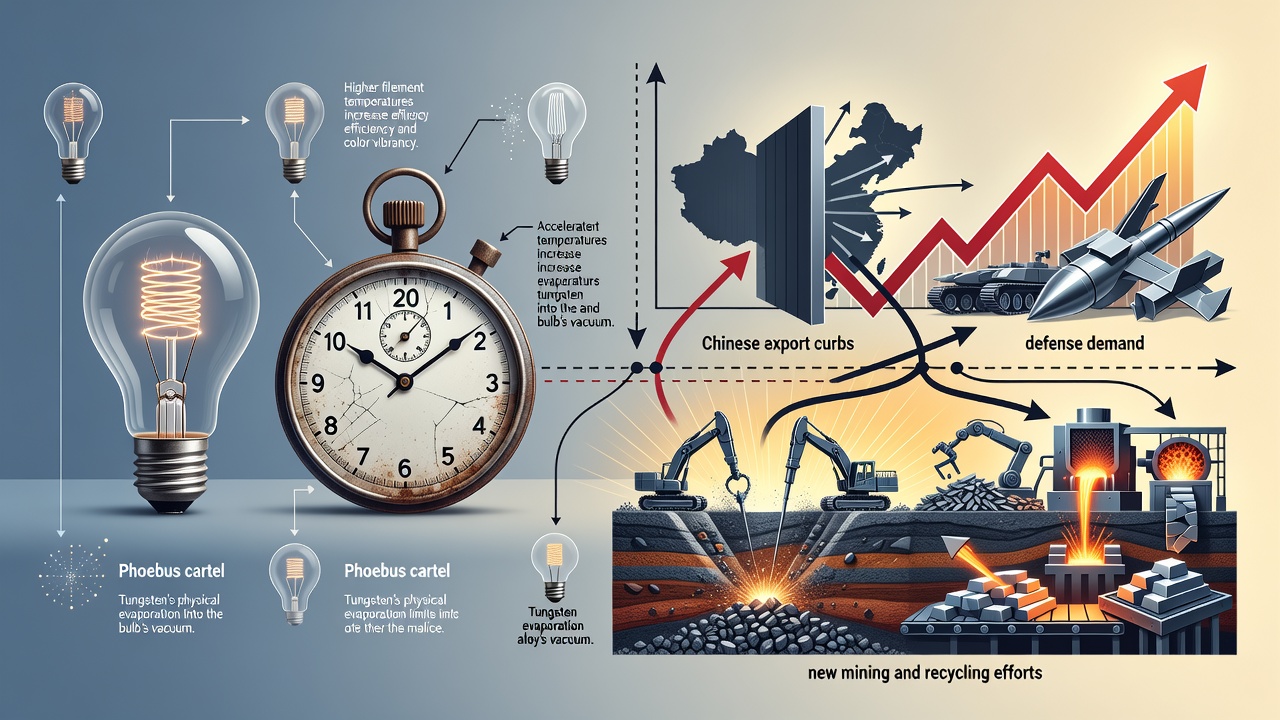
Engineers once pushed tungsten filaments to their limits. They balanced heat, evaporation and crystal slippage in a thin wire no thicker than 20 micrometers. The result glowed white hot inside a vacuum-sealed glass bulb. Yet the story most people remember paints a simpler picture. A 1925 cartel deliberately shortened bulb life to 1,000 hours so customers would buy replacements faster.
The reality proves more complicated.
Maurycy Zawadzki laid out the physics on his blog last year. Tungsten melts at 3,422 °C. Visible light demands filament temperatures near 5,700 °C, the surface of the sun. No material survives that. So manufacturers settle for temperatures that push atoms to the edge of stability. Higher heat yields whiter light and far greater efficiency. Lower heat extends life but wastes electricity on infrared output. (maurycyz.com/misc/tungsten/)
Early handmade bulbs favored longevity. They burned dimly and inefficiently. Automated production changed the math. Electricity at roughly 10 cents per kilowatt-hour made a 60-watt bulb consume $6 over 1,000 hours. The bulb itself cost about $3. A longer-lasting but dimmer version no longer made economic sense. The Phoebus cartel did set a 1,000-hour standard and tested competitors’ products. It also engaged in price fixing. But the standard reflected genuine engineering constraints, not pure malice.
Consider the famous bulb hanging in a California fire station. It has run for more than a million hours since the 1900s. Impressive. Yet it draws only 4 watts instead of its nominal 60. The filament resistance ran unusually high. Light output stayed low. Night-light duty, not general illumination. Zawadzki notes the absence of detailed records. Still, the example illustrates the efficiency penalty of extreme longevity.
Modern non-halogen incandescent bulbs last 500 to 2,500 hours. That range brackets the cartel’s target. Manufacturers shifted resources to fluorescent and LED designs that avoid the tungsten trade-off entirely. Specialized applications reveal the nuance. Photoflood lamps for photography burn hot and bright for only a few hours. Indicator lamps in hard-to-reach spots target 100,000 hours. One datasheet from Mouser lists exactly that rating for a wire-terminal lamp. (mouser.com)
LED technology carries its own compromises. So-called Dubai lamps pack four times as many diodes per bulb. Each runs cooler at lower power. Efficiency climbs to 200 lumens per watt versus 100 for standard LEDs. Yet failures rarely trace to the diodes. Heat damages the power supply’s smoothing capacitor instead. Filament-style LEDs place the driver in the base to shed heat through the metal threads. Traditional bulbs separate diodes onto heatsinks with long capacitor leads. Neither form factor dissipates heat well. Fixtures designed for LEDs achieve far longer service lives.
The tungsten story didn’t end with lightbulbs. It moved to industrial tools, semiconductors and munitions. And today the metal sits at the center of a sharpening geopolitical contest.
China’s grip and the price shock of 2025-2026.
China produced about 79 percent of the world’s roughly 85,000 metric tons of tungsten in 2025, according to the U.S. Geological Survey. Beijing added the metal to export controls in February 2025 amid tensions with the United States. Shipments of restricted products fell roughly 40 percent that year, Project Blue data show. Prices responded with force. The APT European benchmark climbed above $2,250 per metric ton unit by March 2026, a 557 percent rise from pre-control levels, Yahoo Finance reported. (finance.yahoo.com)
Fastmarkets observed domestic Chinese ammonium paratungstate prices decoupling from export markets by late June 2026. Falling input costs inside China contrasted with elevated Western prices driven by supply constraints and limited access to Chinese material. Western buyers paid premiums as procurement strategies shifted toward security. (fastmarkets.com)
Conflicts amplified the pressure. Wars in Ukraine and Iran drew down tungsten stocks for armor-piercing munitions and other defense uses. CNBC noted simultaneous demand spikes and Chinese export curbs created a supply shock unlikely to ease quickly even if shipping lanes reopen. Cove Kaz Capital Executive Chairman Pini Althaus told the network that scarce supply and depleted reserves pushed prices higher. (cnbc.com)
U.S. manufacturers felt the pain directly. Tungsten carbide tools used in machining saw costs triple in some cases. A Marketplace report in May 2026 described shops absorbing doubled prices for drill bits and inserts. Defense contractors faced even tighter timelines. The Pentagon has classified tungsten as a critical mineral with high disruption risk. An executive order issued in July 2026 closes waiver loopholes for defense supply chains. Starting January 2027, contractors must demonstrate traceable domestic or allied sources or submit mitigation plans. (marketplace.org)
Market forecasts reflect both the squeeze and the response. Fortune Business Insights projects the global tungsten market expanding from $5.78 billion in 2026 to $9.19 billion by 2034 at a 6 percent compound annual growth rate. Global Market Insights sees the figure rising from $7.6 billion in 2026 toward $11.6 billion by 2035. Demand drivers include electric vehicles, renewable infrastructure, semiconductors and defense alloys. Yet new non-Chinese supply arrives slowly. Mines require years to develop. Recycling helps but cannot close the gap alone.
Recent analyst work underscores the shift. InvestorNews highlighted tungsten’s rise to the top of critical minerals lists. Non-Chinese production remains limited. One major Western-aligned project could eventually supply 40 percent of that segment, according to discussions captured in industry video. Geopolitical tensions have already prompted strategic stockpiling and fresh investment in Australian, Canadian and U.S. deposits. But the opaque nature of the market complicates rapid adjustment. (investornews.com)
So the filament trade-off lives on at industrial scale. Push performance and the material evaporates or weakens. Accept lower output and costs rise elsewhere. Nations now face the same calculation with supply chains. Over-reliance on one source invites sudden scarcity. Diversification demands time and capital. In the meantime prices surge, manufacturers scramble and defense planners redraw priorities.
Recent X posts capture the anxiety. One widely shared graphic ranks China at 82.7 percent control of global tungsten output, second only to its dominance in gallium and magnesium. Another warns that carbide tooling for weapons production could stall without new sources. Discussions of scrap recovery and urban mining gain traction as immediate partial remedies. The metal’s density, hardness and high-temperature strength make substitutes scarce across applications from drill bits to kinetic penetrators.
History rarely delivers clean morality tales. The Phoebus cartel mixed anticompetitive behavior with legitimate standardization. Today’s tungsten market blends genuine material limits with strategic hoarding. Engineers still optimize around tungsten’s melting point and vapor pressure. Policymakers now optimize around concentrated production and export licensing. Both confront the same core tension. Performance, cost and longevity refuse to align perfectly. The filament that burns brightest rarely burns longest. The supply chain that delivers fastest rarely proves most resilient.
Industry insiders tracking critical materials have seen this pattern before. Rare earths, gallium, antimony. Each reveals similar vulnerabilities. Tungsten now leads the list because its uses span both commercial tooling and advanced munitions. Recent price charts show sustained elevation rather than seasonal fluctuation. Mine-end tightness, not temporary demand spikes, drives the trend. Western premiums over Chinese domestic benchmarks continue to widen. Procurement teams report longer lead times and stricter allocation.
Efforts to rebuild supply chains outside China accelerate. Yet permitting, capital and technical expertise create bottlenecks measured in years. Recycling rates for tungsten already exceed many metals thanks to its value in carbide scrap. Still, primary production must expand. Alliances with producers in Vietnam, Austria and elsewhere gain attention. The U.S. deadline to eliminate Chinese tungsten from defense applications in 2027 adds urgency. Companies race to qualify alternative powders and alloys while maintaining performance specifications.
The lightbulb that lasted a century but produced little useful light stands as a reminder. Longevity without utility solves nothing. The same principle applies to strategic minerals. Stockpiles and export controls can extend perceived security. They cannot create new atoms or bypass thermodynamics. Tungsten’s story, from vacuum tubes to hypersonic vehicles, continues to hinge on those invisible compromises Zawadzki described. Atoms barely holding together at extreme temperatures. Markets barely holding together under concentrated supply. Both require careful management. Neither forgives oversimplification.


 WebProNews is an iEntry Publication