
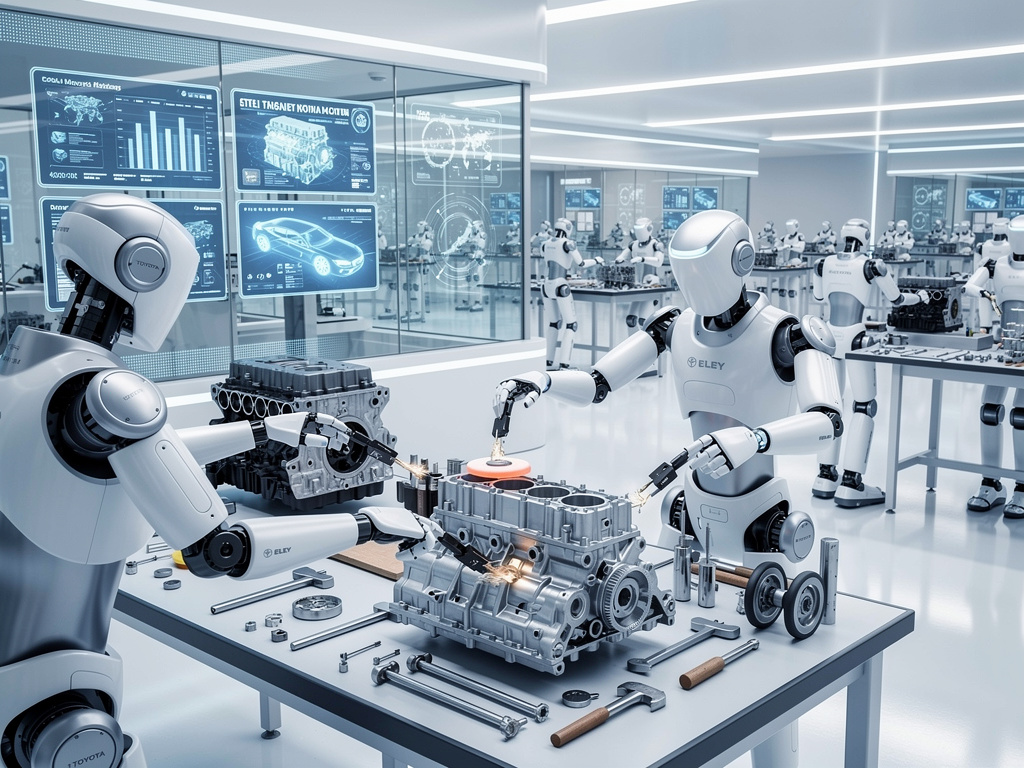

Toyota has told investors that upgrading factories across its own operations, group companies and major suppliers could take about 400,000 robots and roughly 1 trillion yen (about $6.4 billion) a year starting in 2028. The company has not committed to that spending, and it has not said how many years such a program would run.
The estimate came out at a technology briefing for investors at Toyota Motor Europe’s headquarters in Brussels earlier this month. According to Nikkei Asia, about 150,000 of the robots would go into Toyota’s own plants and roughly 250,000 into group company facilities. The total covers both humanoid and conventional machines, and it counts replacements for aging equipment as well as new installations, so the number of genuinely new learning robots is likely to be much smaller than the headline figure.
“We aim for a world where robots coexist with humans, rather than replacing them,” Executive Vice President Hiroki Nakajima told Nikkei Asia.
A wheeled humanoid that copies the takumi
The most visible piece of the plan is ELEY, short for Embodied Learning robot for Enhanced Yield, a platform from Toyota’s research arm. It weighs 50 kilograms, rolls on an omnidirectional base instead of legs, uses two-fingered grippers and runs on a battery or a power cord, according to Toyota’s own spec sheet. That puts Toyota on a different path from Tesla and Figure, which are building bipedal humanoids for factory work.
ELEY learns from people. Workers on some assembly lines now wear jigs modeled on the robot’s fingers while they do routine jobs, which gives the robot real production data to imitate, Ars Technica reported. The training relies on Large Behavior Models, a type of generative AI built for physical actions. At the Brussels event, Toyota said ELEY folded T-shirts with near-perfect accuracy after 1,500 practice runs over two weeks.
The people it learns from are Toyota’s takumi, the roughly 18,000 veteran craftspeople spread across about 60 factories worldwide. Toyota wants to capture their technique as training data before they retire, then share what one robot learns with robots at other plants so each site doesn’t have to repeat the lessons. The company also expects robots to help train new human hires.
What the robots would do
Toyota would time large installations to plant renovation and rebuild schedules, according to Motor1. Executives described robots taking repetitive or physically demanding tasks, such as moving parts between bins, while people keep the judgment calls that still need a trained eye.
Plenty of questions remain open. Toyota hasn’t said how many robots are already deployed or how many of the 400,000 will be humanoids, and Ars noted that safety around human workers and cost compared with human labor are still unresolved for humanoid robots generally. The automaker has several years to work through those before 2028.


 WebProNews is an iEntry Publication