
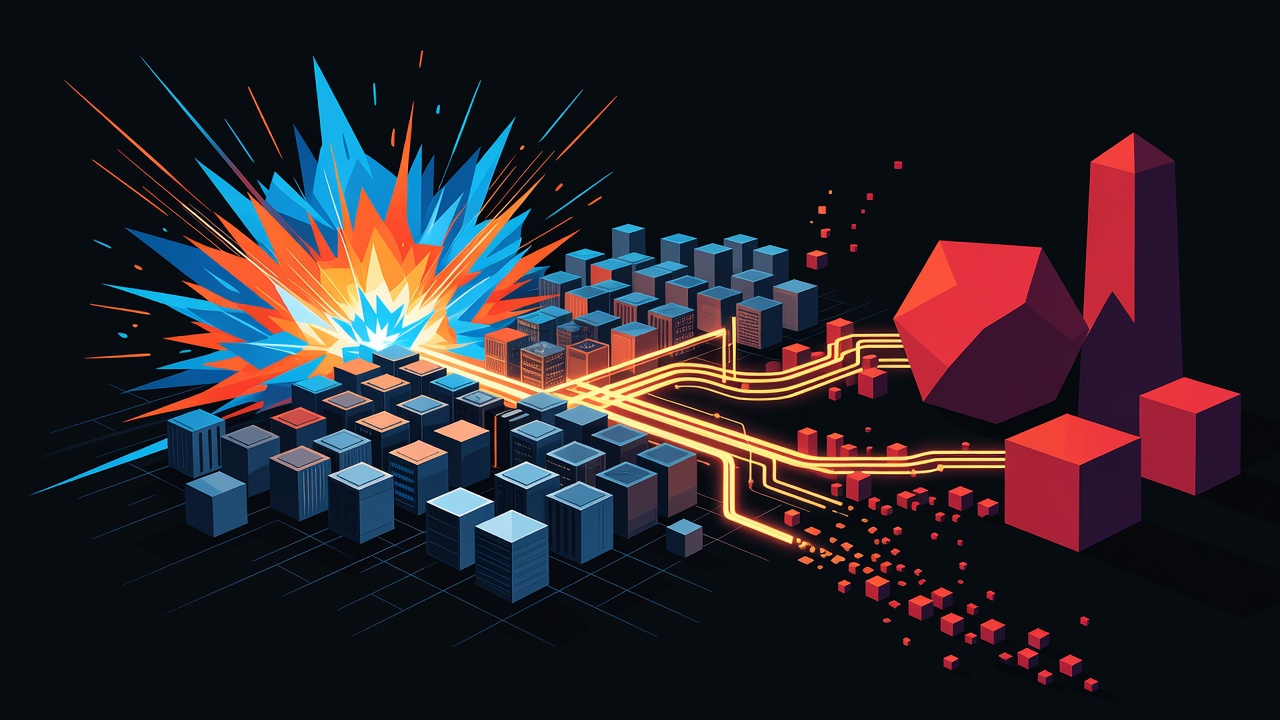
Tech giants pour billions into flashy AI models. Yet the bills for electricity and infrastructure keep climbing higher. Data centers now consume power at rates once reserved for entire nations. Shortages loom. Prices spike. The next phase of artificial intelligence won’t be defined by clever algorithms alone.
But by the stubborn realities of watts and wires. Training one advanced model can draw as much electricity as 120 American households use in a year. Inference, the everyday work of answering queries, multiplies that demand across millions of users. A single ChatGPT-like query once needed nearly 10 times the energy of a standard Google search. Newer optimizations have cut that figure. The aggregate still surges.
The Power Surge Nobody Saw Coming
Global data center electricity use hit about 415 terawatt-hours in 2024. The International Energy Agency projects it will climb past 945 TWh by 2030, with AI workloads driving nearly half the added demand. In the United States, data centers could claim 12 percent of total electricity by 2028. That’s according to Consumer Reports.
One facility focused on AI can pull electricity equivalent to 100,000 homes. The largest now under construction? Twenty times that. Clusters in Virginia already account for nearly 40 percent of the state’s power draw. And new projects keep coming. Nearly half of U.S. data center capacity sits in just five regional clusters, the IEA notes in its Energy and AI report.
John Steinbach in Virginia saw his electric bill jump from $100 to $281 in January 2026. His story, detailed in the same Consumer Reports piece, reflects broader trends. Utilities face pressure to upgrade grids. Ratepayers worry they will foot the bill. Lawmakers on Capitol Hill have argued households shouldn’t subsidize tech companies’ expansion.
And the forecasts keep rising. The U.S. Energy Information Administration expects national power demand to set records in 2026 and 2027, fueled by AI data centers and electrification. Reuters covered the EIA outlook on April 7, 2026. Bloomberg Energy’s January 2026 report predicted U.S. data center demand nearly doubling from 80 gigawatts in 2025 to 150 GW by 2028. Add the power needs of Spain to the grid in three years. That’s the scale.
Costs extend beyond kilowatt-hours. Water for cooling. Land. Specialized chips that themselves require rare materials. Capital spending on data centers by Microsoft, Google, Meta and Amazon is forecast to reach $364 billion this year, according to one analysis from Close Up. Electricity prices near data center hubs have soared as much as 267 percent in some months compared with five years ago.
The original Yahoo Finance analysis from 2025 captured this tension early. It argued that the real AI cost, not just compute but energy, talent and infrastructure, would set the competitive bar for the next decade. That prediction looks even sharper now. Hyperscalers sign power purchase agreements for entire renewable projects. Some explore nuclear restarts or small modular reactors. Venture capital floods into nuclear startups as demand explodes, recent X discussions and OilPrice.com reports confirm.
Yet efficiency gains arrive too. DeepSeek in China trained a reasoning model for a reported $294,000 in its final stage. Analysts later noted the full pre-training costs ran higher. Still, innovations like predicting two tokens at once or using lower precision cut energy per output. The Brookings Institution explored these dynamics in its April 2026 article on global energy demands and AI regulation.
Companies pass rising power expenses down the chain. Gartner noted a 26 percent jump in data center electricity demand for 2026. Operators secure favorable rates and then bill AI providers. Those providers raise subscription fees. Enterprise customers see the hidden line item appear in their 2026 AI bills, as outlined in The AI Enterprise on July 24, 2026.
Who Pays When the Lights Stay On
Executives at Anthropic project the U.S. AI sector will need 50 gigawatts of new capacity by 2028. That’s roughly twice New York City’s peak demand. Former Google CEO Eric Schmidt told Congress that data centers require 29 GW more by 2027 and another 67 GW by 2030. Testimony cited in the Brookings report.
Flexibility offers one path forward. Data centers could shift workloads to times or places with spare power. Many keep buffer server capacity. Yet an AI-focused facility costs 10 times more to build than an aluminum smelter. Curtailing operations carries heavy penalties. Regulators debate incentives. Grid operators hunt for less congested locations.
Environmental toll adds another layer. Many facilities still rely on gas or coal in certain regions. Carbon emissions climb. Water usage strains local supplies. One estimate suggests generative AI could consume 10 times more energy in 2026 than in 2023. Training successive versions of models like GPT-4o compounds the effect.
Investors take notice. Stocks tied to power infrastructure, nuclear technology and data center construction show volatility but long-term bets. Discussions on X highlight companies like KEEL positioned for the infrastructure wave. Others point to satellite-based solar or advanced cooling as speculative fixes.
So the competitive edge shifts. Firms that control their own efficient infrastructure gain advantage. Those reliant on cloud providers with opaque power costs may lag. Inference now dominates 80 to 90 percent of compute demand in some models. Optimizing that slice matters more than ever.
The IEA warns that countries delivering affordable, reliable electricity at speed will lead in AI. The United States holds the largest share of current and projected growth. China follows. Europe trails but invests. Local bottlenecks could slow progress if clusters overload grids.
Tech leaders once sold AI as limitless. Reality brings constraints measured in terawatt-hours and transmission lines. Profits will reflect who manages these constraints best. Not just who trains the biggest model first.
Recent analyses from Lawrence Berkeley National Laboratory and Goldman Sachs reinforce the trajectory. Power demand for data centers could outpace traditional industrial sectors combined in parts of the U.S. by decade’s end. The hidden costs surface in utility rates, investor presentations and procurement contracts.
AI’s progress continues. Its price tag, once obscured by hype, now stares back from balance sheets and power meters. The winners will master energy as skillfully as they master parameters. The rest risk becoming very expensive warehouses full of idle silicon.


 WebProNews is an iEntry Publication