
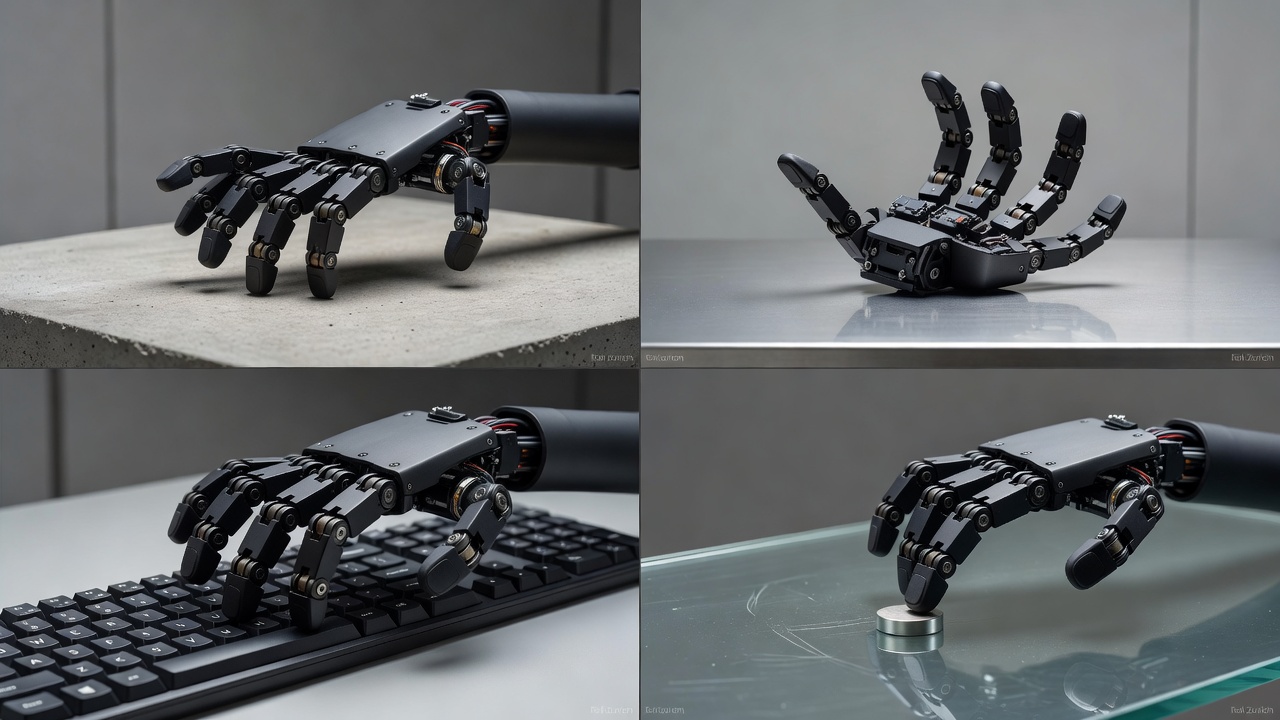

Researchers at ETH Zurich’s Soft Robotics Lab have taught a robotic hand to walk on its own fingers, and the result looks a lot like Thing from The Addams Family. The 818-gram hand carries its own battery and computer, so it crawls, steers, rights itself after a fall and presses keys without any cable attached.
The team, Amirhossein Kazemipour, Hehui Zheng and Robert Katzschmann, described the work in an arXiv preprint titled “Fingers as Legs: Learning Self-Supported Locomotion and Manipulation with an Anthropomorphic Hand.” They started with a commercial five-finger right hand that has 20 actuated joints, four per finger, and kept its finger design and position controller. A Raspberry Pi Zero 2 W, a battery and sensors were added on board, Hackaday reported.
Walking on unequal legs
Fingers make awkward legs. They differ in length, the palm sits at a tilt, and every time one finger lifts to step or press a key, the others have to hold up the whole hand. The researchers trained separate policies for each skill with reinforcement learning, in a simulator calibrated against measurements from the real hardware. Their reward scheme, which gives each fingertip its own target position around the hand’s natural stance, produced faster walking in simulation than rewards tuned for four-legged robots.
On real ground the hand crossed 14 surfaces, from a rubber mat to asphalt, tile, gravel and grass. In 21 of 25 trials it got back on its fingers within 20 seconds after being knocked over. Its asymmetric shape makes it drift to the right, so a constant steering correction is applied. While holding itself up, it tapped out keyboard commands without any vision, enough to finish a level of the puzzle game Sokoban, and it pushed a small cube to targets with help from an overhead camera.
The point goes beyond a Halloween party trick. “A robotic hand with its own mobility could operate in confined workspaces without requiring the arm that normally carries it to follow,” the researchers wrote, as quoted by Gizmodo. A bigger robot could set the hand down near a narrow opening, let it walk to a control or object, and pick it up again afterward.
Not everyone found it charming. PC Gamer filed it under “nightmare fuel.” The authors see it as a step toward more versatile machines. “Giving robotic hands their own mobility could make future robots more versatile in the spaces and interfaces built for people,” the paper says.


 WebProNews is an iEntry Publication