
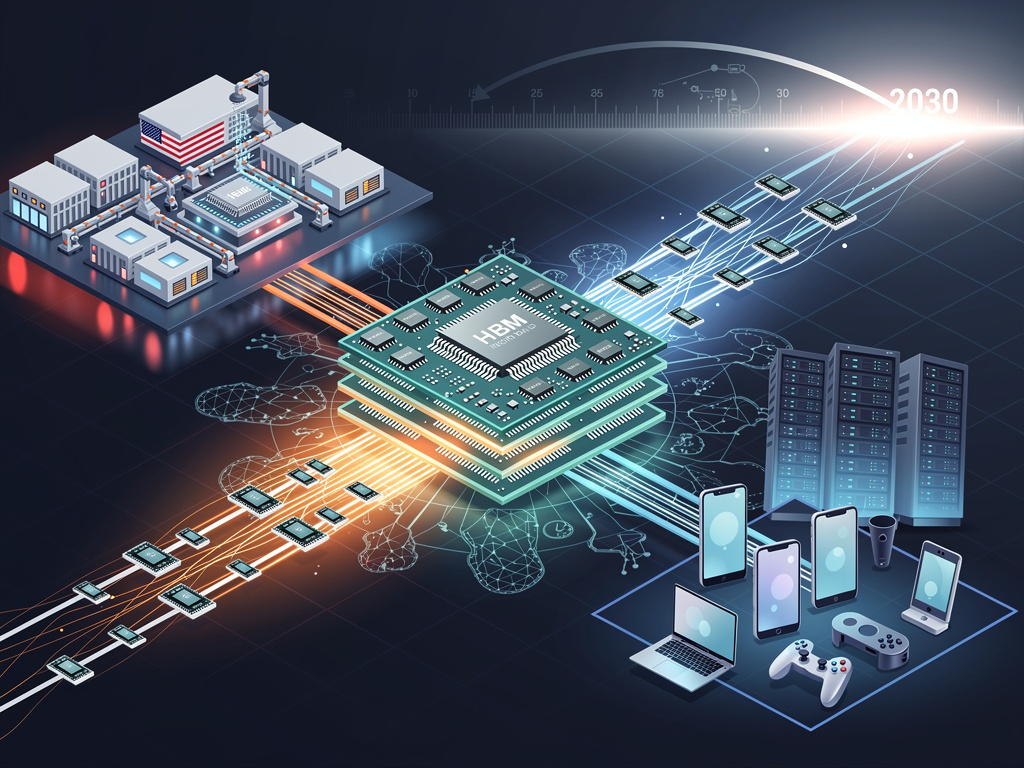

SK Hynix’s chief executive doesn’t expect the memory shortage to let up until the end of the decade. Speaking at the groundbreaking for the company’s more than $4 billion plant in West Lafayette, Indiana, on Thursday, Kwak Noh-jung said he saw no clear signs of a downturn and expected tight supply to “continue to the end of 2030,” Hankyoreh reported.
Kwak argued that AI has changed how memory demand behaves. “The next downturn is going to be different from the past downturns we experienced a couple of decades ago,” he said, according to Dow Jones. Memory for AI servers is increasingly customized and developed jointly with customers rather than sold as a commodity, which makes demand easier to forecast, he said, so any slowdown should look like moderating demand rather than a crash.
“In the case of HBM, we need much more time to adjust chips inside our customers’ systems to maximize performance,” Kwak said. Asked about the years after 2030, he answered: “I don’t worry.”
What the Indiana site will do
The plant at Purdue Research Park is SK Hynix’s first U.S. production base for high-bandwidth memory. It will package and test wafers made in South Korea and supply customers in the U.S., where the company counts Nvidia, Microsoft and Google among its buyers. Cleanroom operations are scheduled to start in the second half of 2028, with volume production of next-generation HBM4E chips in the third quarter of 2029, The Korea Times reported. The site will also house an AI chip research and development facility, and the company expects about 7,000 direct and indirect jobs.
The U.S. government finalized $458 million in CHIPS Act grants and up to $500 million in loans for the project in December 2024. Earlier this month SK Hynix’s board approved about 54.3 trillion won ($38.3 billion) in investments through 2031, including 35.2 trillion won for the second phase of its fabs in South Korea.
Kwak left room for more American investment but said, “I don’t have any shortlist,” and that “nothing is decided.” On Washington’s push for front-end wafer fabs, he said SK Hynix “is considering anywhere in the world if that place provides us opportunities and provides business opportunities with our customers.”
A crowded order book
SK Hynix held 58% of the HBM market by revenue in the first quarter, according to Counterpoint Research, with Samsung and Micron at 21% each. Nvidia, one of its biggest customers, forecast last week that its revenue would jump 70% in its next fiscal year.
Buyers are locking in supply years ahead. Samsung has committed 70% of its HBM capacity through 2031 under long-term deals with Microsoft, Nvidia and Google, 24/7 Wall St. reported, with contract buyers paying $300 to $400 per module against about $2,100 on the spot market.


 WebProNews is an iEntry Publication