
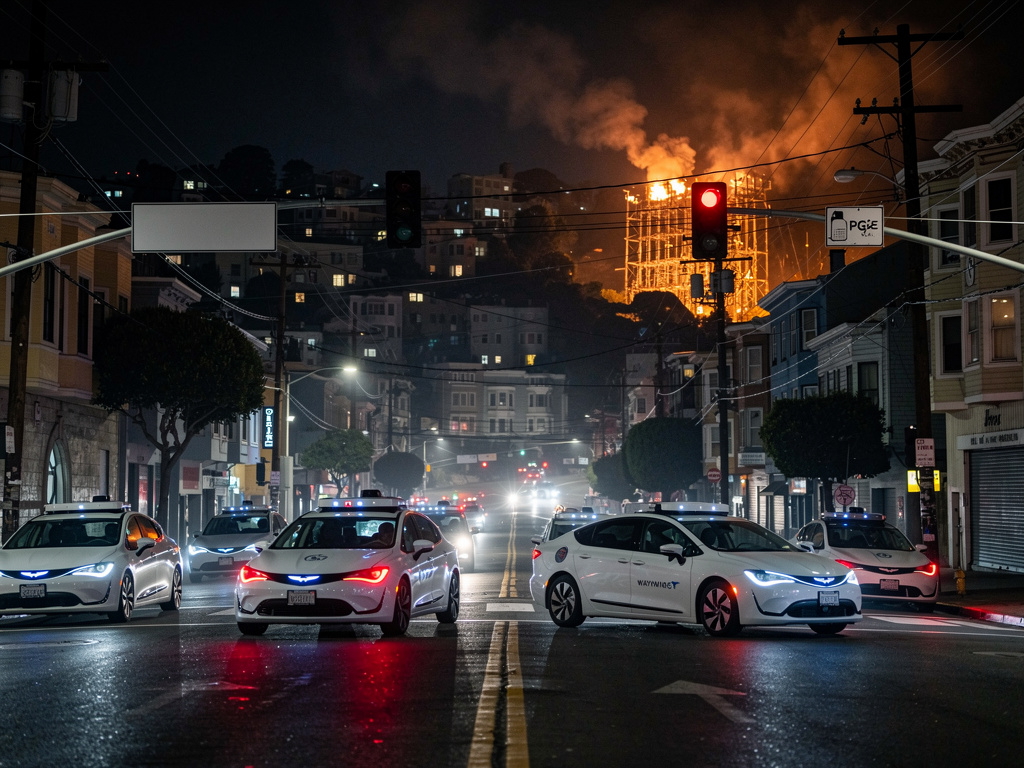
When Darkness Descends: Waymo’s Autonomous Fleet Falters in San Francisco’s Power Crisis
In the early hours of a chaotic Saturday, San Francisco’s bustling streets ground to a halt not just from a massive power outage, but from an unexpected technological glitch that exposed vulnerabilities in the city’s embrace of driverless vehicles. Waymo, the autonomous vehicle subsidiary of Alphabet Inc., was forced to suspend its robotaxi operations across the city after dozens of its self-driving cars stalled at intersections, creating widespread traffic jams amid darkened traffic signals. This incident, triggered by a fire at a Pacific Gas & Electric substation, affected roughly 30% of San Francisco, leaving about 130,000 customers without power and highlighting the fragility of integrating advanced AI-driven systems into urban infrastructure.
The outage began around 8 p.m. local time on December 20, 2025, when flames erupted at a PG&E facility near 8th and Mission Streets, according to reports from The Financial Express. As electricity flickered out across neighborhoods, traffic lights went dark, plunging key thoroughfares into confusion. Waymo’s vehicles, designed to navigate complex urban environments using sensors, cameras, and AI algorithms, suddenly found themselves unable to proceed safely without the guidance of functioning signals. Eyewitness accounts and social media posts described scenes of robotaxis freezing in place, blocking lanes and exacerbating gridlock for human drivers and emergency responders alike.
Company officials quickly acknowledged the issue, with a spokesperson confirming the temporary suspension to minimize risks. This decision came after reports of vehicles causing disruptions, including stalling at intersections and contributing to traffic snarls that delayed public transit and complicated emergency access. The event underscores a critical dependency: autonomous systems like Waymo’s rely heavily on predictable infrastructure, and when that fails, even the most sophisticated tech can falter.
The Blackout’s Ripple Effects on Urban Mobility
Power restoration efforts by PG&E progressed through the night, with most customers regaining electricity by late Saturday, as detailed in an update from The New York Times. However, lingering outages affected about 25,000 households and businesses into Sunday, per The San Francisco Chronicle. For Waymo, the suspension was a precautionary measure, but it revealed deeper challenges in how self-driving cars handle edge cases—scenarios outside their typical operating parameters, such as widespread signal failures.
Industry experts point out that while Waymo’s fleet is equipped with lidar, radar, and computer vision to detect obstacles and make decisions, the absence of traffic lights forces these systems into a conservative mode. “When confidence levels drop below a certain threshold, the vehicles are programmed to stop rather than risk an unsafe maneuver,” explained a source familiar with autonomous vehicle protocols. This safety-first approach, while prudent, can lead to cascading problems in a city like San Francisco, where narrow streets and high traffic density amplify disruptions.
Posts on X, formerly Twitter, captured public sentiment in real-time, with users describing Waymo cars “freezing in place” and “honking at each other” during similar past incidents, though none matched the scale of this blackout. One post highlighted how the outage “paralyzed” the fleet, turning potential mobility saviors into obstacles. These anecdotes, while not definitive, illustrate growing frustrations among residents who have witnessed repeated hiccups with robotaxis, from blocking pride events to interfering with emergency scenes in previous years.
Waymo’s Technological Backbone Under Scrutiny
Delving into Waymo’s operations, the company’s robotaxis operate on a sophisticated platform that integrates machine learning models trained on millions of miles of driving data. Yet, as The Information reported in its briefing, the suspension was a direct response to the citywide disruption, emphasizing how external factors like power failures can override even the most robust AI safeguards. Waymo has invested heavily in redundancy, including onboard batteries and backup systems, but these are no match for a complete loss of urban signaling infrastructure.
Comparisons to competitors like Cruise, which faced its own regulatory setbacks after incidents in San Francisco, reveal a pattern in the autonomous vehicle sector. Regulators had previously urged caution in expanding robotaxi services due to traffic blockages and emergency interference, as noted in historical coverage. This latest event reignites debates about whether cities are prepared for the full integration of such technology, particularly in areas prone to infrastructure vulnerabilities like California’s aging power grid.
Moreover, the incident occurred during the holiday season, amplifying its impact on public transportation. The Los Angeles Times detailed how the blackout disrupted BART and Muni services, leaving commuters stranded and forcing many to seek alternatives—only to find Waymo’s fleet offline. Analysts suggest this could prompt Waymo to enhance its algorithms for “dark signal” scenarios, perhaps by incorporating more human-like decision-making heuristics or better integration with city emergency protocols.
Broader Implications for the Autonomous Vehicle Industry
The fallout extends beyond immediate traffic woes, raising questions about the resilience of autonomous technologies in real-world crises. San Francisco, a testing ground for innovations from companies like Waymo and its rivals, now serves as a case study in the perils of over-reliance on stable infrastructure. “This isn’t just about one company; it’s about how we build cities that can support next-generation mobility,” said an urban planning expert who has tracked these developments.
Financially, Waymo’s parent company Alphabet may face scrutiny from investors, as service interruptions could dent confidence in the unit’s path to profitability. While Waymo has expanded to cities like Phoenix and Los Angeles with fewer hiccups, San Francisco’s dense, unpredictable environment continues to pose unique challenges. Reports from The San Francisco Standard described how stalled vehicles blocked intersections, prompting the mayor to urge residents to stay home amid inoperative stoplights.
On X, discussions evolved from frustration to broader critiques, with some users mocking the “future” of self-driving cars that can’t handle a blackout, while others praised the swift suspension as a sign of responsible oversight. These online reactions, combined with media coverage, paint a picture of a technology still maturing, where public perception can shift rapidly based on high-profile failures.
Lessons Learned and Future Safeguards
In response to the outage, Waymo engineers are likely analyzing telemetry data from the affected vehicles to refine their systems. Potential upgrades could include advanced simulation training for power-failure scenarios or partnerships with utilities like PG&E to receive real-time alerts about infrastructure issues. As Mission Local reported, numerous vehicles contributed to traffic jams after the outage hit one-third of the city, underscoring the need for better contingency planning.
Regulatory bodies, including the California Public Utilities Commission, may revisit approval processes for autonomous fleets, demanding more robust demonstrations of resilience. Past letters from San Francisco officials, as referenced in earlier incidents, called for scaling back expansions until such issues are addressed. This event could accelerate those conversations, pushing for standards that ensure driverless cars enhance rather than hinder urban safety.
Looking ahead, the incident highlights the interplay between technology and public infrastructure. Cities investing in smart grids and redundant systems might better support autonomous vehicles, creating a symbiotic relationship that benefits all road users. For Waymo, rebounding from this setback involves not just technical fixes but also rebuilding trust with a public weary of disruptions.
Industry-Wide Reflections and Path Forward
Competitors in the space, from Tesla’s Full Self-Driving ambitions to Zoox’s purpose-built vehicles, will undoubtedly take notes. The blackout serves as a stark reminder that autonomy doesn’t exist in a vacuum; it requires harmonious integration with existing systems. Analysts predict that events like this could slow the rollout of robotaxi services in other metros, as stakeholders demand proof of reliability under duress.
Public sentiment, as gauged from X posts, mixes humor with concern—tales of cars “trapping” event attendees or blowing through caution tape in past mishaps resurface, fueling skepticism. Yet, proponents argue that these are growing pains in a transformative field, where each failure informs safer iterations.
Ultimately, San Francisco’s power crisis exposes the chasm between cutting-edge innovation and everyday urban realities. As Waymo resumes operations—expected once full power is restored and systems are verified—the company must navigate not only the streets but also the expectations of a city that has become both a pioneer and a cautionary tale in the autonomous era. With ongoing investigations into the substation fire and its causes, the full story may yet unfold, but for now, it stands as a pivotal moment in the evolution of driverless transportation.


 WebProNews is an iEntry Publication