
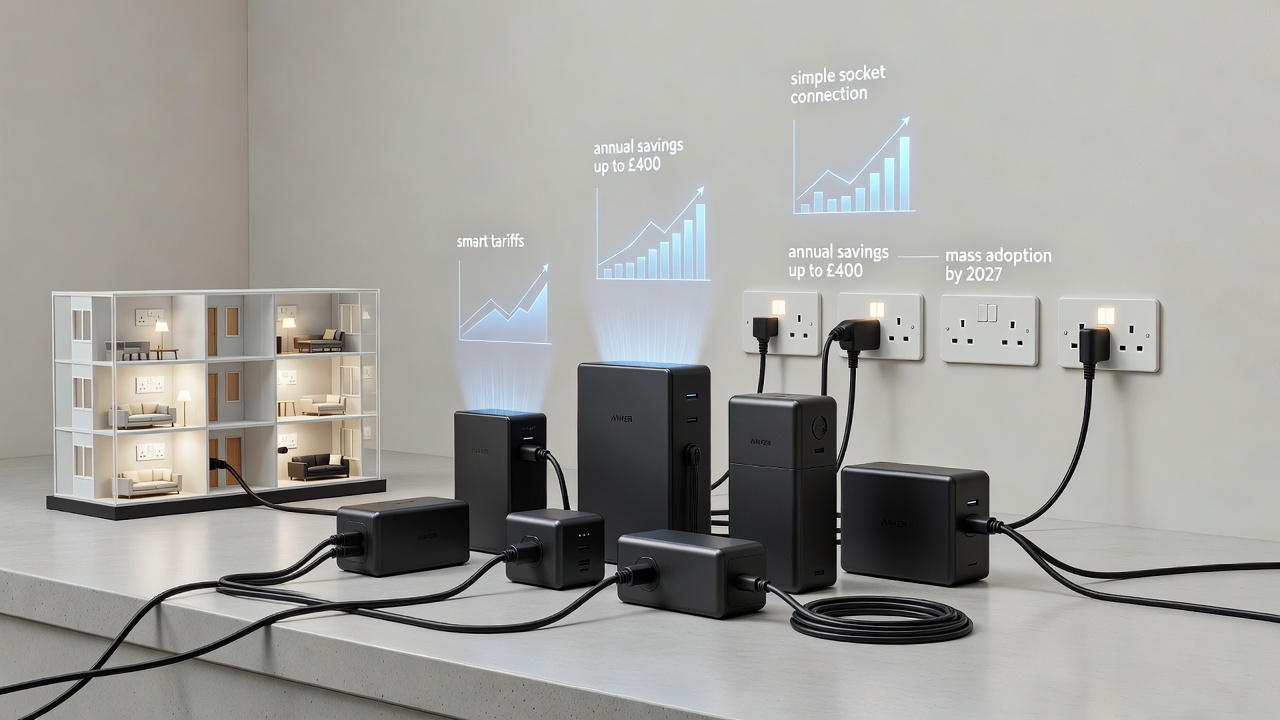
Alex Schoch sees it clearly. The Group Director for Flexibility at Octopus Energy told TechRadar that plug-in batteries will drive transformational scale deployment in the next couple of years. “I think it has the potential of being a mass market thing even faster than solar,” he said.
His view carries weight. Octopus serves eight million customers. Already 1.2 million sit on smart tariffs that shift with wholesale prices. Those tariffs reward timing. Charge when power costs pennies. Discharge when it spikes. Simple in theory. Transformative in practice.
But the hardware lagged. Traditional home batteries demanded complex installation. Certified electricians. Structural assessments. Thousands in upfront costs. Renters stayed locked out. Apartment residents had no option. That barrier may soon fall.
Plug-in batteries connect straight to a standard wall socket. No permits. No tradespeople. Owners stack compact modules as needs grow. Early models start around 2 kilowatt-hours. Add more units to reach 10 or beyond. They charge at night on cheap rates. Feed power back during peak hours. And pair with rooftop solar when available.
Kelvin Cao makes the analogy stick. As Anker SOLIX EU CEO he compared the technology to household staples. “The vast majority of households own a refrigerator to store groceries and extend the shelf life of perishable food. Battery storage brings the same benefits to household energy,” Cao explained in the same TechRadar interview. He sees it as the step from merely producing electricity to actively managing it.
Savings add up fast. Price arbitrage alone delivers results. Buy at 10 pence per kilowatt-hour overnight. Use or sell at 30 pence during the day. That 20-pence spread compounds across daily cycles. TechRadar reported potential annual savings between £100 and nearly £400 depending on tariff, usage and system size. Payback periods could shrink to three or four years.
Yet numbers only tell part of the story. The deeper value lies in grid participation. Utilities gain flexible demand response without building new peaker plants. Consumers earn credits or lower bills. Octopus already experiments with virtual power plants that orchestrate thousands of devices. Batteries become nodes in that network. The company controls dispatch to maximize owner savings. Trust builds when monthly statements drop.
Rob Hallifax pushes the accessibility angle harder. Co-founder of Windfall Energy, he noted in TechRadar that the UK counts 28 million homes. Roughly half are rented, flats or small properties. Those segments could now join the energy transition. “More people could get them, millions,” Hallifax said. He draws the parallel to air fryers. They appeared from nowhere. Suddenly half the country owned one.
Regulators move cautiously. The UK government legalized plug-in solar panels effective August 2025. Batteries face extra scrutiny over safety, grid stability and import quality. Department for Energy Security and Net Zero officials told TechRadar they continue investigating technical hurdles. Industry expects approval within the next year. Some developers aim for late 2026 launches timed with final rules.
Anker already ships advanced systems elsewhere in Europe. In April 2026 the company introduced the Solix Solarbank Max AC. PV Magazine detailed its 7-kilowatt-hour base capacity expandable to 42 kilowatt-hours with additional LFP modules. A 3.5-kilowatt bidirectional inverter comes integrated. The design targets existing rooftop solar arrays that lack storage. Owners add the unit without swapping out their original inverters. Pricing starts near €2,229. Self-installation remains possible under local rules in many markets.
Octopus moved even more recently. In June and July 2026 the supplier unveiled its Nook battery range. PV Magazine reported the Nook Cube, a compact 2-kilowatt-hour plug-in unit stackable to 10.5 kilowatt-hours. A larger wall-mounted Nook Colossus offers 5 kilowatt-hours scalable to 30. Both carry 12-year warranties and integrate with solar. Availability begins in 2027 across the UK, Germany, Italy, Spain and France. The company also partnered with CATL on Swaptopus, a battery-swapping network for electric trucks that hints at broader supply-chain ambitions.
These products differ sharply from legacy installations. Traditional systems often require roof or garage mounting, wiring upgrades and professional commissioning that can exceed £10,000. Plug-in versions ship in suitcase-sized boxes. Consumers wheel them inside, plug them in and pair via smartphone apps. That friction drop opens entire customer segments previously ignored by energy suppliers.
Safety standards remain non-negotiable. Hallifax warned against chasing the lowest price. “A battery that cuts corners on cell quality, protective engineering and compliance with applicable safety standards might look more attractive on its price tag, but it will not deliver the same reliability over the 10 to 15 years that a household should reasonably expect,” he cautioned in TechRadar. Buyers should insist on lithium iron phosphate cells, high cycle ratings, weather protection and listing on the Energy Networks Association Type Test Register that verifies G98 grid compliance.
Lorna Wallace-Smith echoed the call for measured progress. As EcoFlow’s Head of UK PR she told the same outlet that Germany’s rapid rollout of plug-in solar and batteries offers lessons. Regulators must balance speed with fitness for UK homes. Rushed imports could flood the market with substandard gear once rules loosen.
Grid operators watch closely. Variable renewable output demands storage somewhere in the system. Hallifax believes decentralized home batteries provide part of the answer. “If you have renewable generation, that’s always going to be variable. That’s just the nature of the world. And so somewhere in the system, storage has to be part of it,” he observed. Perfect grid balance may lie decades away. But every plugged-in unit reduces pressure on centralized infrastructure.
Consumer behavior will decide the pace. Early adopters already shift usage patterns around tariffs. Smart apps notify when rates drop. Automation handles the rest. Over time those habits spread. Energy plans grow as personalized as mobile contracts, Schoch predicted. Generic one-size-fits-all offerings give way to tailored products matched to individual consumption and property type.
Challenges persist. Upfront cost still deters some even at £1,200 for a 2.5-kilowatt-hour Windfall unit. Financing options and bill-credit schemes will matter. Supply-chain capacity for quality LFP cells could tighten if demand surges. And regulatory clarity must arrive before mass marketing begins.
Yet momentum builds. Anker, Octopus, Windfall and others prepare catalogs. Recent announcements signal confidence that approval is near. When the green light appears, the products stand ready. Millions who could never justify a full solar-plus-storage investment may find a simple plug sufficient to cut bills and support the grid.
The comparison to solar holds weight but misses nuance. Solar generates. Batteries manage and shift. Together they achieve more than either alone. For the half of households long excluded from both, the battery may prove the easier first step. Easier to install. Faster to deliver returns. And immediately useful even without panels on the roof.
Industry insiders expect the next 24 months to clarify the trajectory. If savings materialize as projected and regulators approve safe designs, adoption could accelerate beyond current forecasts. The technology exists. The market waits on paperwork and public demonstration that these devices deliver consistent value without drama.
Consumers will judge for themselves. Lower monthly statements provide the clearest evidence. When neighbors report meaningful reductions and easy setup, the air-fryer-like takeoff becomes plausible. Energy storage then moves from niche upgrade to standard appliance. The socket becomes the new frontier.


 WebProNews is an iEntry Publication