
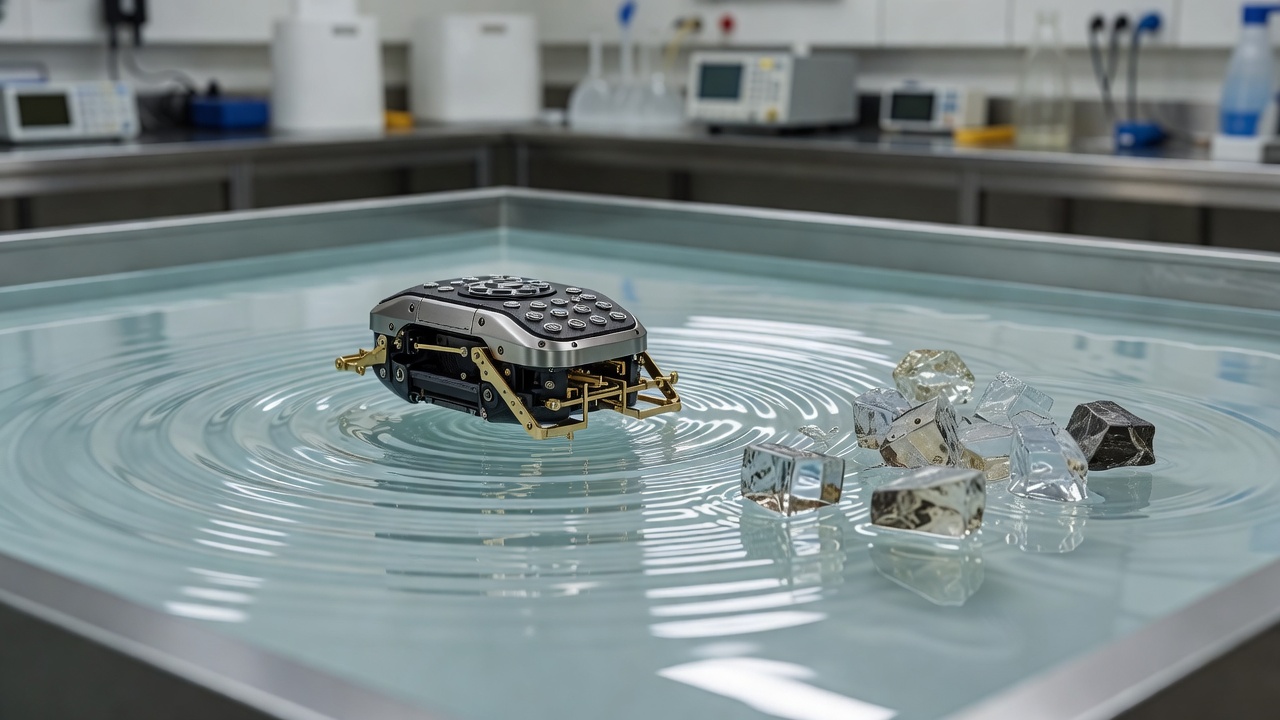

Physicists at the University of Oxford have steered a robot car with a computer made of water waves. The system uses interference patterns in a container of water, not a GPU, to recognize obstacles and decide how the car should move, according to the university’s Department of Physics. The study was published in Nature Communications.
How the water computer works
The work comes from Oxford’s Magnetism for Intelligent Devices (MIND) group, led by Dr. Safeer Chenattukuzhiyil, and draws on reservoir computing. In that approach, the nonlinear dynamics of a physical system transform the input, and only the output layer gets trained. Waves suit it well because they naturally spread, interact and interfere, creating complex patterns over space and time.
The team filled a circular metal container with water and added electronically controlled actuators that dipped into the surface at precisely timed moments, turning input data into waves. An LED lit the surface, and a camera recorded the interference patterns projected onto a screen, so the computation itself was visible.
Information about the robot’s surroundings was converted into waves. After training, the system identified different obstacle situations with up to 100% accuracy. Connected to a physical robotic car, the wave patterns directed its movement so it avoided obstacles on its own. The researchers also showed an event-driven mode in which computation only ran when the robot detected a change in its surroundings, which cut unnecessary processing.
“Instead of simply studying a physical phenomenon, here we harness the phenomenon itself to process information and make decisions for a robot,” Chenattukuzhiyil said.
From water to spin waves
Real AI chips would need solid-state wave systems that run at nanoscale sizes and gigahertz speeds. To explore that, the team simulated spin waves, collective excitations of magnetization that travel through magnetic materials. The micromagnetic simulations showed that a spin-wave reservoir just one micrometer across could handle the same robotic recognition tasks, pointing toward compact, energy-efficient neuromorphic processors for autonomous machines.
The water setup was built largely from everyday parts: a metal container, water, small motors, an LED, a camera and control electronics. “Impactful research does not always have to begin with an expensive or complicated experimental system,” said co-author Professor Thorsten Hesjedal. Oxford University Innovation has filed a patent application on the underlying computing hardware.


 WebProNews is an iEntry Publication