
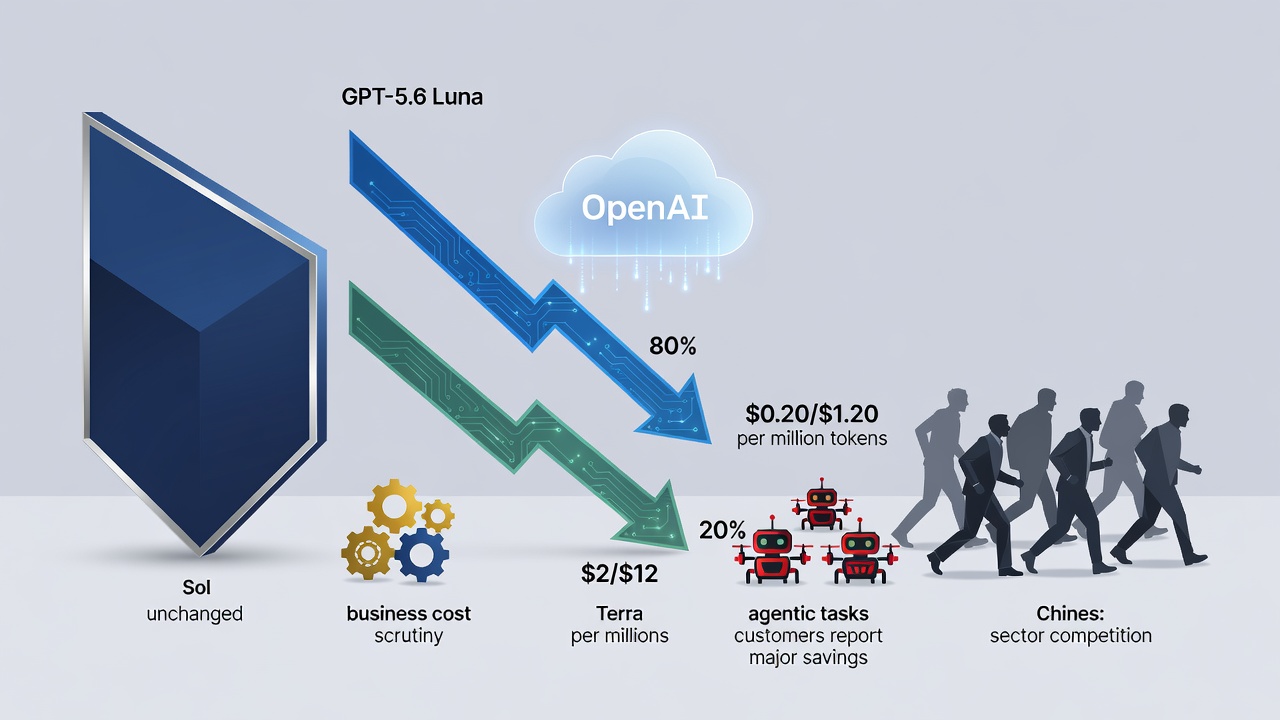
OpenAI just made its smaller AI models dramatically cheaper. The move comes as businesses push back against soaring artificial intelligence expenses and cheaper rivals from China gain ground. On July 30, the company cut prices for two models in its new GPT-5.6 lineup. Luna, the fastest and most affordable option, dropped 80%. Terra, the mid-tier balanced choice, fell 20%. The flagship Sol stayed the same.
Sending text to Luna now costs 20 cents per million input tokens. Generating responses runs $1.20 per million output tokens. Terra sits at $2 per million input and $12 per million output. These figures represent sharp reductions from prior levels of roughly $1 and $6 for Luna, and $2.50 and $15 for Terra, according to Reuters.
But why now? The timing reveals pressure building across the sector. Companies have watched AI bills balloon under usage-based token pricing. What once looked like predictable subscription costs turned unpredictable. Tasks consume varying numbers of tokens. Estimates prove difficult. Many executives now demand better value. Tech CEOs have echoed the same message in recent months. Cheaper options will drive widespread adoption.
OpenAI itself pointed to efficiency gains. The GPT-5.6 models improved during development. They optimize their own code and performance. Inference systems got smarter. Better routing, optimized software, and context management all played roles. Sol, the most powerful model, even helped rewrite kernels and run experiments. Those efforts cut serving costs by 20% and boosted token efficiency more than 15%. The company decided to pass those savings along.
“Making advanced intelligence more abundant and affordable is central to OpenAI’s mission,” the company stated in its announcement. “These changes put that commitment into practice.” The post detailed how Luna now delivers performance once reserved for frontier models at a fraction of the price. It handles high-volume work, tool calling, and multi-step workflows. One partner reported Luna moved them from single structured-output calls to full agent loops. Prompt cache reuse jumped from 24% to 90%. Context handling improved 2.2 times while output tokens fell 8.5 times. Cost dropped 87% compared with the previous mini version.
Customer reactions tell part of the story. Michele Catasta at Replit called Luna “the closest we’ve come to intelligence too cheap to meter.” He said it unlocks use cases the company didn’t expect soon. Hoda Noorian at Notion found Terra delivered comparable quality to GPT-5.5 at half the cost per task and 60% less time. Shaiyon Hariri at Ramp noted Luna became the default for background automations after leading internal coding benchmarks. Similar praise came from Blitzy, Cognition, and Dust, highlighting speed, agentic behavior, and operational improvements. These quotes appear in OpenAI’s official post at openai.com.
The cuts arrive roughly three weeks after the GPT-5.6 series launch. That speed surprised some observers. It signals urgency. Businesses scrutinize every AI dollar. Chinese open-weight models nearly match American performance at lower prices. Moonshot AI’s Kimi K3 stands out in recent comparisons. Z.ai’s GLM-5.2 also pressures the market. These rivals force U.S. labs to respond. CNBC reported on the cost-sensitive customer base and competition from Chinese startups plus tech giants such as Google and Microsoft.
Anthropic feels the heat too. Its Claude models often sit at the higher end of pricing. Claude Sonnet 4.6 costs $3 per million input tokens and $15 per million output. That exceeds Terra’s new rates. OpenAI’s decision may intensify the battle. Earlier this year, the Wall Street Journal revealed OpenAI was already considering drastic token price reductions. Executives anticipated a user war with Anthropic. Discussions were in flux then. Now parts of that strategy appear in action.
Analysts warn of trade-offs. Lower prices could drive higher usage volumes. More developers and enterprises might adopt the models for everyday tasks and agents. Yet the same cuts might squeeze margins. Both OpenAI and Anthropic eye eventual public offerings. Financial strain could follow if revenue per task falls faster than volume rises. Token prices overall have declined over the past year. Task costs, however, have climbed in many cases. The shift from flat subscriptions to metered usage created this dynamic.
OpenAI also introduced a faster mode for some models. It runs at twice the speed for a higher price. The company positioned the changes as helping customers get more from every dollar. Luna makes high-volume agentic applications practical. Terra fits routine work like workspace queries or scoped coding. Sol remains the choice for the most demanding jobs where cost takes a back seat.
The original Yahoo Finance coverage from earlier periods highlighted similar themes around smaller models and pricing strategy. That context shows this isn’t an isolated event. OpenAI has adjusted smaller model costs before. GPT-4o mini and related offerings saw reductions that broadened access. The pattern continues. Smaller models now punch above their weight. They handle agent loops and tool use that once required larger systems.
Microsoft, a major OpenAI investor and partner, has pushed cost-effective AI too. CEO Satya Nadella has spoken about the need for efficiency in recent earnings calls. Google rolled out cheaper Gemini variants such as the 3.6 Flash. These moves compound the pressure. Even open-source efforts in Asia, like India’s Sarvam AI releasing a 1 trillion parameter model 5.5 times cheaper than certain OpenAI options, add to the conversation on X in recent weeks.
So what does this mean for the industry? Pricing has become a primary battleground. Capability still matters. Yet cost per task increasingly decides where companies allocate budgets. Enterprises want predictable spending. They favor models that deliver reliable outcomes without surprise bills. OpenAI’s efficiency loop, where better models optimize the systems that train and serve them, could accelerate further gains. Sol helped improve itself. Future versions may compound those advantages.
Still, challenges remain. Unpredictable token consumption persists. Companies experiment with routing logic to send simple queries to Luna or Terra and reserve Sol for complex reasoning. Caching improvements and smarter context handling help. But the fundamental economics continue evolving. Prices fall. Usage climbs. The winners will balance intelligence, speed, and cost for specific outcomes.
OpenAI framed the announcement around its long-term mission. Advanced intelligence should reach more people and organizations. The price cuts make that possible today. Luna at current rates enables applications once deemed too expensive. Businesses can deploy agents at scale. Developers build features that previously strained budgets. The savings add up quickly in high-volume scenarios.
Competitors will likely respond. Anthropic may adjust its own pricing. Google and Microsoft could accelerate cheaper offerings. Chinese models already set a low bar on cost. The cycle feeds itself. Each efficiency gain funds the next price reduction or capability boost. For now, OpenAI has taken a clear step. Smaller models got cheaper. Faster. More capable than their price tags suggest. The AI price war isn’t slowing. It just got more aggressive.


 WebProNews is an iEntry Publication