
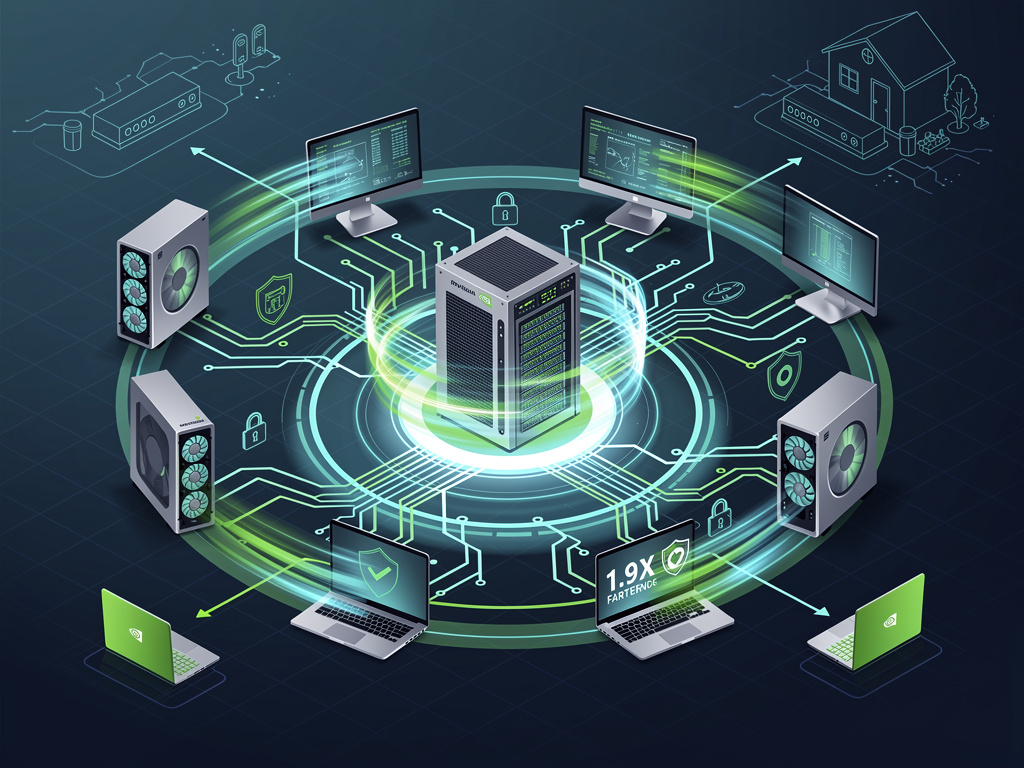

Nvidia wants the gaming PC in the den and the laptop on the kitchen table to share the work of running local AI models. Its new Personal AI Router, or PAIR, is free, open-source software that finds compatible computers on a home network, links them and hands them inference jobs while they would otherwise sit idle, The Verge reported.
Despite the name, PAIR is not networking hardware. It works with tools such as Ollama and LM Studio and supports GeForce RTX 20-series cards and newer, RTX Pro GPUs and DGX Spark systems, plus Macs with Apple’s M4 chips or later. The beta launched Thursday for Windows, Linux and macOS.
Built for agents that split up their work
The pitch is parallelism. An agentic workflow that breaks a complex task into smaller jobs can spread those jobs across several machines instead of queuing them on one GPU. Nvidia says PAIR adapts as devices join or leave the network, including when someone starts playing a game on a desktop that had been doing AI work.
Devices pair with a six-digit code, and traffic between them runs over mutual TLS so each machine authenticates the other.
In a media briefing, Nvidia product manager Seth Schneider described an extreme household with an RTX Spark laptop, a DGX Spark desktop, an RTX 5090 laptop, a gaming desktop and a MacBook Pro, which he estimated adds up to about 165 teraflops of underused compute. “It’s truly a treasure trove of free tokens just sitting in homes today,” he said. Asked what setups are realistic, Schneider said Nvidia expects most PAIR users to have something like one laptop and one gaming PC.
Faster local inference, simpler agent setup
Nvidia paired the launch with performance work done alongside the llama.cpp and vLLM projects. On a GeForce RTX 5090, llama.cpp token throughput rose up to 50% on Qwen3.6-27B and 90% on Qwen3.6-35B, while the RTX Pro 6000 Blackwell gained up to 20% in vLLM and DGX Spark saw a 1.4x increase on Qwen3.6-27B, Wccftech reported, citing Nvidia’s SpeedBench-Coding results.
The company also announced simpler local setup for three agent apps on GPUs with at least 24GB of memory: Perplexity’s Portable Computer, Nous Research’s Hermes Agent and OpenClaw. Hermes will detect the GPU, pick a model and run it through llama.cpp with Nvidia’s optimizations already applied, while a Windows app built with Microsoft handles local model setup for OpenClaw. Portable Computer asks permission before sending content to any of the cloud models it can escalate to.
Not all of it ships at once. PAIR is a beta, and Nvidia described one-click local model setup in Hermes as coming soon.


 WebProNews is an iEntry Publication