
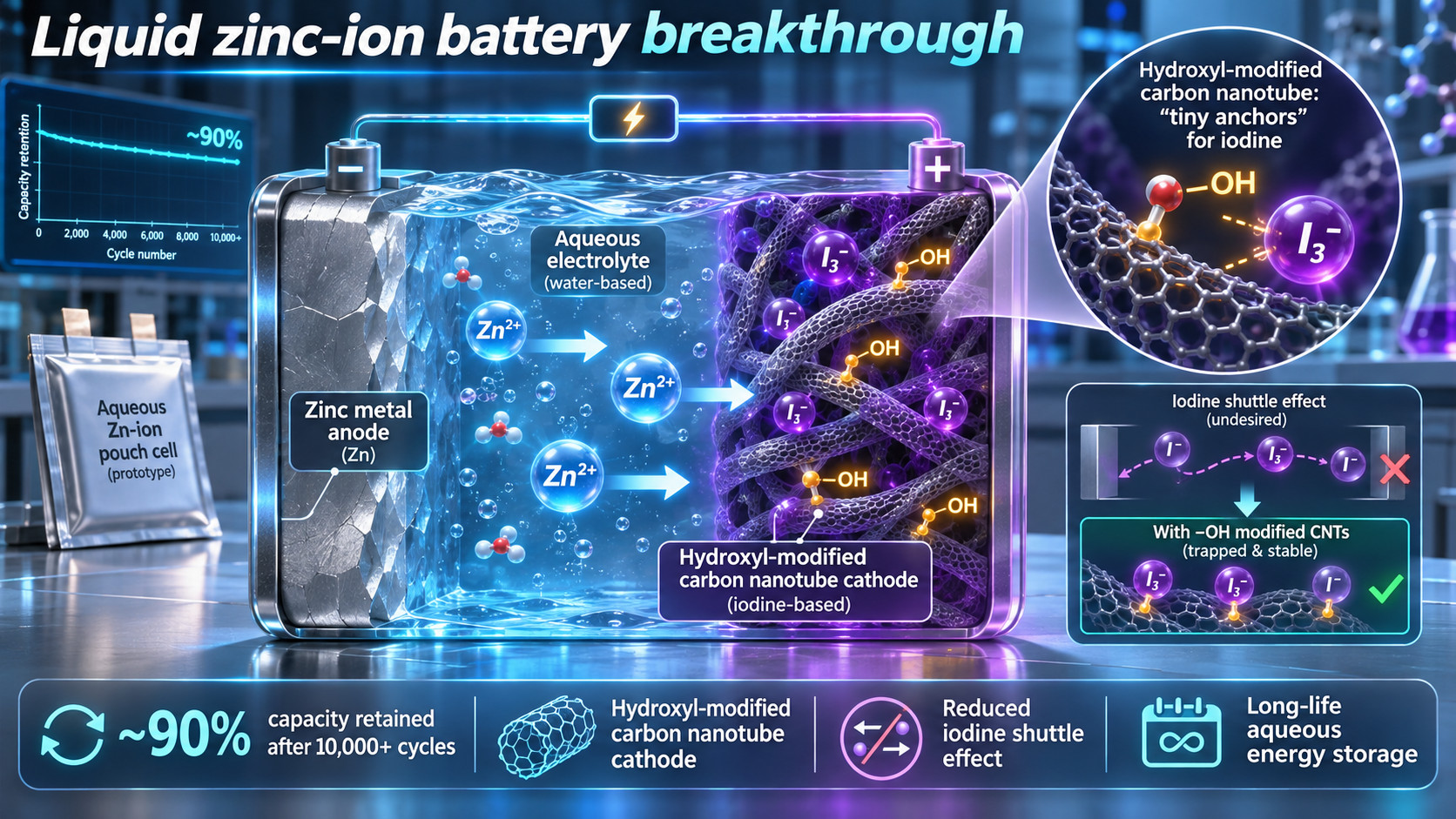

Chinese researchers have made a battery breakthrough, revealing a zinc-ion battery that can maintain almost 90% of its capacity, even after more than 10,000 charge cycles.
Zinc-based batteries often have short lifespans, especially compared to other battery tech. According to Interesting Engineering, Chinese researchers appear to have overcome that limitation by changing the chemistry of the battery cathode. The result is a liquid zinc-ion battery that breaks the mold of what zinc-based batteries are currently capable of.
The key was modifying the cathode’s functional group chemistry to create self-supporting carbon nanotube cathodes (SSCC) that keep the iodine from migrating through the battery. Per Interesting Engineering:
To demonstrate practical potential, the team built a larger pouch-cell prototype containing 150 mg of iodine. The battery operated at 1.1 volts, delivered an actual capacity of 23.8 mAh, and retained 91.7 percent of its original capacity after 350 charge-discharge cycles, demonstrating promising performance under more realistic operating conditions.
The researchers concluded that modifying the cathode’s functional group chemistry provides a simple and effective way to improve iodine conversion kinetics while stabilizing aqueous zinc-iodine batteries. They added that the approach could guide the future design of long-life aqueous energy storage systems based on naturally abundant zinc metal.
If the manufacture of the liquid zinc-ion batteries can scale, the breakthrough could represent one of the biggest steps forward in modern battery tech.


 WebProNews is an iEntry Publication