
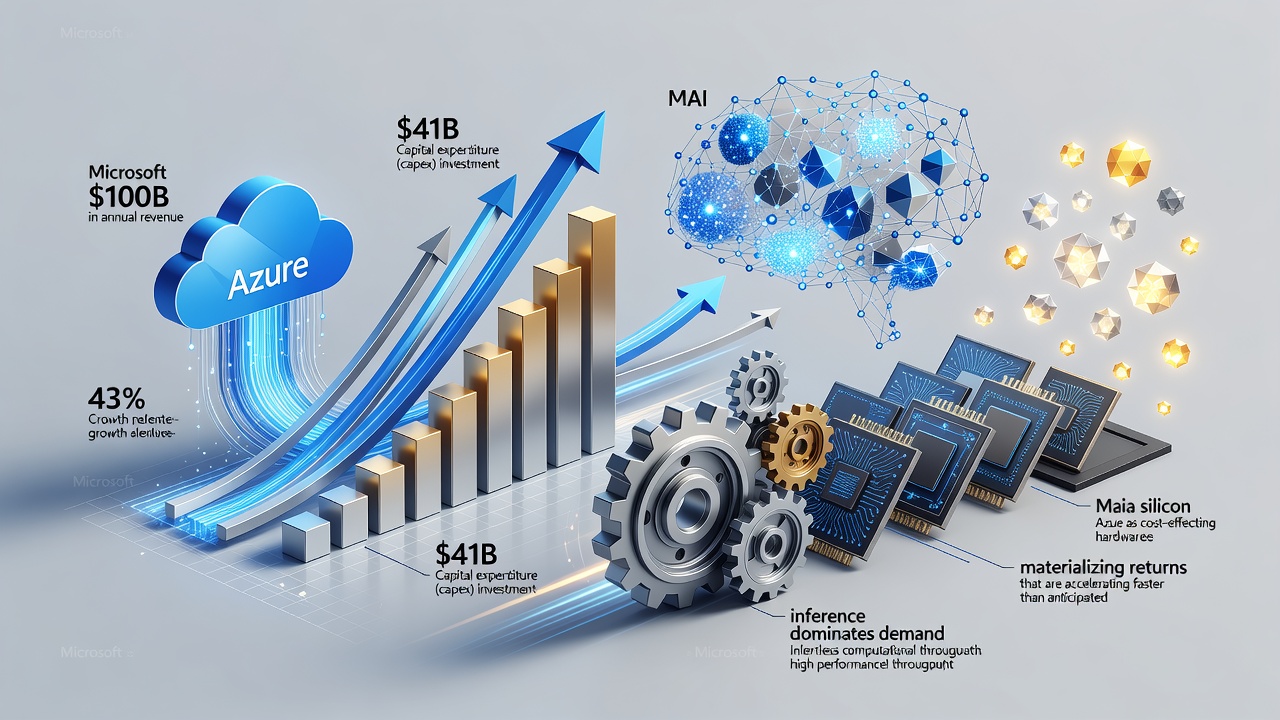
Microsoft delivered results that silenced doubters. Azure revenue topped $100 billion for the full fiscal year. Quarterly growth accelerated to 43 percent. Capital spending jumped 70 percent to $41 billion in the latest quarter. Yet free cash flow still reached $19.6 billion. Operating income rose 18 percent. The numbers tell a story of demand that keeps outrunning supply.
Satya Nadella made the shift explicit on the earnings call. Enterprises want the right model for each task based on quality, latency, cost and compliance. Microsoft offers the broadest catalog in the cloud with over 11,000 models. That includes leaders from OpenAI and Anthropic. It also includes the company’s own MAI family. The message was unmistakable. Microsoft no longer positions itself solely as a partner to frontier labs. It competes with them.
The company now pitches homegrown models and silicon as cheaper, more efficient alternatives. MAI models running on Maia 200 deliver 40 percent better performance per watt. One new offering, MAI-Cyber-1-Flash, achieves better performance than a much larger Mythos model at half the cost when paired with Microsoft’s multi-agent security harness. Nadella drove the point home. The goal is for the firm to control its own destiny.
From dependency to portfolio strategy
That control comes through architecture. Nadella stressed keeping the harness separate from the model. Any model can swap at any time. The Hugging Face incident with an OpenAI model reinforced the risk of single-vendor reliance. Customers heard the warning. They also saw the financial proof.
Commercial remaining performance obligations surged 84 percent to $678 billion. That gives Microsoft unusual revenue visibility. AI adoption stretches far beyond ChatGPT-style interfaces. GitHub Copilot, Microsoft 365 Copilot, Fabric, Foundry and security products all contribute. They reinforce one another. A single enterprise deal can touch multiple workloads at once.
Analysts had spent nearly two years questioning whether massive AI infrastructure bets would pay off. Microsoft answered with results that changed the conversation. The Seeking Alpha analysis captured the pivot perfectly: the market no longer debates if AI demand exists. It asks how quickly returns catch up to spending. (Seeking Alpha)
Recent data confirms the trend. Microsoft’s fiscal 2026 fourth-quarter revenue reached $90 billion, up 18 percent. Intelligent Cloud revenue hit $39.3 billion, up 32 percent. Azure and other cloud services grew 43 percent in constant currency. Full-year Azure revenue exceeded $100 billion, up 41 percent. These figures come straight from the company’s earnings release. (Microsoft Investor Relations)
CFO Amy Hood described the infrastructure as a fungible fleet. The company mixes first-party silicon like Maia 200 and Cobalt 200 with GPUs from Nvidia and AMD. Efficiency gains get monetized quickly because demand exceeds capacity for multiple quarters running. Inference now dominates AI compute demand. Training still matters, but running the models at scale drives most of the spending and revenue.
But here’s the nuance investors missed at first. Higher component pricing pushed capex higher. Microsoft still expects calendar 2026 capital expenditures around $190 billion after adjustments for leases and pricing. The bet remains on physical capacity. Chips, land, power and speed of assembly decide advantage. Meta raised its own 2026 capex guide to $130-145 billion. Across big tech the total heads toward $600 billion or more this year, nearly double 2025 levels. One X post summed the market reaction: Microsoft got rewarded because its spending already shows up as cloud and AI revenue. Meta’s payoff sits further out. (TechCrunch)
Partnerships continue to expand even as competition intensifies. Microsoft broadened its work with Nvidia on the RTX Spark platform. The platform delivers up to 1 petaflop of AI performance for Windows PCs built for personal agents. It targets creators, developers and power users who need on-device capabilities. The collaboration stretches from cloud inference to desktop agents. Yet Microsoft frames its own silicon and models as the margin lever inside the Azure fleet.
Wall Street responded. Consensus now projects Microsoft revenue approaching $744 billion and earnings per share above $41 by fiscal 2031. Today’s premium valuation compresses sharply on those numbers. The stock rose after the report. Analysts pointed to sustained acceleration in Azure and Copilot traction across enterprise accounts.
Still, risks remain. Supply constraints persist. Power availability limits buildouts in some regions. Competition from pure-play AI companies and other clouds could intensify. OpenAI and Anthropic keep advancing their frontier offerings. Microsoft must balance its heavy investment in first-party technology with continued strong partnerships. Nadella’s comments suggest the company believes the multi-model, infrastructure-agnostic approach gives it flexibility.
The narrative has indeed changed. Two years ago skeptics asked whether enterprises would spend on AI at scale. Today’s data shows they do. The question has moved to execution speed, cost efficiency and model substitutability. Inference economics matter more than raw frontier capability for most workloads. Microsoft positioned itself at the center of that shift.
And the spending continues. Next quarter capex guidance exceeds $50 billion including lease impacts. The company shows no sign of slowing the build. Demand keeps pulling capacity forward. For industry watchers the pattern is clear. Microsoft turned infrastructure conviction into measurable financial momentum. The rest of the sector watches closely. Returns may take time to fully materialize. But the early evidence suggests the bet is landing.
Recent coverage reinforces the momentum. A CNBC report highlighted how Azure beat expectations and how the company reaffirmed its capex commitment. (CNBC) Another analysis on X noted that inference cost-efficiency, not just model size, defines the economic battleground. Microsoft’s fungible fleet approach lets it optimize across vendors and its own chips. The payoff appears in the numbers. Azure and AI services keep compounding.
Microsoft has moved from AI infrastructure skeptic target to proof point. Its results, architecture choices and public positioning signal a maturing market. Enterprises want options. They want control. They want measurable returns. Microsoft is selling exactly that combination. The numbers back the pitch. For now, the narrative belongs to Redmond.


 WebProNews is an iEntry Publication