

Microsoft says handing employees AI tools didn’t transform how it works. Redesigning the work did. In a Sept. 17 blog post, Kathleen Hogan, Microsoft’s executive vice president and chief strategy and transformation officer, laid out lessons from the company’s internal rollout, which also feed its Frontier Playbook for customers.
“We initially treated AI like a traditional technology rollout: deploy the tools, provide training, drive adoption,” she wrote. “We learned that access and usage do not equal transformation: a tool licensed to over 200,000 people does not change how the work gets done.”
Sales: start from the business goal
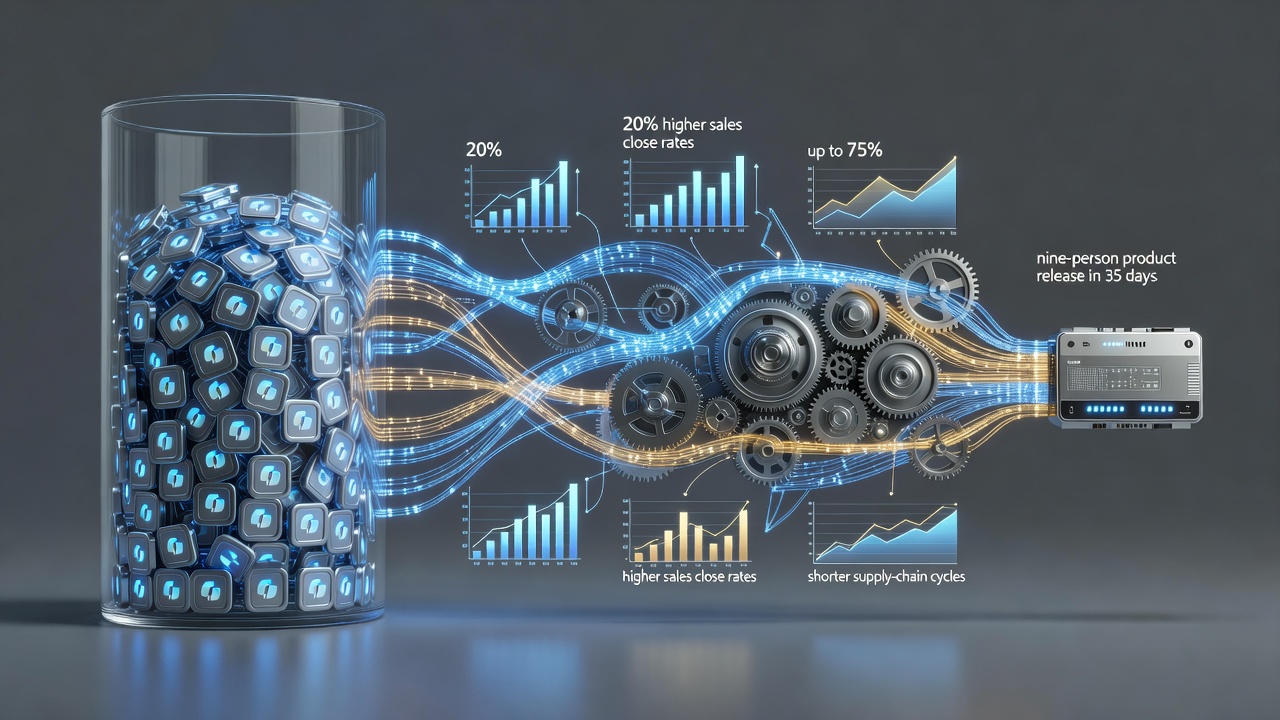
In sales, usage plateaued despite broad deployment. Instead of pushing adoption harder, one team mapped how account managers spent their week and matched tools to the moments that mattered: an Analyst agent for pipeline, a Deal agent for deal packages and Researcher for customer research. Weekly peer-led huddles spread what worked. Within that group, adoption of priority use cases tripled, revenue per account manager rose 9.4% and close rates were 20% higher, according to Microsoft.
Supply chain: simplify first
“Adding agents to a broken process still leaves a broken process — speeding up one step just creates a longer queue at the next,” Hogan wrote. Microsoft’s cloud supply chain team mapped and simplified its workflows, built a single source of truth for data, then deployed more than 100 purpose-built agents across planning, sourcing, fulfillment and logistics. Cycle time fell by up to 75% in selected workflows. Planners who spent five to seven days tracing why a demand plan changed can now get an answer in hours, sometimes in under 20 minutes, and within set permissions agents can now help update or cancel purchase orders.
Engineering: small teams, AI from day one
The nine-person team of engineers, designers and product managers behind Copilot Cowork was given room to rethink how a product gets built with AI embedded from the start. Members described their roles as “meta-engineers, meta-designers and meta-PMs,” and they shipped an initial release in 35 days. Microsoft’s Camp AIR, a multi-week accelerator in which cross-functional teams redesign work around a real business problem, has scaled to more than 3,000 engineers in that organization.
Managers matter, too. Microsoft’s research found that when managers actively model AI use, reported value from agentic AI rises 17 points and trust rises 30 points. Employees on teams where managers create psychological safety are 1.4 times as likely to be frequent users of agentic AI.
Hogan also argues companies should measure more than efficiency. “We like to say efficiency is the floor; capability is the ceiling,” she wrote. For account managers, she says, early signals might be more customer time or better win rates before revenue gains show up. For engineers, the question isn’t how much code AI produces, but whether the team is building better products faster.


 WebProNews is an iEntry Publication