
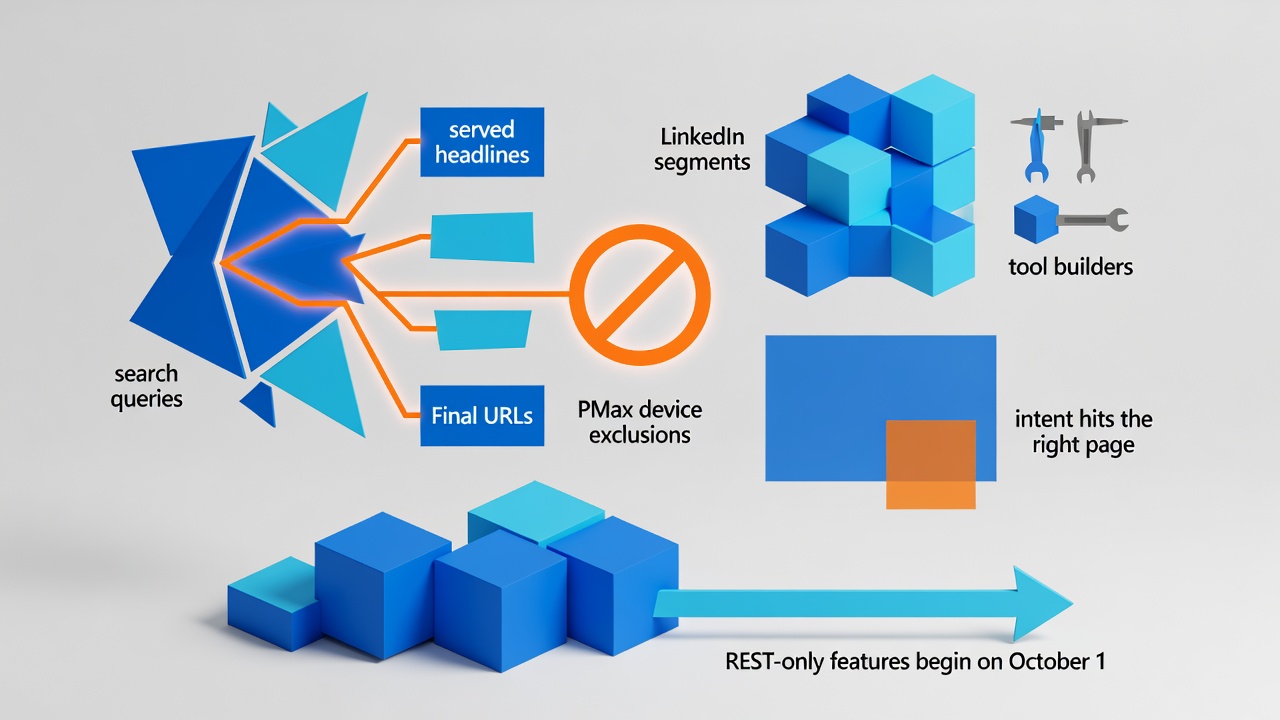

Microsoft Advertising has added a report to its API that puts a customer’s search term, the headline Microsoft actually served and the Final URL that got the click into a single row. The Search Term Landing Page report arrived alongside campaign-level device exclusions for Performance Max and new LinkedIn segment targeting interfaces.
Search Engine Land covered the update Friday, and PPC News Feed reported it a day earlier, pointing tool builders and script users to Microsoft’s official notes. Both match the August 2026 section of the Bing Ads API release notes, which describe the new SearchTermLandingPageReportRequest as an AI Max report that maps search terms to landing pages and leaves out rows with zero clicks.
What the report returns
Developers submit the request through SubmitGenerateReport, like other Microsoft reports. Aggregation runs from hourly to yearly, plus day of week and hour of day, and scope covers accounts through campaigns. Filters include ad type, delivered match type, language and a list of search queries. Every request must include Final URL and at least one performance column, according to the SearchTermLandingPageReportRequest reference.
The column list pairs SearchQuery, Keyword, Headline and FinalUrl with metrics such as impressions, clicks, CTR, average CPC, spend, conversions, revenue and return on ad spend. Headline comes back as a pipe-delimited string of up to three headlines delivered for the impression. Two source columns carry most of the diagnostic value. FinalUrlSource shows whether the landing page was the advertiser’s URL or one picked through AI URL expansion. HeadlineSource, which Microsoft added to the report in September, flags a row as AIGenerated if at least one headline in the combination came from AI rather than the advertiser.
Microsoft says the data can show how search intent maps to ad delivery and landing-page experience, Search Engine Land reported. The publication said the connection can make it easier to spot mismatches between what someone searched for, the message Microsoft served and where the click went. Google has since added a similar AI Max report that links search terms to ads and landing pages, as WebProNews reported.
The API report follows a run of reporting additions in Microsoft’s web interface. In April, the company said landing page (Final URL) reporting was available for Performance Max campaigns, with spend, impressions, clicks and conversion metrics, according to the Microsoft Advertising blog. In May, Performance Max’s Website Publisher URL report gained conversion and spend data, Search Engine Land reported. By August, PMax search terms appeared in both the search term insights report and the standard search term report, which Microsoft said makes cross-account reporting easier, according to its August product roundup. An API version is the one agencies can schedule and load into their own warehouses.
Device exclusions and LinkedIn segments
Microsoft’s Performance Max guide lists DeviceCriterion as a campaign-level exclusion, alongside age, gender, audience, location and webpage exclusions. The August bulk update mapped BulkCampaignNegativeDeviceCriterion in the .NET SDK, so advertisers can exclude Computers, Smartphones or Tablets from a PMax campaign in bulk workflows. Bid adjustments still aren’t available for PMax criteria, so exclusion is the main device control.
The same release added CustomLinkedInCriterion and GetLinkedInSegments to the Campaign Management API. Microsoft says it is the only advertising platform other than LinkedIn that can target people by LinkedIn profile company, industry and job function, according to its LinkedIn profile targeting documentation. That targeting works in Search, Dynamic Search, Shopping, Audience and Performance Max campaigns, though not every advertiser has it in PMax yet. In June, Microsoft added job seniority filters across Search and Audience campaigns, Search Engine Land reported. The new API interfaces let third-party tools apply LinkedIn segments without going through the web interface.
Bulk users also got AssetGroupNegativeKeywords as a downloadable entity and the BulkAdGroupUrlTarget mapping for AI Max URL inclusions. SDK version 13.0.29 shipped August 4 for .NET, Java, PHP and Python, and the Python and PHP REST models gained concrete deserialization for criteria and settings including ChannelPlacementCriterion, CustomLinkedInCriterion and frequency caps.
REST deadline on Oct. 1
Integrations still on SOAP have little time left to pick up features like this one. Microsoft said in April that all new features and enhancements become available only through the REST API starting Oct. 1, 2026, and that SOAP will be fully deprecated on Jan. 31, 2027, in Evolving the Microsoft Advertising API Platform. Oct. 1 is also when Microsoft stops allowing Max CPC limits on new campaigns using several standalone automated bid strategies, a change Search Engine Land covered earlier this month.
Google is moving in parallel. Version 25.2 of the Google Ads API, released Sept. 23, added competitive benchmark percentiles, asset-group URL controls for Performance Max and a method to create PMax drafts from Smart campaigns, Search Engine Land reported. Microsoft’s release focuses instead on query-to-URL detail, device exclusions and LinkedIn audiences.
Some PMax limits remain. Microsoft still caps accounts at 300 Performance Max campaigns, requires Maximize Conversion Value or Maximize Conversions bidding, doesn’t support shared budgets and doesn’t allow Product Scope criteria, according to its Performance Max guide.


 WebProNews is an iEntry Publication