


Microsoft had not fully restored Outlook and other Microsoft 365 services as of its 3:38 p.m. ET update Thursday, more than two and a half hours after nearly 130,000 users told Downdetector they could not reach their email, AP reported.
Microsoft says a large number of its servers dropped out of service after failing automated health checks, which pushed load onto the rest of its infrastructure. It has not named a root cause or said when service will return. Its service-health notice, MO1550821, lists Exchange Online, Teams, SharePoint Online, Copilot, Defender XDR, Planner and To Do as potentially impacted, which spans mail, chat, files, its AI assistant and security tooling. Microsoft opened that second notice at 1:26 p.m. ET, about two hours after the Exchange incident began.
That post, on X at 12:54 p.m. ET, said Microsoft was investigating problems reaching Exchange Online mailboxes in the Americas. Thirteen minutes later it said the issue “may affect Microsoft 365 service connectivity for users in any region.” Microsoft’s incident record for administrators lists a start time of 11:17 a.m. ET (16:17 UTC), according to Cloud Admin Hub and the University of Pennsylvania’s PennO365 incident feed, which republish Microsoft’s service-health data. Its first notice to admins went out at 11:20 a.m.
Earlier in the day, a separate Teams incident in the Americas ended with Microsoft posting at 12:09 p.m. that “Customer impact is now fully resolved.” The mail outage is a separate incident, and Microsoft tracks the Teams, SharePoint, Copilot and Defender XDR problems under a second notice, MO1550821. Consumers were affected as well, TechCrunch reported, with OneDrive and Office for the web among the services people could not reach. Microsoft’s public status page, which was slow to load for The Verge and Engadget, showed no Azure issues when WebProNews checked it at about 3:48 p.m. ET, and Microsoft’s notices for this outage do not list Azure. Windows Central, citing Downdetector, reported that Outlook, Teams, Copilot, OneDrive and Azure “all appear to be affected.”
Microsoft’s explanation has changed through the afternoon. At 1:35 p.m. it cited “elevated load” in a portion of its infrastructure across multiple regions. At 2:31 p.m. it said the load “isn’t driven by an increase in traffic, but by a number of servers being unexpectedly unavailable.” At 2:43 p.m., its incident notes said the failing health checks “may be related to a recent change to a component involved in processing those checks.” By 2:57 p.m. the notes said Microsoft had not identified recent changes that correlate with the start of impact.
The company has paused all deployments and configuration changes, moved traffic off the affected infrastructure and restarted servers. At 2:43 p.m. it began testing a configuration change on a subset of affected infrastructure. It is now deploying “a targeted change to bypass this component on a subset of servers” to see whether availability returns, and is investigating why affected servers show “elevated processor usage while handling requests.” At 3:38 p.m., Microsoft said that while it validated the change, “many of the affected servers have become unresponsive,” which kept it from confirming whether the change works. It is restarting those servers so they come back online with the change in place.
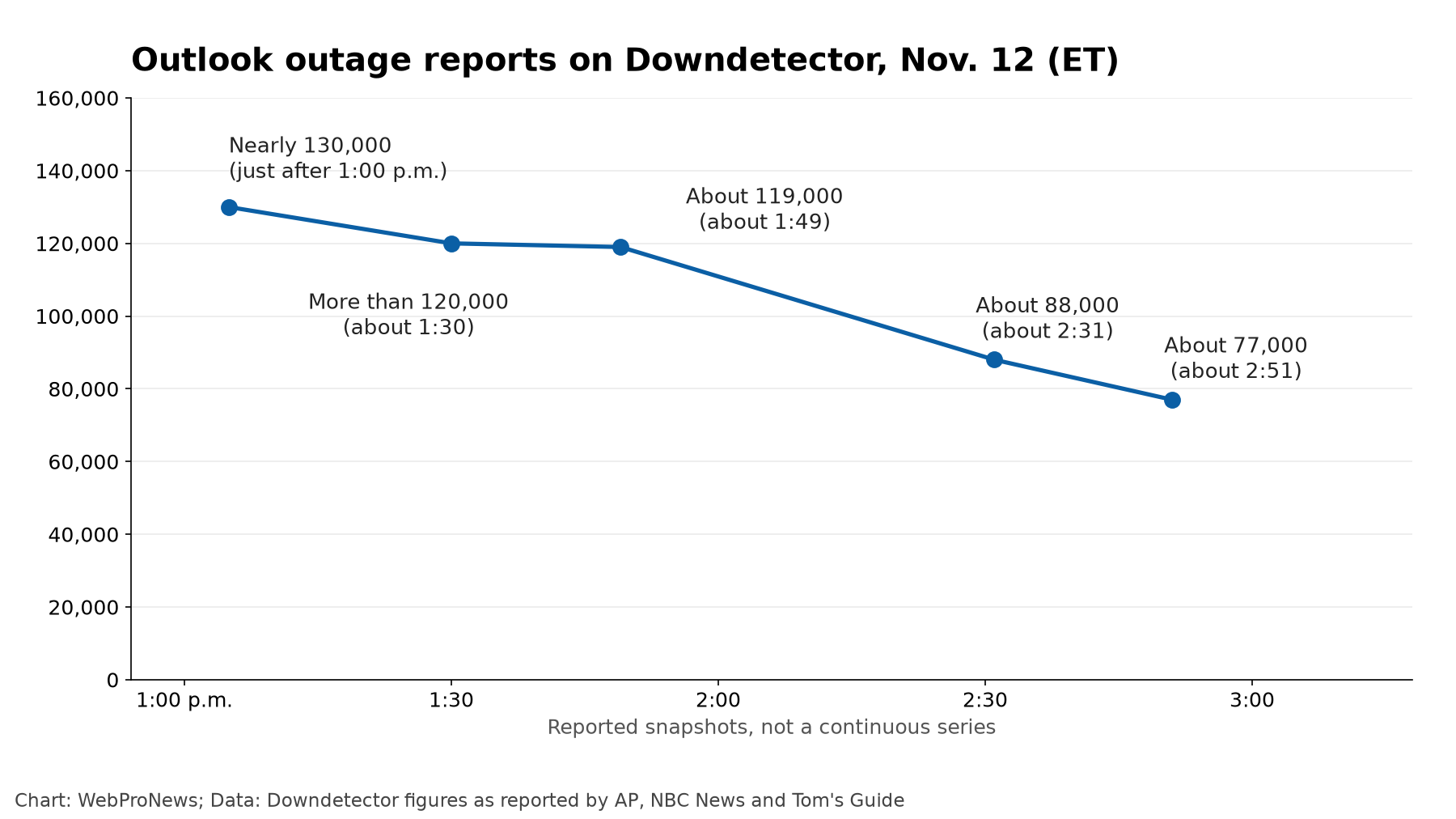
Downdetector reports for Outlook fell through the afternoon but stayed high. Tom’s Guide counted about 77,000 at 2:51 p.m. ET, and NBC News had put the count above 120,000 around 1:30 p.m.
TechCrunch noted that Microsoft’s last major incident came in September, when a days-long Microsoft 365 outage was blamed on a “core authentication configuration” issue.
Microsoft’s next update on the Exchange Online incident is due by 4 p.m. ET. As of 3:38 p.m., the company had not said when service will return or what is wrong with the component that handles the server health checks.
Status as of 3:50 p.m. ET Thursday. Microsoft’s latest update was at 3:38 p.m. ET.


 WebProNews is an iEntry Publication