
Micron Technology stands at a rare point in the semiconductor cycle. AI servers devour memory chips at a pace few predicted. Supply cannot catch up fast enough. The result is scarcity that feels almost deliberate. Contracts now bind customers to take product at set prices and volumes. Deposits total billions. This setup promises to extend high margins well beyond any traditional boom.
The shift is striking. Memory markets have long swung between glut and shortage. Prices crashed. Profits evaporated. Executives at Micron, Samsung and SK Hynix once managed inventory like a game of hot potato. Those days look distant. Structural changes in demand and deliberate supply discipline have altered the arithmetic.
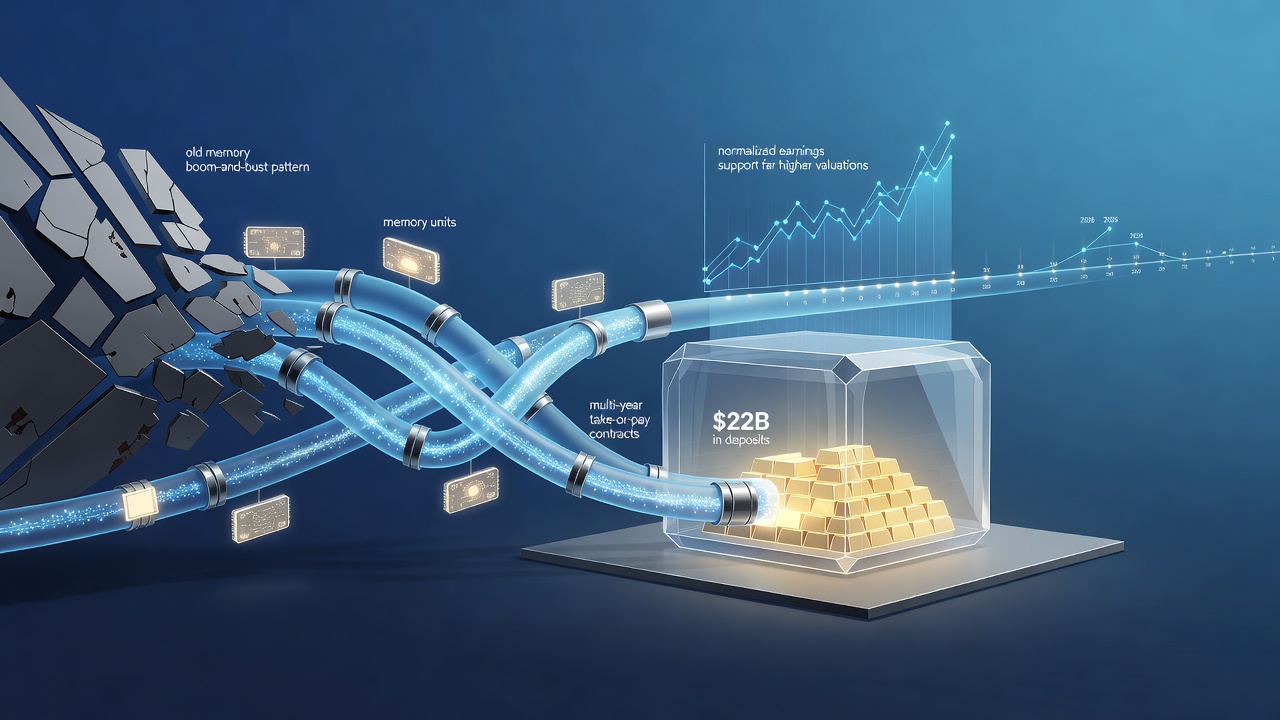
AI accelerators need specialized high-bandwidth memory, or HBM. Data centers gobble it. Hyperscalers sign long-term deals to guarantee supply. Micron reported that its strategic customer agreements now cover roughly half its future revenue, according to a Seeking Alpha analysis. Take-or-pay clauses reduce the risk that orders disappear when sentiment sours. Customer deposits reached $22 billion. Cash arrives before chips ship. Visibility improves. Volatility drops.
But this is no ordinary shortage. CEO Sanjay Mehrotra told investors the AI-driven memory shortfall is “unprecedented.” It will persist beyond 2026. That call came in January. By May the message had sharpened. The global memory-chip shortage will last past 2026, he reiterated, citing insatiable AI demand and structural supply gaps. Roic.ai reported the comments. The market listened. Micron shares reacted. So did the broader chip sector.
Numbers tell part of the story. AI data centers are projected to consume 70 percent of global memory chip supply this year. Consumer electronics, once the dominant buyer, now fight for scraps. Laptops and smartphones face higher component costs. Prices rise. Demand destruction follows in price-sensitive segments. Yet hyperscalers keep writing checks. Their capital expenditure plans keep expanding. Microsoft raised Azure guidance. Amazon lifted AWS forecasts and capital spending. Memory costs factor heavily into those budgets.
Micron has moved faster than many expected on HBM. It qualified its products with Nvidia. Production ramps. Yields improve. The company’s gross margin hit near 85 percent in the latest quarter, according to traders on X who tracked the earnings release. That level exceeds recent peaks and, for the first time, topped Meta’s margin in the same period. The figure underscores pricing power in a tight market.
Competitors face the same forces. SK Hynix leads in HBM supply for Nvidia’s current generation. Its exposure to high-margin AI memory will climb above 50 percent of revenue by 2028, analysts project. Samsung reallocates capacity too. The three firms control more than 95 percent of DRAM output. Their collective pivot to HBM has left conventional DRAM and NAND in short supply. A Tech Insider report from March laid out the math: 93 percent of combined production capacity redirected toward AI chips. Consumer memory pays the price.
Yet new fabs will not solve the imbalance quickly. Micron announced a $24 billion investment in Singapore for NAND and DRAM expansion. Output starts in the second half of 2028 at the earliest. U.S. facilities in Idaho and New York, supported by CHIPS Act funding of $6.14 billion, face similar timelines. Capacity arrives too late for the current surge and too early to assume demand will moderate. TrendForce sees memory industry revenue jumping 134 percent to $552 billion in 2026, then another 53 percent to $843 billion in 2027. Those forecasts appeared in a Yahoo Finance piece in May.
Long-term agreements change the risk profile. Past cycles featured soft commitments. Customers walked when spot prices fell. This time contracts include penalties and upfront payments. One X user noted that Micron’s 16 take-or-pay deals lock in roughly $100 billion of minimum revenue plus deposits through 2030. The arrangement shifts inventory risk to customers. It gives Micron a floor under earnings that previous booms lacked.
Still, skeptics exist. Some investors rotated from Micron to SK Hynix, arguing the Korean firm’s higher percentage of revenue from HBM justifies a premium valuation. HBM revenue at SK Hynix could represent 35 percent, 50 percent and more than 50 percent of total revenue in 2026 through 2028, versus roughly 20 percent, 30 percent and 35 percent for Micron. The concentration matters if one believes HBM demand is more structural than the broader memory market. A detailed thread on X by @EhrmantrautCap_ captured that logic in late July.
Execution risks remain. Yields on advanced HBM stacks must improve. New process nodes bring challenges. Geopolitical tension between the U.S. and China adds uncertainty. Beijing wants domestic memory champions. Subsidies flow. Yet technology gaps persist. Micron’s U.S. base and alliances with American hyperscalers offer some protection.
Analysts who model the business conservatively still see substantial upside. The Seeking Alpha contributor projected fiscal 2027 earnings per share at $1.18. That figure assumes normalized conditions rather than peak-cycle exuberance. Applying a reasonable multiple produces a fair value near $1,150 per share. The rating is Buy. Even if prices for standard DRAM and NAND soften, the contracted portion of revenue should cushion the blow.
Memory bulls point to hyperscaler capex acceleration. Nvidia cannot ship GPUs without adequate HBM. Microsoft, Google, Amazon and Meta continue to build out data centers at record pace. Their spending plans show no sign of fatigue. Memory becomes a bottleneck that raises overall system costs. Suppliers capture more of the economic value.
The old playbook no longer applies. In past recoveries, chipmakers rushed to add capacity the moment prices turned positive. This cycle shows more restraint. Oligopoly discipline holds. High barriers to entry deter new players. China’s efforts have yet to yield competitive 1-alpha or 1-beta class DRAM at scale. Supply response stays measured.
So what happens when AI spending eventually slows? Contracts provide a bridge. Take-or-pay terms mean customers pay even if they slow deployment. Deposits already sit on Micron’s balance sheet. The company can weather a pause better than in any prior downturn. That optionality carries real value.
Investors now debate valuation. Micron trades at a premium to historical averages. Some call it justified by the new earnings floor. Others warn that any crack in AI momentum could still trigger a sharp reset. The debate will intensify as quarterly results roll in. Yet the underlying scarcity narrative has strengthened in recent months, not weakened.
Recent commentary on X reinforces the point. One investor called the AI memory and HBM opportunity “still underpriced” relative to the tightness in DRAM and NAND supply. Hyperscaler capex keeps rising. The memory bottleneck underneath the GPU boom remains less crowded than the Nvidia trade itself. Those observations, posted in the past week, reflect sentiment that has not cooled despite summer volatility in tech shares.
Micron’s position is stronger than it was two years ago. The combination of contracted revenue, technology progress in HBM, and a concentrated customer base that cannot easily switch suppliers creates a moat. Scarcity has become contractual. That contract may outlast the boom. The memory business, long dismissed as cyclical and commoditized, suddenly looks more like a high-margin, structurally tight industry. At least for now. And quite possibly for longer than the skeptics expect.


 WebProNews is an iEntry Publication