
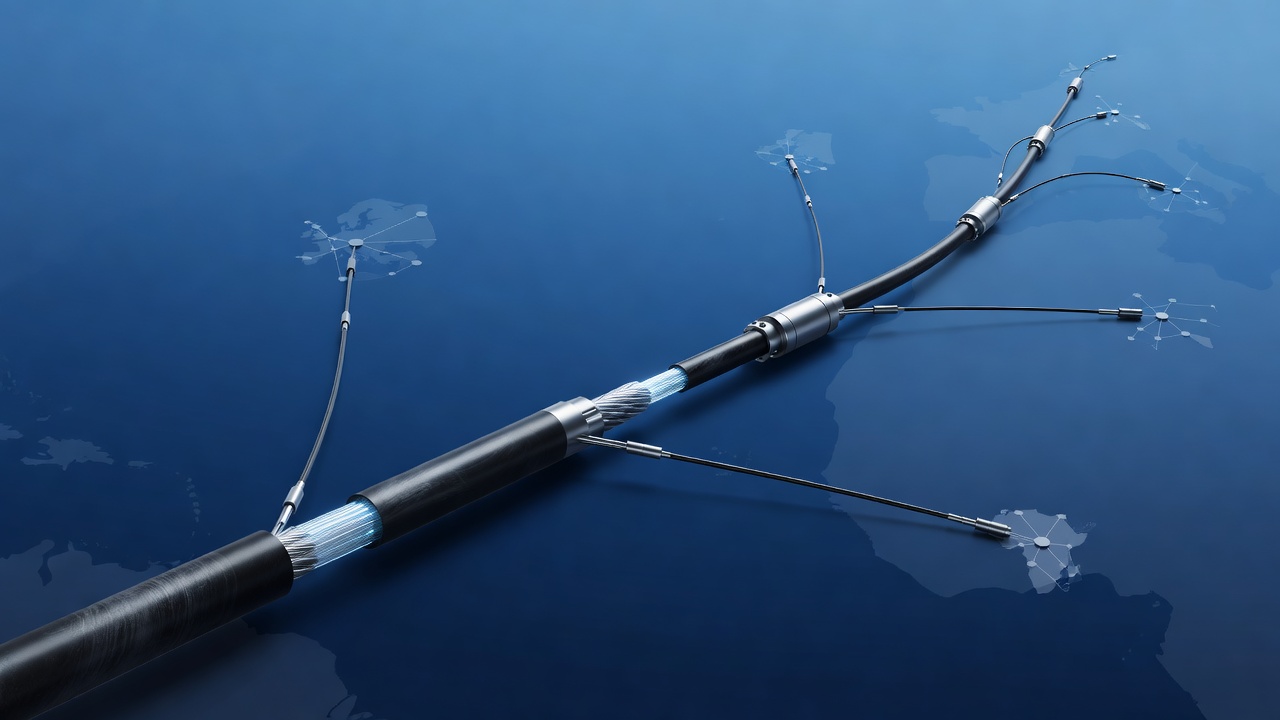

Meta said Monday it will build Petal, a subsea cable running about 7,000 kilometers (4,300 miles) between the U.S. and France and designed to carry 1 petabit per second. Meta says that is twice what today’s most advanced transoceanic cables carry, and it expects the system to enter service in 2029.
The gain comes from the fiber itself. Petal uses 24 fiber pairs, the same count as Meta’s Anjana transatlantic cable, but each strand holds two optical cores, which Meta’s engineers say makes it the equivalent of 48 fiber pairs. Anjana was the first 0.5 Pbps transatlantic system, and Meta’s engineering post puts Petal at 5.5 times the capacity of Marea, its first transatlantic investment.
Doubling capacity normally means more cable and more power. A 7,000 km cable typically needs about a hundred repeaters, and Petal’s single-body repeater amplifies 96 fiber cores by splitting each 2-core fiber into two single-core fibers, boosting the signals and recombining them. Meta says that keeps the system within existing power feeding equipment rated up to 18 kV, so the rest of the subsea supply chain doesn’t have to be requalified for higher voltages.
NEC is the turnkey supplier and will manufacture and install the system, while Sumitomo Electric makes the 2-core fiber. Orange is working with Meta on landing the cable on France’s Atlantic coast and connecting it to Europe’s terrestrial network. “Reaching one petabit on a transatlantic link, 25 years after the terabit milestone, represents a significant breakthrough to meet the exponential traffic growth while optimizing network capacity,” said Jean-Louis Le Roux, executive vice president of Orange International Networks. Meta hasn’t named the exact landing sites.
Meta says subsea cables carry about 99% of intercontinental traffic and that it has invested in more than 20 cable projects, including Project Waterworth. For enterprises, TechRepublic noted, the extra capacity won’t automatically mean faster links, since performance will depend on routing, landing-station connections, carrier access and the cloud regions involved.


 WebProNews is an iEntry Publication