
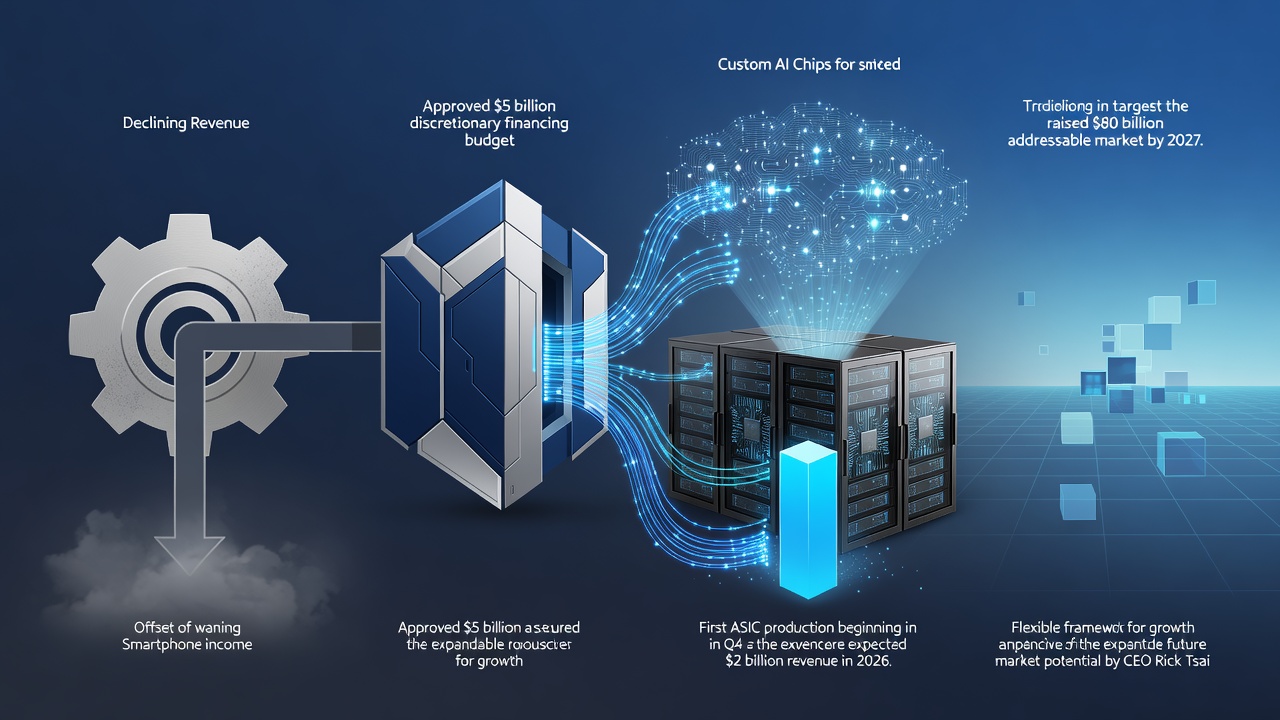
Taipei-based chip designer MediaTek just greenlit a discretionary $5 billion financing plan. The board approved it late last month. The money targets long-term expansion. Chief among the priorities: custom AI accelerators for data centers.
But the move comes as the company’s smartphone business falters. Mobile revenue dropped 20% in the second quarter. Global phone shipments hit their lowest level since 2013. And MediaTek expects the market to shrink another 15% this year. So the timing makes sense. Diversify now. Or risk stagnation later.
Board Approval and Executive Vision
CEO Rick Tsai laid it out clearly on the Q2 earnings call. “This flexible framework provides us with optionality when needed to agilely support our long-term growth and capitalise on massive data center opportunities,” he said, according to a Reuters report.
The funds won’t flow all at once. Management will tap them through one or more transactions. Timing and structure depend on market conditions. That discretion gives the company breathing room. No immediate pressure to issue debt or equity in unfavorable environments. Yet the war chest stands ready.
Shares jumped nearly 10% the day after the announcement. Investors liked the signal. MediaTek’s market value sits around $176 billion. The stock has climbed 149% so far this year. That outpaces the broader Taiwan index by a wide margin.
Analysts see the logic. Smartphone processors still dominate revenue. Yet margins there face pressure from rising supply-chain costs. Tsai noted the firm has begun passing those increases along through pricing actions. Still, the segment contracted. Second-quarter revenue reached T$152.18 billion, or about $4.71 billion. That edged up 1.2% from a year earlier. Net income fell 12.3% to T$24.6 billion.
The data-center pivot offers higher margins. And faster growth. MediaTek now projects its AI chip business for servers will bring in more than $2 billion during 2026. That’s a notable ramp from zero not long ago.
First custom AI chip production starts in the fourth quarter. A second-generation design stays on track for volume output in 2028. These application-specific integrated circuits, or ASICs, aim squarely at major cloud operators. The hyperscalers want tailored silicon. They don’t always want to rely solely on Nvidia’s GPUs.
MediaTek raised its view of the addressable market for such custom AI chips. The 2027 opportunity now stands at $80 billion. Previously the range ran from $70 billion to $80 billion. The company also lifted its targeted slice of that pie. It now eyes 15% to 20%. Earlier guidance sat at 10% to 15%.
This isn’t a side bet. It represents a deliberate reorientation. Taiwan’s largest fabless semiconductor firm built its name on smartphone SoCs. Those chips power devices from budget Android handsets to premium models. Yet saturation in phones has set in. Demand for AI training and inference infrastructure keeps accelerating.
Cloud providers seek alternatives. They value cost efficiency. They also want supply-chain diversity. MediaTek brings decades of design expertise. It knows how to optimize for power and performance at scale. The $5 billion buffer lets it invest in talent, tools, and manufacturing partnerships without immediate constraints.
Production milestones matter here. That Q4 start for the first ASIC gives the company real skin in the game. Engineers have already completed development. Tape-out and validation succeeded. Now comes the test of yield and customer acceptance. Success with one or two big cloud names could open doors quickly.
Competitors watch closely. Nvidia dominates AI accelerators today. Yet custom silicon from hyperscalers and their partners gains ground. Google designs its own TPUs. Amazon builds Inferentia and Trainium chips. Microsoft works with partners on Maia. MediaTek positions itself in this expanding group of specialists.
The financing announcement arrived alongside quarterly results that mixed signals. Overall revenue held steady despite the mobile decline. That suggests other segments, perhaps IoT or automotive, helped offset the weakness. Still, the smartphone contraction looms large. Shipments fell 11% in the second quarter. Memory shortages played a role in the downturn, forcing price hikes on entry-level and midrange devices.
Tsai struck a steady tone on phones. “Our view for global smartphone shipment remains unchanged and we continue to expect the market to decline by about 15% in units this year,” he told analysts, as reported by both Reuters and The Economic Times.
Investors appear willing to look past near-term handset softness. The AI narrative carries more weight. Data-center chips promise not only new revenue but also stickier, higher-value relationships with enterprise customers. Once designed in, these ASICs tend to stay for generations. Switching costs run high.
MediaTek has partnered before with big tech on silicon. Its experience with Dimensity mobile processors demonstrates the ability to deliver complex, power-efficient designs in volume. That track record transfers. Yet data-center AI brings different thermal, interconnect, and scale requirements. The $5 billion gives management flexibility to address those challenges. Whether through internal R&D, acquisitions, or co-development deals remains to be seen.
Recent coverage reinforces the momentum. A Yahoo Finance article from the same day highlighted the raised market estimates and revenue guidance. It noted the company’s market capitalization and year-to-date share performance. The piece also pointed to the contrast between shrinking phone volumes and surging AI infrastructure spend.
Broader industry trends support the strategy. Global semiconductor revenue forecasts point to strong growth in 2026, driven largely by AI. Custom chips form a meaningful part of that expansion. If MediaTek captures even its low-end target, the financial impact would transform its business mix within a few years.
Execution risk exists, of course. Foundry capacity for advanced nodes stays tight. Packaging technologies for high-performance AI chips require specialized capabilities. MediaTek does not own fabrication plants. It relies on partners such as TSMC. Competition for slots could intensify. The discretionary nature of the financing lets the firm time its capital raises to favorable windows. That matters when interest rates and equity valuations fluctuate.
So far the market response has been positive. The share pop reflected belief in Tsai’s vision. Analysts will now dig deeper into the cost assumptions behind the $2 billion revenue target. They will model the gross margins on these new products. And they will track customer announcements that validate design wins.
MediaTek isn’t alone in sensing the shift. Other traditional mobile chip vendors explore similar moves. Yet few match its scale or established relationships across Asia’s supply chain. The $5 billion commitment underscores seriousness. It moves the discussion from aspiration to funded execution.
Production of that first custom chip will begin soon. Results from initial runs will arrive in coming quarters. Cloud providers will test performance per watt and total cost of ownership. Positive feedback could accelerate adoption. It could also justify further investment beyond the initial budget.
For now the company holds optionality. It can move fast if opportunities arise. Or it can conserve cash if conditions tighten. Either way, the board has signaled a clear strategic direction. Phones built the brand. AI data centers may redefine it.


 WebProNews is an iEntry Publication