

KDE Linux, the KDE community’s own image-based distribution, published its July progress report on Monday, and for the first time it appeared on blogs.kde.org rather than Nate Graham’s personal blog. The post said the project is “growing up and becoming a more important part of KDE.”
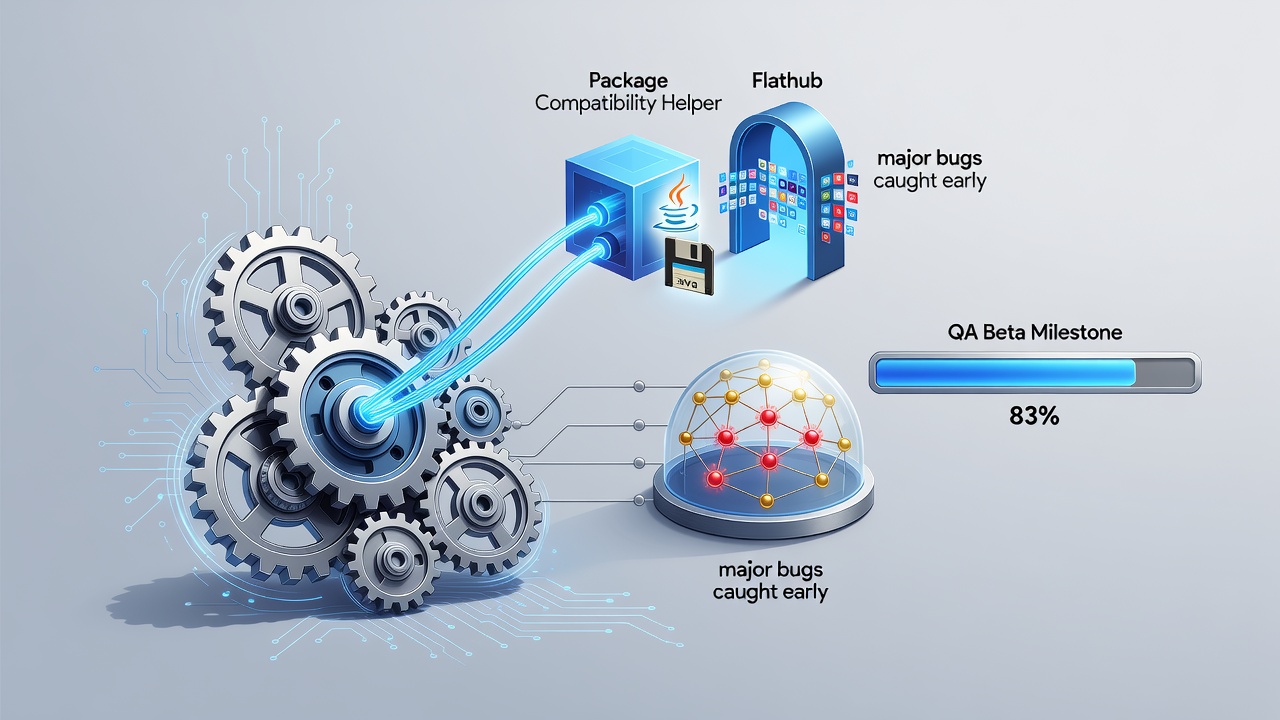
The most visible user-facing change is an upgrade to the Package Compatibility Helper. Hadi Chokr extended it so that, with the user’s consent, it downloads software from Flathub to open files nothing on the system can handle. Launching a Java app for the first time now offers to install a Java Runtime Environment, and launching a DOS program offers DOSBox, which the report pitched as “that authentic 1993 Doom experience.” The code is generic enough to work on other image-based systems that use Flatpak, according to the post.
A test suite that already paid off
Thomas Duckworth and Bhushan Shah integrated the next-generation QA system they had been building. It doubles as a full-stack integration test suite, and it has already caught two significant regressions before they reached users: a login-breaking KWin crash caused by a gcc regression in Arch Linux, and a failure to automatically unlock the wallet at login. Both are fixed. Duckworth also wrote documentation on using and extending the system.
Several changes trim resource use. Chokr applied kernel-hardening tweaks borrowed from the SecureBlue project that the report said “wouldn’t noticeably burden users.” Graham removed kernel modules for hardware watchdogs that desktops don’t need, which slightly lowers CPU usage and improves boot times, and Duckworth switched CUPS printing to socket activation so its services run only when needed.
Fixes and smaller changes
Philip Grant repaired the mechanism that keeps existing installs in line with the Flatpaks preloaded on new images. David Fundament fixed the script that disables USB auto-suspend for input devices without a product name. WenChao Zhang restored the esp4 and esp6 kernel modules, which had been removed to mitigate the DirtyFrag vulnerability and whose absence broke IPsec VPNs. Chokr also made WWAN modems work out of the box.
Prajna Sariputra preinstalled vulkan-virtio for better performance in VMs whose graphics drivers support Vulkan. Graham pulled the Push Services library and its System Settings page because it isn’t ready to ship, and documented how to get Fcitx 5 input for CJKV languages working in XWayland apps. Chokr documented dual-boot bootloader menus, though the installer doesn’t yet support complex disk setups.
The project says it is 83% of the way to its beta milestone and is asking for help with user support on discuss.kde.org, bug reports, documentation, Flatpak packaging and OS development.


 WebProNews is an iEntry Publication