
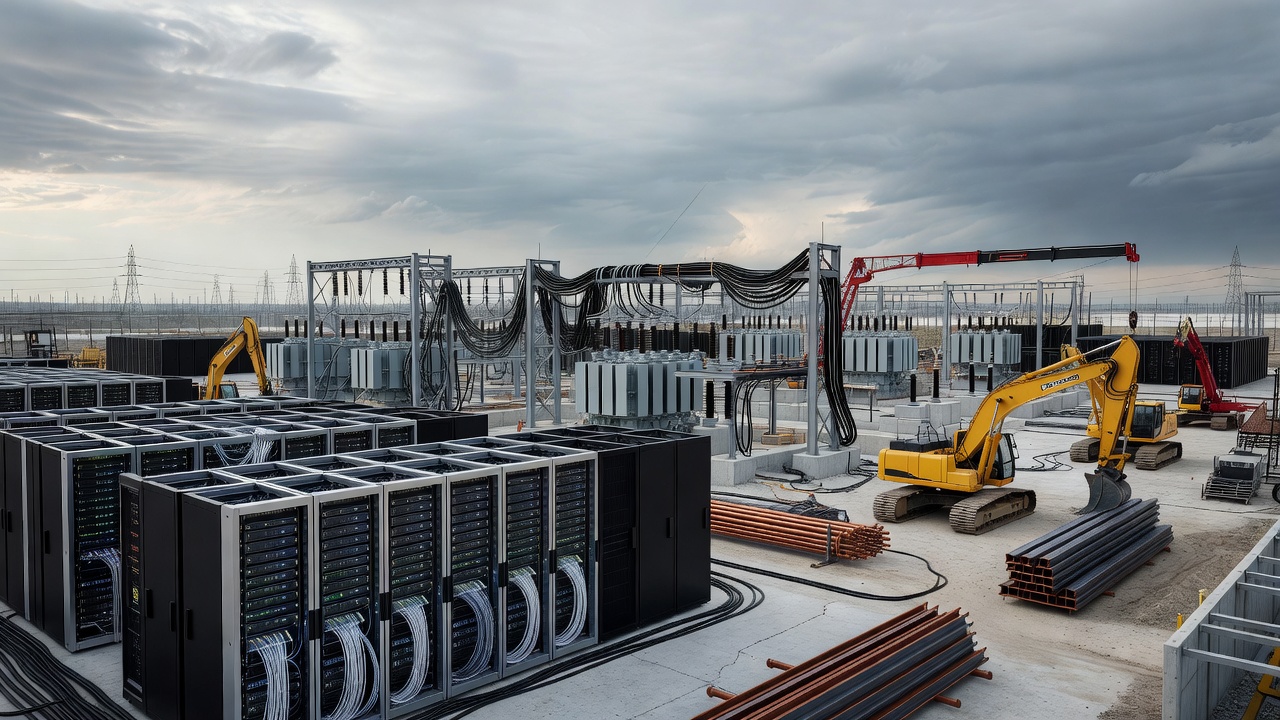
Nvidia CEO Jensen Huang has a message for young people eyeing college degrees in computer science. Look at the pipes. Look at the wires. The AI race that his company helped ignite is about to hand six-figure paychecks to electricians, plumbers and steelworkers who can keep the servers cool and the power flowing.
“It’s wonderful that the jobs are related to trade craft,” Huang told BlackRock CEO Larry Fink at the World Economic Forum in Davos in January. “We’re going to have plumbers and electricians and construction and steelworkers and network technicians and people who install and fit out the equipment.” Business Insider captured the exchange. He called it the largest infrastructure buildout in human history. One that would create a lot of jobs.
Short. Direct. And already proving true.
The original spark came months earlier. In a conversation with Britain’s Channel 4 News in late 2025, Huang laid out the scale. “If you’re an electrician, you’re a plumber, a carpenter—we’re going to need hundreds of thousands of them to build all of these factories,” he said. “The skilled craft segment of every economy is going to see a boom. You’ve going to have to be doubling and doubling and doubling every single year.” That interview, later referenced in Fortune, shifted the conversation. AI wasn’t just code. It demanded concrete, copper and cold water loops measured in miles.
Construction spending on U.S. data centers hit $49.5 billion through April 2026. Nearly four times the year-ago pace. Average facility costs now reach $475 million. Power infrastructure starts jumped 21 percent in early 2026 and analysts expect the full year to finish more than 30 percent above 2025 levels. BuildWCG tracked the surge in a recent analysis.
But the numbers hide friction. Goldman Sachs Research forecasts U.S. data center power demand will climb from 31 gigawatts in 2025 to 41 gigawatts in 2026 and then 66 gigawatts in 2027. That doubling in two years strains an aging grid built for a different economy. Goldman Sachs warned supply chain and labor shortages remain the most common causes of delay. A typical data center still takes 18 to 24 months to build once permits clear.
Nearly half of planned 2026 AI data centers in the United States now face delays or cancellations. Power bottlenecks top the list. Equipment backlogs follow. In the Watershed reported the figure sits between 30 and 50 percent, citing Sightline Climate data. Utilities scramble to add capacity. Some reconnection wait times stretch seven years. The physical world has reasserted itself.
Huang saw this coming. In earlier remarks he noted AI models growing tenfold would require data centers to consume ten times the power. Someone has to install the transformers. Someone has to design the liquid cooling loops that prevent racks from melting. Those tasks don’t run on prompts. They run on skilled hands.
One 250,000-square-foot data center can employ up to 1,500 construction workers. Many earn over $100,000 without college degrees. Each facility worker creates another 3.5 jobs in the surrounding economy. Those figures, cited across industry reports and echoed in Observer, paint a picture of multiplier effects rarely discussed in software circles.
Data Center Knowledge put the labor ask in stark terms. The U.S. will need roughly 650,000 workers for data center construction and operations to support 2026 growth. Nearly 90 percent of contractors surveyed reported shortages in mechanical, electrical and plumbing trades. Seventy-one percent cited overall construction labor gaps. Data Center Knowledge published the survey in July.
And. The pay has already moved. Young electricians on AI projects in certain regions report total compensation between $240,000 and $280,000. Overtime, night shifts and scarcity premiums explain the jump. Traditional median wages for plumbers, pipefitters and steamfitters hovered near $63,000 recently, with construction laborers around $46,000. The gap is closing fast where data centers cluster.
Yet the boom isn’t uniform. Some states weigh moratoriums on new facilities over grid strain and water use. Others race to offer tax breaks. The winners will be those who secure power first. Huang has repeated the point: whoever builds the compute wins. Recent X discussions show the sentiment spreading. One July thread quoted Huang at length on the reindustrialization underway. “We will have a lot more construction workers, a lot more builders and makers, which is fantastic,” he said in that clip shared widely on the platform.
Mike Rowe, longtime advocate for skilled trades, welcomed the validation. After Davos he noted Huang and Fink were confirming years of warnings about labor shortages. The culture may be shifting. For decades, policy and parents pushed four-year degrees. Now headlines highlight tradespeople earning more than many mid-level coders while avoiding student debt.
But challenges remain. Training pipelines lag. Apprenticeship programs take years. Prefabrication helps speed builds yet still requires experienced oversight on site. Electrical switchgear, transformers and cooling equipment face their own shortages. The same Data Center Knowledge report flagged these constraints as capacity limits on a global scale.
Power sits at the center. Nvidia itself describes its role as a conversion machine: electrons in, tokens out. The physical plant that makes that possible consumes vast electricity. Hyperscalers including Amazon, Microsoft, Alphabet and Meta committed more than $300 billion in combined capital spending for 2025 alone. Much of it targets data centers. Goldman Sachs noted the wave is accelerating despite the delays.
So the jobs Huang describes aren’t abstract. They involve welding pipe for chilled water systems that remove server heat. Pulling thousands of miles of fiber and power cable. Installing redundant backup generators the size of trucks. Testing cooling loops that must never fail. These tasks demand judgment, presence and accountability that current AI systems cannot replicate.
History offers parallels. Productivity gains from past technologies eliminated some roles but created others. Huang has referenced the washing machine replacing laundromat work yet spawning an entire consumer appliance industry. He expects a similar pattern. Some jobs will change. Many more will appear.
Recent coverage reinforces the trend. Yahoo Finance in January summarized Huang’s prediction of huge increases in six-figure construction jobs tied directly to AI factories. The piece noted the shift toward physical infrastructure over pure software plays.
Construction firms already feel the pull. Bids on data center projects come in higher and slower because qualified crews stay booked. Union halls report record demand for electricians. Vocational schools see enrollment ticks upward after years of decline. The rebalancing has begun.
Still, 650,000 needed workers won’t appear overnight. Community colleges, trade unions and private training providers must expand capacity. Companies may sponsor apprenticeships tied to specific projects. Governments could streamline permitting without sacrificing safety. The alternative is slower AI progress and missed economic gains.
Huang’s comments carry weight because Nvidia sits at the heart of the boom. Its GPUs power the models driving demand for ever-larger data centers. When the company’s leader says trades will boom, hyperscalers listen. So do investors. BlackRock’s Fink appeared alongside him in Davos for a reason. Capital allocation now includes serious bets on the physical backbone.
The irony doesn’t escape observers. After years of headlines about AI destroying white-collar jobs, the technology’s biggest immediate impact may be creating high-paying blue-collar opportunities. Plumbers who understand data center fluid dynamics. Electricians fluent in high-voltage substation integration. Welders who can meet seismic and thermal specifications. These specialists become scarce and therefore valuable.
Markets have responded. Shares of companies tied to electrical infrastructure, cooling systems and industrial construction have climbed with the forecasts. Utility capital expenditure plans now reflect the largest cycle since postwar electrification. The buildout is redefining growth for the entire sector.
Of course risks persist. If power shortages cancel too many projects, the job surge could moderate. Inflation in construction inputs could erode margins. Regulatory pushback over environmental impact might slow timelines further. Yet the underlying demand for intelligence shows no sign of easing. Models keep growing. Use cases multiply. The compute must be housed somewhere.
Huang keeps returning to the same theme. This isn’t temporary. It’s structural. The skilled craft segment must double and double again. Hundreds of thousands of positions. Six-figure salaries in many cases. A cultural return to makers and builders.
Young people paying attention have options. Four years of coding bootcamps or four years of apprenticeship. Both can lead to strong careers. One now carries less debt and, in the right locations, comparable or better pay. The AI era may finally deliver the respect for trades that advocates like Rowe have sought for decades.
The servers keep multiplying. The heat keeps rising. And someone has to keep them running. That someone is increasingly likely to carry a union card, a set of tools and a six-figure W-2.


 WebProNews is an iEntry Publication