
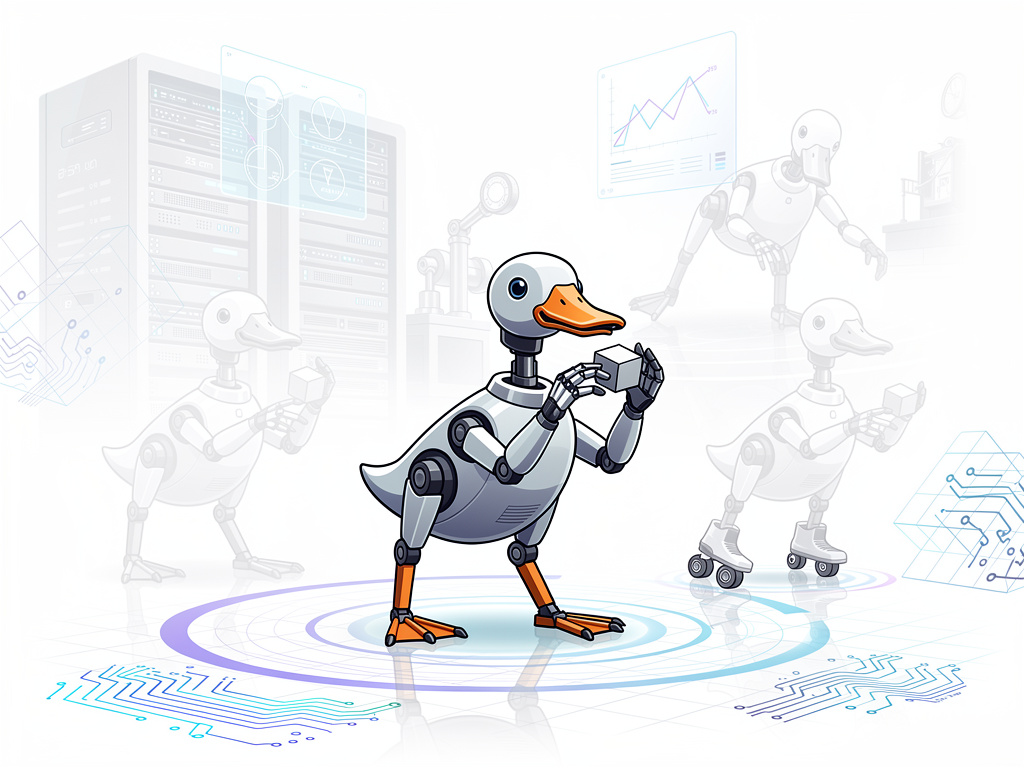

Hugging Face has unveiled Microduck, a $399 open-source robot shaped like a duck that’s built for people who want to experiment with reinforcement learning, TechCrunch reported. It’s available for pre-order and is due to ship before Christmas.
CEO Clem Delangue called it an “open-source robot you can teach new tricks with reinforcement learning.” The 25-centimeter-tall duck can waddle, pick things up with its beak, get back up after a fall, crouch and even roller skate. It perceives its surroundings with a camera, lidar sensors and two inertial measurement units.
Train in simulation, deploy on the robot
The selling point for developers is the workflow. According to Pollen Robotics, Microduck’s behaviors can be trained in simulation and deployed directly to the robot, then fine-tuned, retrained and redeployed. The SDK, the simulation environment and the full RL training stack are on GitHub. That makes it a relatively cheap way to try sim-to-real robot learning, which usually requires far more expensive hardware.
Microduck is the second robot from the Hugging Face and Pollen Robotics partnership. Hugging Face acquired the French startup in April 2025, and a couple of months later the two launched Reachy Mini, a desktop robot that now sells for $499 with a Raspberry Pi or $399 in a Lite version powered by a Mac or PC. “Welcome to the era of open-source affordable robots to democratize physical AI and world models!” Delangue wrote.
Privacy depends on the apps
Delangue has argued that robots running open models are better for privacy than black-box systems controlled by a few companies. Open source gives developers the ability to audit and control the robot, but TechCrunch noted that it doesn’t guarantee privacy once people install apps on top. Those apps can access the camera and microphones and, depending on how they’re built, send data to outside services. Anyone putting a Microduck in a home or office should check what each app does with that data.


 WebProNews is an iEntry Publication