
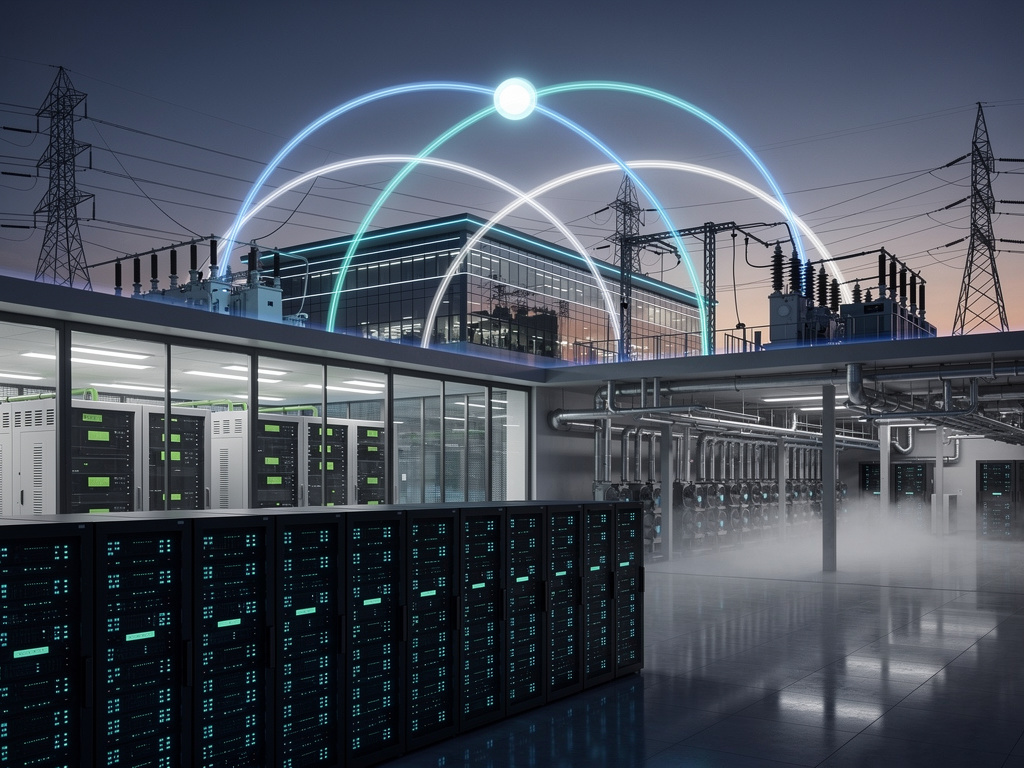

Huawei wants AI data centers to stop behaving like passive loads on the power grid and start helping hold it up. The company unveiled what it calls a grid-interactive AI data center (AIDC) solution at the Green Energy Development Conference in Shenzhen this week, pitching integrated power, storage and cooling built to keep output high per watt.
“Electricity is essential for computing. Today, in the AI era, the startup, shutdown, and load fluctuations of a large AIDC campus can all impact grid operations,” Zhou Jianjun, a Huawei vice president who runs global marketing, sales and services at Huawei Digital Power, said in the company’s announcement. He added that as renewables take a bigger share, local grid strength is falling and volatility is rising, so future campuses have to ride out grid swings and support the grid rather than just draw from it.
The hardware behind the pitch
Huawei describes the plan as “3+1”: three technical domains (electricity, digital operations and heat) plus a shift to prefabricated, modular construction. On the power side it centers on grid-forming control and energy storage, plus an energy router built on solid-state transformer technology. Huawei says it is the first vendor to pass a wideband oscillation damping test at the Shanghai Electrical Apparatus Research Institute.
According to The Next Web, the products shown alongside it included the Taishan UPS, which Huawei calls the first megawatt-class single-cabinet UPS, delivering 1,280 kVA at up to 98% dual-conversion efficiency, and a software-defined DC UPS that supports 270V, 400V and 800V systems on one platform. Huawei says its PowerPOD 5.0 cuts footprint by 40% and shortens lead time from seven days to three.
On cooling, Huawei is moving from coolant distribution units to a thermal management unit that uses AI to spot micro leaks, predict the health of the working fluid and adjust cooling as compute load changes. The unit is natively compatible with Huawei’s Ascend servers, which is the case for buying the whole stack instead of parts.
Tokens per watt instead of PUE
Data center efficiency has long been judged by power usage effectiveness, which compares total facility power with the power that reaches IT equipment but says nothing about useful output. Huawei and its customers are promoting tokens per watt instead. Lin Hai, who runs SenseTime’s intelligent computing center business, said SenseTime has improved its tokens-per-watt figure by 80% through optimization from power plants and grids up through racks, cloud services and models, The Next Web reported.
Huawei isn’t alone in trying to make AI campuses flexible. Google and Nvidia launched an energy management alliance the same week, The Next Web noted, though their approach asks operators to flex demand, while Huawei is selling inverters, storage, cooling and chips as one system. In Europe, where grid connection queues already limit data center buildout, that integration may be a harder sell, given the ongoing debate over Huawei gear in telecom networks.


 WebProNews is an iEntry Publication