
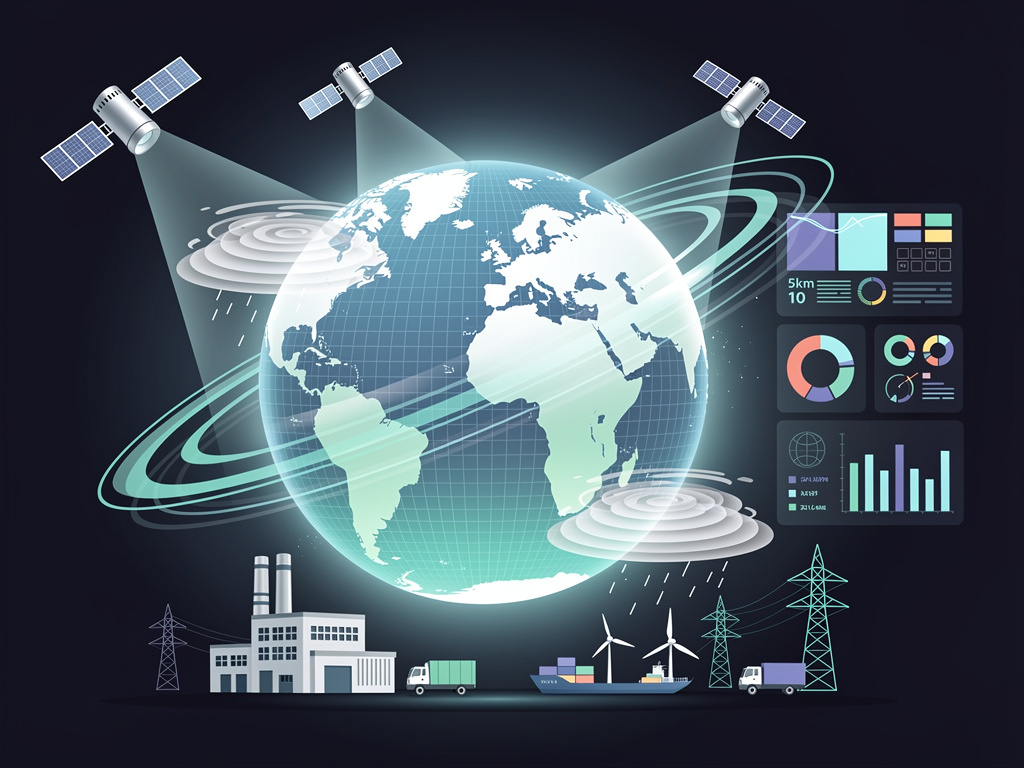

Google DeepMind and Google Research released WeatherNext 3 on Thursday, a weather model that feeds live geostationary satellite data into its forecasts and produces a new one every hour. Google calls it its most accurate global weather model yet, citing independent live evaluations by Brightband.
The resolution jump is large. According to Google’s announcement, key surface variables such as temperature and moisture come at 5-kilometer resolution, other surface variables at 10 kilometers and atmospheric variables like wind speed at 25 kilometers. Google says that makes the picture roughly five times sharper than WeatherNext 2, which produced forecasts on a 25-kilometer grid in six-hour increments.
Training on observations, not simulations
The bigger change is the training data. Most AI weather models, including WeatherNext 2, learn from the output of numerical weather prediction models, physics simulations that carry a six-hour data lag. Google says that lag can bias forecasts of fast-changing variables like rain and surface temperature. WeatherNext 3 instead ingests one-hour satellite mosaics alongside historical analysis, and it trains directly on sparse weather station observations to resolve local detail near coastlines, valleys and mountains.
The model runs on a single Functional Generative Network mesh transformer that outputs gridded fields, cyclone tracks and station-level predictions.
For rain and snow, Google trained the model on NASA’s Integrated Multi-satellite Retrievals for GPM (IMERG) and its own satellite-radar precipitation reanalysis. In medium-range global forecasts, Google reports a Continuous Ranked Probability Score improvement of up to 60% against IMERG, 30% against MRMS and 10% against rain gauges at early lead times. For people planning a day or more ahead, it says precipitation forecasts will be up to 50% more accurate, with the biggest gains where forecasts have historically been least reliable, Android Authority reported.
Where it shows up
The model also adds forecasts aimed at renewable energy: 100-meter wind speeds, roughly turbine height, plus high-resolution cloud cover and solar radiation for solar farms, Engadget noted. Google says the higher resolution matters most in parts of Latin America, Africa and Asia-Pacific that have lacked high-resolution regional models because of their supercomputing cost.
WeatherNext 3 starts powering weather in Google Search, the Gemini app, Google Maps, the Google Maps Platform Weather API and Google Earth Engine right away. Researchers and businesses can query the hourly forecast data in BigQuery and Earth Engine or download it in bulk from Google Cloud Storage, and anyone can try the model in Google’s Weather Lab.


 WebProNews is an iEntry Publication