
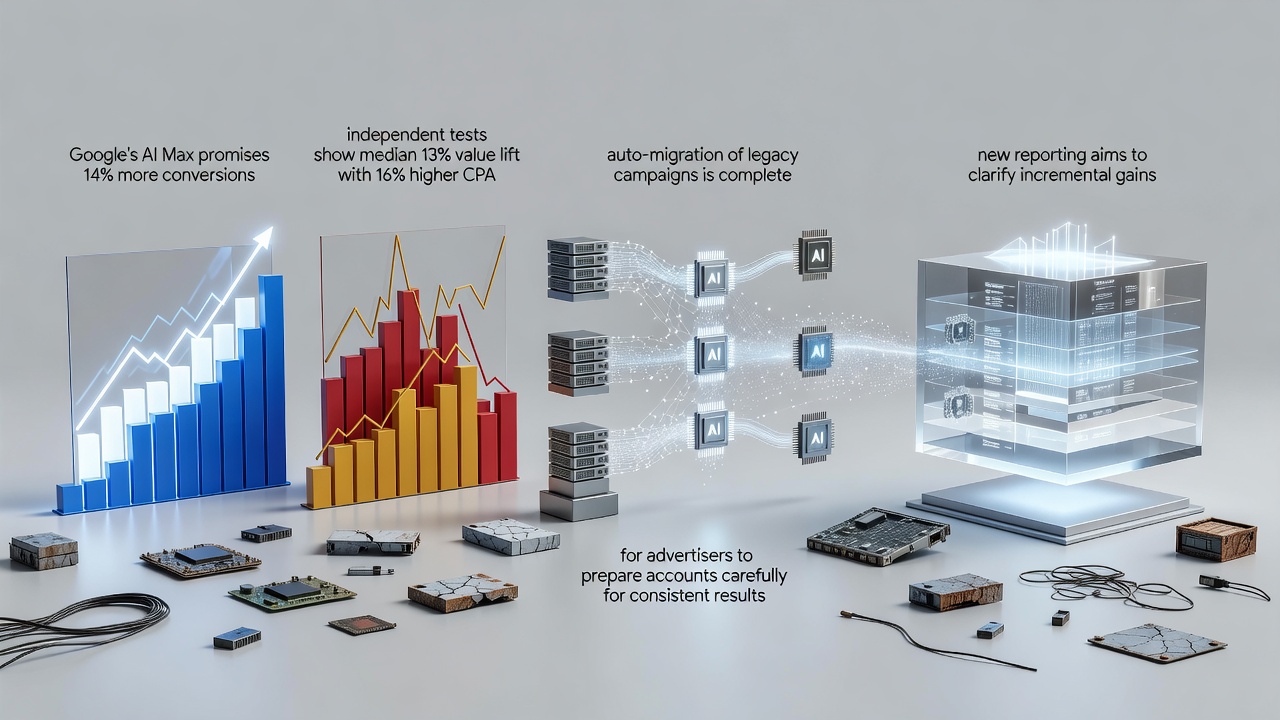

Google is giving advertisers more ways to steer and audit AI Max, its AI layer for Search campaigns, just as older Search campaigns are being switched over to it automatically.
In a short post on Wednesday, Google said it is opening the closed beta of AI Brief, which lets advertisers describe their business, audience and key messages in their own words, to Dutch, French, German, Italian, Japanese, Portuguese and Spanish. It is also adding a Google Ads report that puts the whole Search ad journey in one place: the search term that triggered an ad, the creative assets the user saw and the page where they landed. Google said it will share more details and availability later this year.
The switch-over
The update lands in the middle of a forced transition. Throughout September, Google is converting every Search campaign that still uses the campaign-level broad match setting or legacy automatically created assets into AI Max, according to a detailed review by Choice OMG. Advertisers lost the ability to set up those legacy options on Aug. 3, and Sept. 1 was the deadline to keep a campaign from being mapped over, though AI Max settings can still be changed after the conversion. Dynamic Search Ads are next, with automatic migration scheduled for February 2027.
What the numbers say
When it launched AI Max in May 2025, Google said advertisers that turned it on would “typically see 14% more conversions or conversion value at a similar CPA/ROAS,” and 27% for campaigns still relying mostly on exact and phrase keywords. Those figures came from internal, non-retail data. Google’s current claim is smaller: 7% more conversions or conversion value for the full suite compared with search term matching alone.
Outside measurements are mixed. Smarter Ecommerce found a median 13% increase in conversion value across more than 250 retail campaigns, with a median change in return on ad spend of zero. Lunio measured invalid-traffic rates on AI Max rising from 2.46% to 5.28% over nine months, while standard Search ended at 3.07%. Choice OMG noted that Google discloses no account count or randomization method behind its own benchmarks.
That’s the gap the new report is meant to close. Advertisers who want to know whether AI Max is finding new customers or just re-buying traffic their keywords already caught will be able to trace each conversion back through the term, the ad and the landing page. Google hasn’t said when the report will reach all accounts.


 WebProNews is an iEntry Publication