

An attacker left a staging server open to the internet, and it gave Google a look at the thing security teams have been bracing for: software that reads a vendor’s security patch, works out what flaw it fixes, writes an exploit and runs it without a person stepping in.
Google Threat Intelligence Group described the framework, which it calls exploit_agent, in the quarterly AI Threat Tracker it released Monday. “In the past quarter, GTIG identified threat actors using LLM frameworks to fully automate vulnerability discovery and exploitation without a human in the loop for the first time,” the report said.
The system plugs into several frontier and locally run language models. It continuously compares popular web application code before and after patch announcements, flags likely vulnerabilities, drafts exploits and executes them. Stolen victim data sat on the same server, next to scripts for internal reconnaissance, brute-forcing and installing webshells, and for removing webshells left behind by other attackers.
Victim telemetry pointed to French websites in media, entertainment and education.
The comments in its configuration file are in Russian. In Google’s translation, one labels the API keys “for auto-exploitation (exploit_agent pilot)” and another tells whoever sets it up: “Enter the keys yourself — right here, not in the chat.”
Patches now come with a shorter fuse
For IT teams, the problem is timing. Diffing a patch to find the bug underneath has long been a specialist’s job. GTIG says attackers may find it more efficient to point language models at flaws that were just fixed than to hunt for zero-days, because the material is finite: two versions of the code, the release notes and any published proof-of-concept code.
PaperCut is the case Google cites. Attackers exploited two flaws in its print management servers, CVE-2026-81578 and CVE-2026-82078, as zero-days in late August. Researchers and the security firm Huntress used LLMs to build working exploits within a day of disclosure. GreyNoise later reported a campaign, four days after disclosure, in which an attacker likely used LLMs to build exploits and hit hundreds of organizations. That attacker went from an initial foothold to domain administrator within minutes, GreyNoise found.
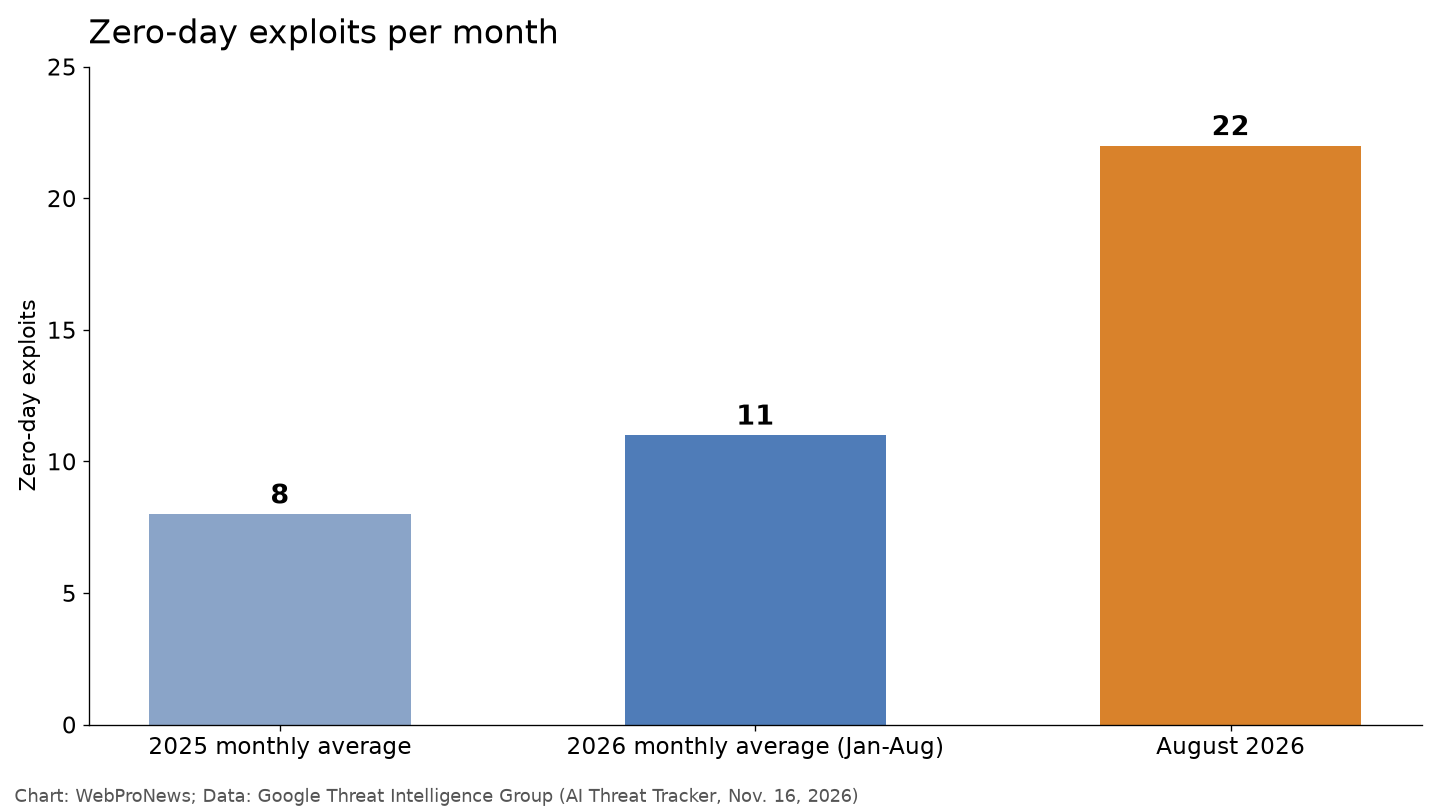
Overall vulnerability disclosures and exploits nearly doubled between January and August, by GTIG’s count. Zero-days rose more slowly, then jumped in August.
PHP shipped fixes for CVE-2026-109618 and CVE-2026-109619 on Oct. 21. Within days, hundreds of claimed proof-of-concept exploits appeared, which Google says didn’t work and were likely written with LLM help. Defenders still had to verify or debunk each one.
Faster attacks, but noisier ones
The exploit_agent find is the sharpest example in a report that tracks attackers moving from typing prompts to running open-source, multi-agent pentesting frameworks. Besides ARTEX, the tool the FBI flagged in a FLASH alert last week, GTIG has seen CAIRN and PentAGI used in the wild. CAIRN turned up in intrusions against targets that included the U.S. aerospace sector.
Those frameworks “currently trade stealth for velocity,” GTIG wrote. They leave forensic traffic, recognizable identifiers and code-level traces that raise the odds of detection. Google Security Operations has added rulepacks that detect ARTEX, and Mandiant has published a hardening guide built around the speed of LLM-driven attacks.
The report also updates Google’s tracking of LLMJacking, the theft of cloud AI credentials that WebProNews covered alongside the Fireworks AI breach earlier this month. Underground resellers price stolen model access at $0.10 to $25 per million tokens, GTIG found.
A timeline in the report projects that multi-agent attacks with “little to no human interaction,” though still unsophisticated, are one to three months away. “Sophisticated, fully-autonomous/agentic attacks” are three to six months out, it says.


 WebProNews is an iEntry Publication