
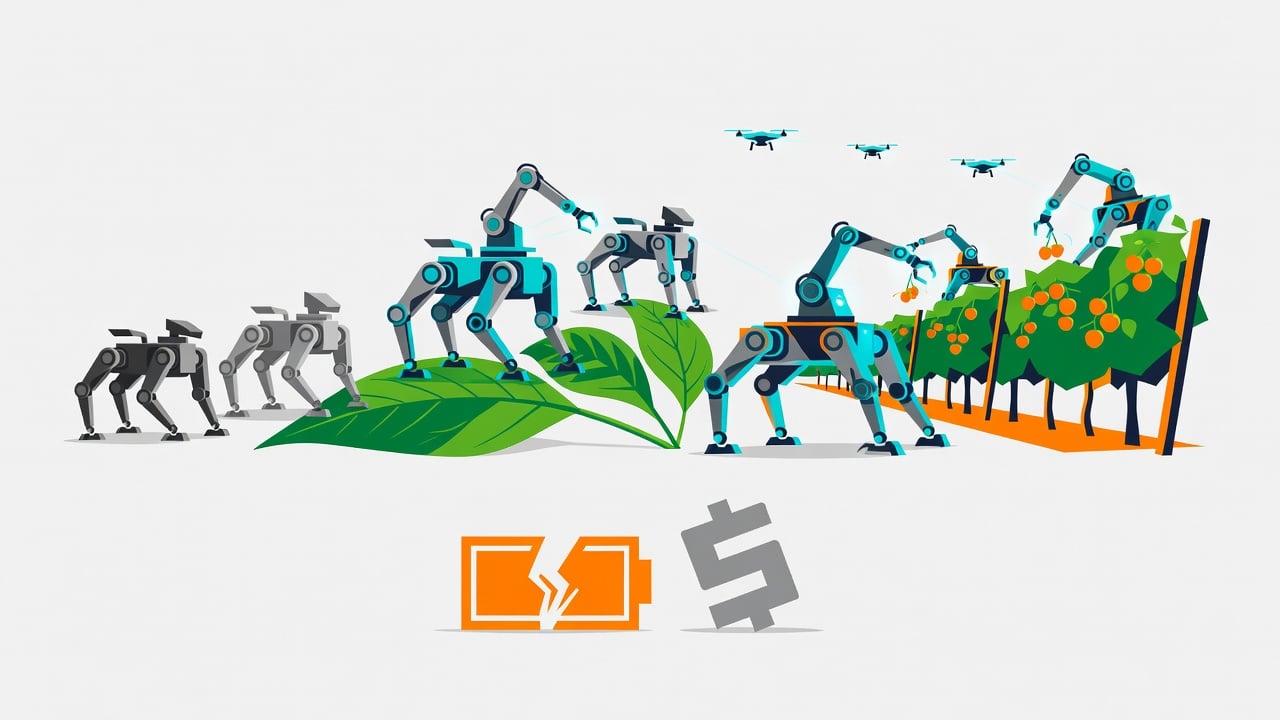

Four-legged robots first showed up on farms as night guards, using thermal cameras to watch seed fields and equipment yards. They still do that work, but the same machines are now walking between crop rows to photograph individual leaves.
American growers have begun deploying the robots to protect high-value crops, where thermal sensing and electro-optical cameras detect threats, record incidents and alert staff in real time, Engadget reported. Some developers think the bigger payoff lies outside security. Satellites and drones give the wide view, manual inspections are slow and labor-intensive, drones are impractical in greenhouses, and wheeled machines can’t cross uneven ground without damaging plants. What farmers lack is close, repeatable imagery from ground level.
Syngenta’s robodog
Syngenta, working with the University of Nottingham, fitted a quadruped with high-resolution cameras, spinning LIDAR and an onboard GPU that runs computer vision models on the machine itself. The company calls it robodog. It can detect weeds, flag possible disease and help find pests, and its battery lasts up to four hours. “Plants speak to us in the language of light and robodogs are ideally placed to see these messages to allow us to act upon them,” Rob Lind, Syngenta’s fellow for computer vision and AI, said in a company article.
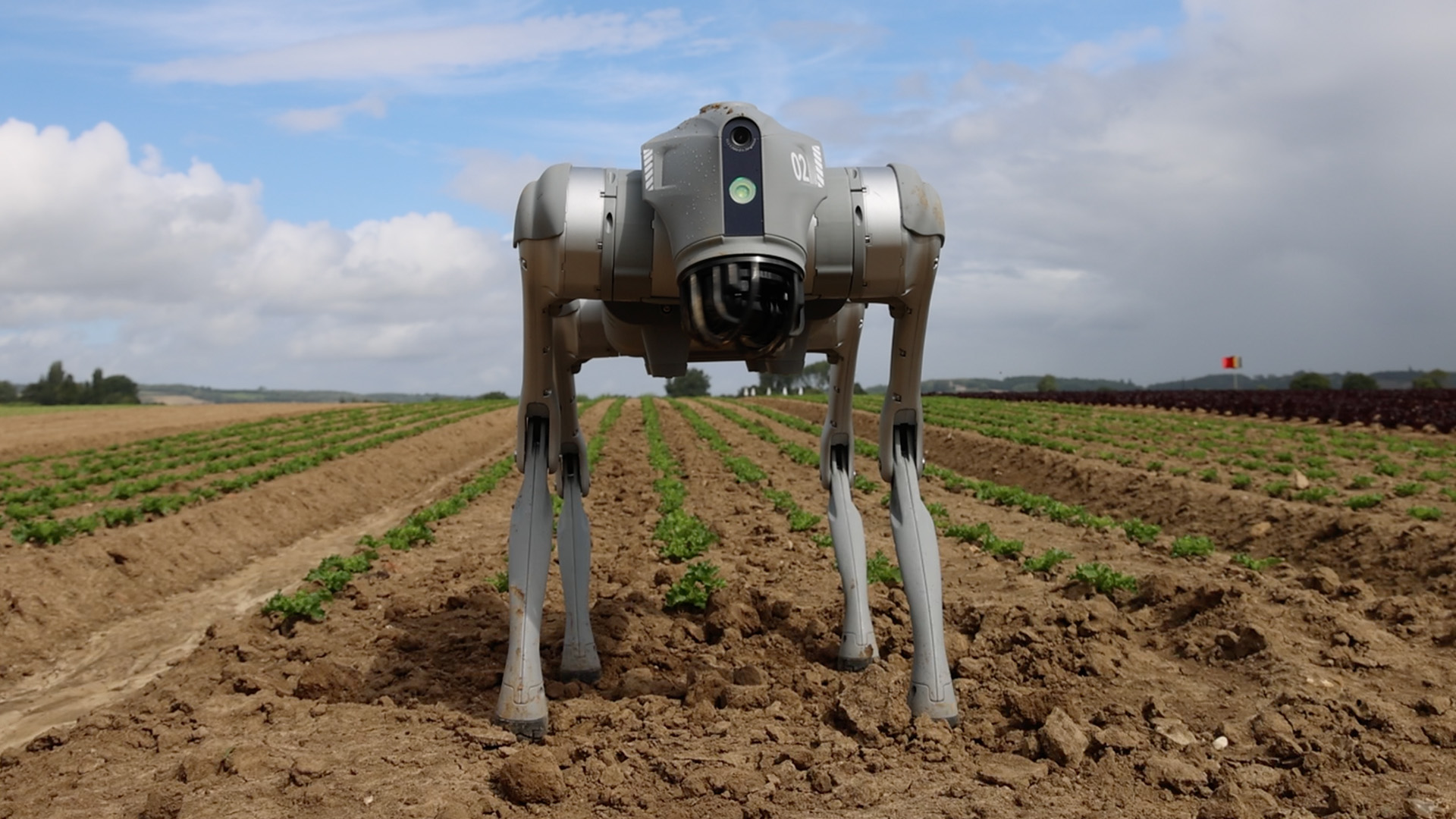
“There’s a gap, as it were, for an extra imaging platform in the field, or in the greenhouse,” Lind said. “There’s already satellites, there’s drones, there’s phones. So, it’s basically integrating the dog into this matrix of imaging platforms.” At Cereals 2026 in June, he told Farmers Weekly the robots were already working Syngenta trial sites, doing plant and head counts and monitoring crop health, and that he sees agronomists using them as field scouts the way they use drones now. The base platforms start at about £3,000 before sensors are added and weigh about 15 kg, so they do little damage to the field, according to the Irish Farmers Journal. Robodog isn’t on the market yet.
Hauling grapes in Turpan
China has put a similar form factor to harder work. DEEP Robotics deployed its Lynx M20S wheeled-legged robots in vineyards in Turpan, where ground temperatures regularly top 50°C during the August harvest. The machines don’t pick grapes. They carry baskets from the rows to collection points, move irrigation tubing and relay field data, cutting manual carrying work by more than 70%, according to Global Agriculture. Each unit carries up to 35 kg and can get through passages as narrow as 50 cm without turning around. Because picked grapes dehydrate quickly in that heat, getting them to the packing point sooner protects quality, and pickers can stay on the fruit.
Security is still a business
Asylon Robotics sells its DroneDog as a service rather than a purchase. Bayer has used the units for about two years to guard seed corn fields and equipment in Hawaii and California against thieves, vandals, feral hogs, deer, flooding and wildfire, AgWeb reported. At one 387-acre Bayer site, the robot takes the graveyard shift and can work 16-hour days. “It’s not a replacement; I look at it as a supplementation. It’s a force multiplier for our teams,” said Matthew Paschoal, Bayer’s corporate security lead for the western U.S. and Pacific. The National Equipment Register puts heavy-equipment theft at $300 million to $1 billion a year, and the American Farm Bureau Federation says feral hogs can cost agriculture $1.6 billion a year. The robots handle “the dull, dangerous, dirty tasks that humans don’t like to do and don’t do as well when they get mundane and repetitive,” said Dennis Crowley, Asylon’s chief growth officer.
Cheaper university builds
At North Carolina A&T, three professors are programming robot dogs to find weeds, insects and plant diseases, CAES News reported. Harmandeep Sharma is using two of them, along with drone imagery, to compile the first comprehensive weed-image dataset in North Carolina; weeds account for more than 45% of global crop losses, she said. One dog can be fitted with a mechanical arm to pull the weeds it identifies. Hannah Talton’s dog inspects tomatoes for blight and insect damage, so farmers can spot-spray only where problems appear. The A&T dogs cost about $4,000, weigh about 35 pounds and run about two hours per charge. “It’s technology that’s in reach financially for the farmers that we serve,” said Mark Light, a 4-H STEM Extension specialist, adding that the robots may eventually join Cooperative Extension’s equipment rental program.
At the University of Minnesota, Ce Yang’s Agricultural Robotics Lab built a quadruped called OmniAgrobot for crop phenotyping, choosing legs because a wheeled robot would get stuck in parts of an uneven field. In Spain, the agri-food technology center CTAEX is testing its AGRHOUND robot dog in vineyards and blackberry plantings. Robot dogs have also been used to clean public beaches in Italy and to hunt invasive fire ants in China, according to Engadget.
Limits
Batteries still run down in hours, and the vision models have to be trained for each weed, disease and crop. Engadget noted it’s unclear whether a potential FCC ban on similar imaging technology in drones could affect the LIDAR on these quadrupeds. Lind compares the moment to the early days of drones. “Give it five to 10 years, and it’ll probably be unrecognizable,” he said.


 WebProNews is an iEntry Publication