


The Federal Aviation Administration is extending an AI planning system built by the startup Air Space Intelligence to the airspace of all 22 of its en route centers. The system is part of a 12-year, $875 million bet that software can spot congestion and steer flights around it before they leave the gate.
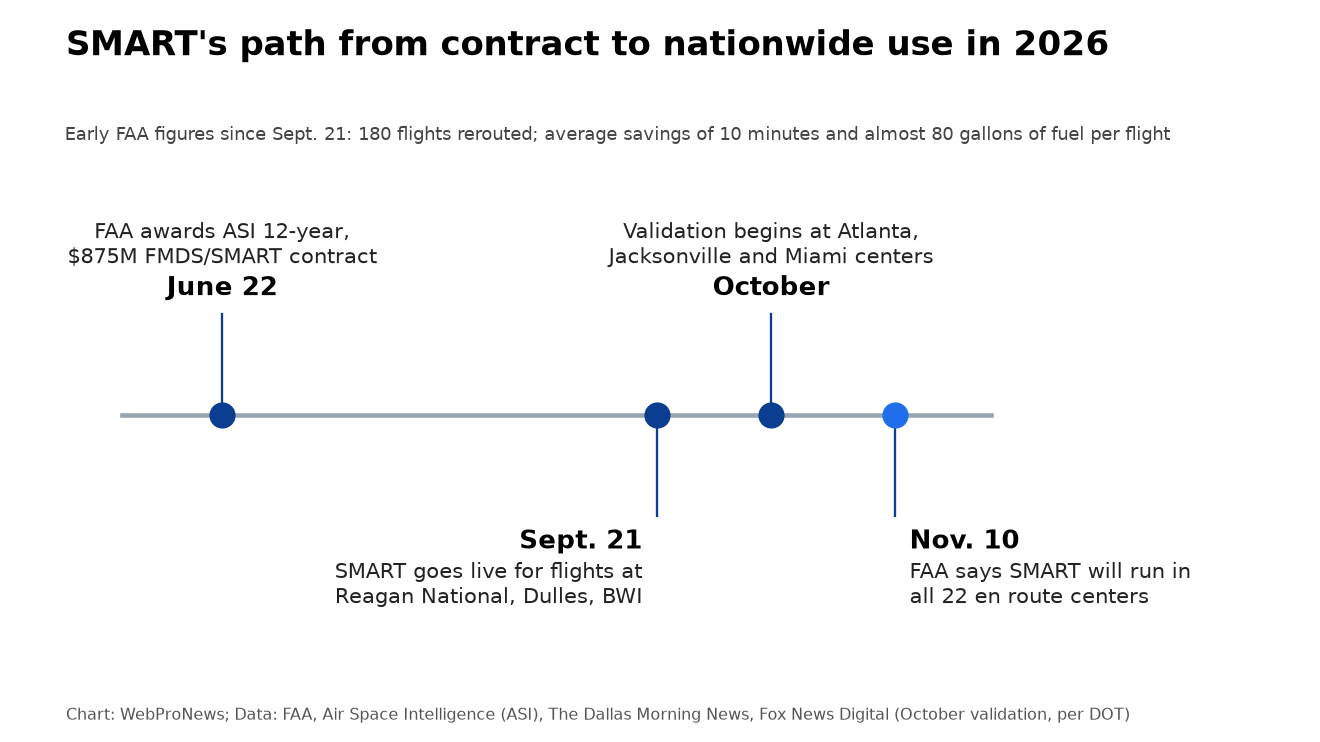
The FAA said Tuesday that SMART, short for Strategic Management of Airspace, Routes and Trajectories, would expand from the Washington region to the airspace of all 22 centers “to reduce delays, reduce fuel consumption and improve the travel experience for the flying public.” That came seven weeks after the tool went live on Sept. 21 for flights at Reagan National, Dulles and Baltimore/Washington. What started as a regional trial is set to become a planning layer for the entire national airspace system.
The early numbers are the agency’s own. Since Sept. 21, the FAA said, SMART helped reroute 180 flights and saved an average of 10 minutes and almost 80 gallons of fuel per flight. The Transportation Department gave The Dallas Morning News one example, a cargo flight from Tampa that reached Dallas-Fort Worth 12 minutes early on a shorter route SMART suggested. The paper noted that the department didn’t say when the flight happened or how often the tool had helped passenger traffic there.
A planner, not a controller
The FAA describes SMART as a cloud-based system that centralizes 200 data streams, including weather, flight paths, traffic flow and controller staffing, into one platform. Its fact sheet says the system uses AI to “predict traffic flows and identify potential conflicts before they occur.” People stay in the loop at each step. Specialists at a SMART center in Washington check the output and pass scheduling recommendations to the agency’s command center in Warrenton, Va., which sends them to local facilities. Leaders there can take the advice or pass on it. When the system launched, the agency said in a September release that SMART “cannot be used to replace the critical role air traffic controllers play or take over control of an aircraft.”
The contractor is Air Space Intelligence, which goes by ASI. It won the work in June, and the deal covers SMART and the Flow Management Data and Services platform, which the FAA calls the future technological backbone of the traffic flow management systems that run its command center. NPR described ASI as a relatively small company that had built AI-assisted dispatch software for Alaska Airlines and other carriers. ASI says the government isn’t paying for a product built from scratch. “We have invested nearly $100 million of our own resources to develop a platform that is operational today,” Bernard Asare, ASI’s president of civil aviation, said when the award was announced. ASI said then that the two systems would be deployed over the next 12 to 24 months. The FAA began validating SMART at its Atlanta, Jacksonville and Miami centers in October, according to Fox News Digital, and announced the nationwide expansion less than five months after the award.
Airlines backed the program from the start. “If it works as we think it can, it will do more to reduce delays and cancellations than anything that’s happened in decades,” United Airlines CEO Scott Kirby said in the FAA’s September release. American Airlines CEO Robert Isom was more measured in the same document, saying programs like SMART will help travelers “when done thoughtfully and methodically.”
The open questions
Air traffic controllers had less say in the system. The National Air Traffic Controllers Association, which has more than 15,000 members, told Flying magazine it was not involved in the “design, testing, or implementation of SMART and therefore cannot speak to its effect on the air traffic control workforce,” Ars Technica reported. More than two dozen lawmakers asked the FAA in October to pause the Washington-area rollout and explain how it had tested SMART for safety and trained staff to use it. The agency’s Tuesday update didn’t address those questions, AeroTime noted.
The system got more attention Friday, when a communications failure at en route centers led to a nationwide ground stop. ASI said on X that the stop “is not based on or a result of the SMART system, any product of ASI or our integration with FAA and ATC.” The FAA’s hardware is also being replaced on a separate track, down to the floppy drives some facilities still use.
The FAA’s fact sheet sets a blunt target for the software: “zero delays at the start of the day.” So far the public record is the FAA’s count of 180 rerouted flights since Sept. 21. The first results from all 22 centers will show whether an AI planning layer can deliver at national scale what airline CEOs were promised in September.


 WebProNews is an iEntry Publication