


Docker on Thursday launched Cloud Sandboxes, which run the same microVM isolation it uses for AI coding agents on a laptop on Docker-managed compute instead. A single command, sbx move my-project –to cloud, captures a sandbox’s filesystem and recreates it on the other side, and it works in both directions.
Docker Sandboxes, launched earlier this year, put each agent in a microVM with its own kernel and Docker daemon, walled off from the developer’s machine. The cloud version is aimed at long jobs. In the launch post, Docker’s Timir Karia and Srini Sekaran framed the problem as “how do I run a dozen agents at once, for five, ten, or 21 hours each, without watching any of them?”
Billing is pay-as-you-go and metered by the second. A one-vCPU Micro instance with 2 GiB of memory costs $0.07 an hour, and a 16-vCPU XL runs $1.12 an hour. Sandboxes stop after an hour by default and can run up to 24 hours per session, and a paused sandbox costs nothing.
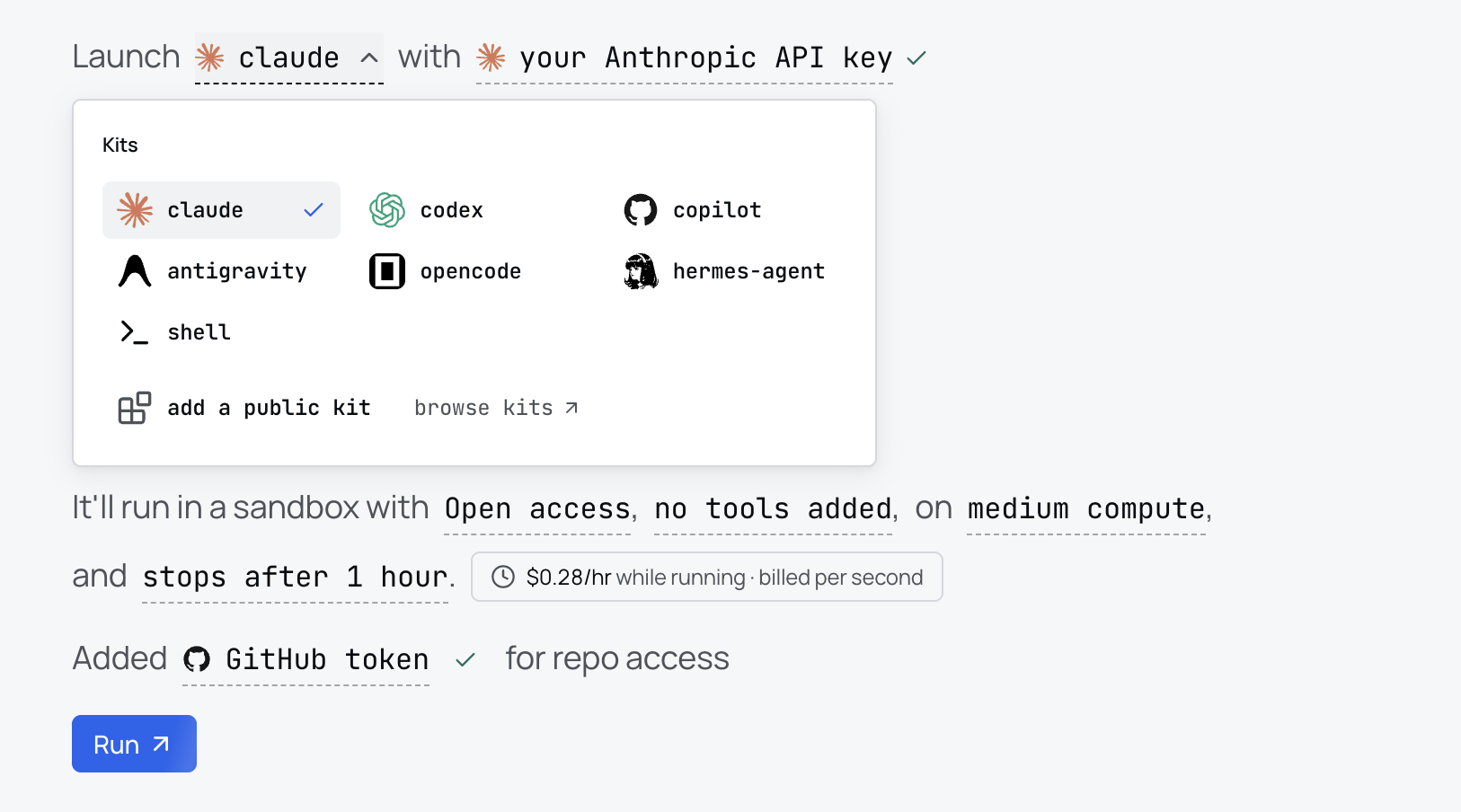
Prebuilt Kits cover Claude Code, Codex, Copilot, Antigravity, Open Code and Hermes, and sbx –cloud run codex starts one. Secrets are stored once and injected per request by a proxy, so the agent never holds the real token. “Prompt injections can’t touch secrets your agents never had in the first place,” Docker wrote. Network policies set which endpoints agents may reach; locally, Docker offers Open, Balanced and Locked Down presets.
The same day, Docker published the Docker Sandbox Kit Specification v3, open source under Apache 2.0, and said it is bringing the spec to the CNCF under neutral governance. A Kit is an ordinary OCI image that carries the agent, its tools and a typed list of the hosts, credentials and volumes it asks to reach. Because that list lives in the image, pinning the image pins the permissions too. Docker Sandboxes is the first runtime that enforces the spec.
“Agents need containment, and a sandbox is only half of it. Something still has to say which agent runs there, what it gets, and what it may touch,” wrote Christian Dupuis, who wrote the specification.
Docker said it worked with AWS, Box, Datadog, Dynatrace, JFrog, Palo Alto Networks, Snyk and others to build Kits for their tools. “The CNCF welcomes this, and we’re excited to work with Docker and the community on making it broadly adopted,” said Chris Aniszczyk, CNCF’s CTO.
Partners moved quickly. BAND announced a Kit Thursday that lets a sandboxed agent join its multi-agent rooms over an outbound WebSocket connection, and Chainloop has a Kit that records Claude Code sessions inside a sandbox as signed attestations. Others are building similar isolation; WebProNews has covered the Google-backed Capsem project and Google Cloud’s microVM plans.
Local Docker Sandboxes stay free and don’t require Docker Desktop. Cloud Sandboxes need sbx 0.45.1 or later and the pay-as-you-go plan on Docker Personal and Pro accounts, and Docker is offering new accounts $250 in credit for a limited time.


 WebProNews is an iEntry Publication