

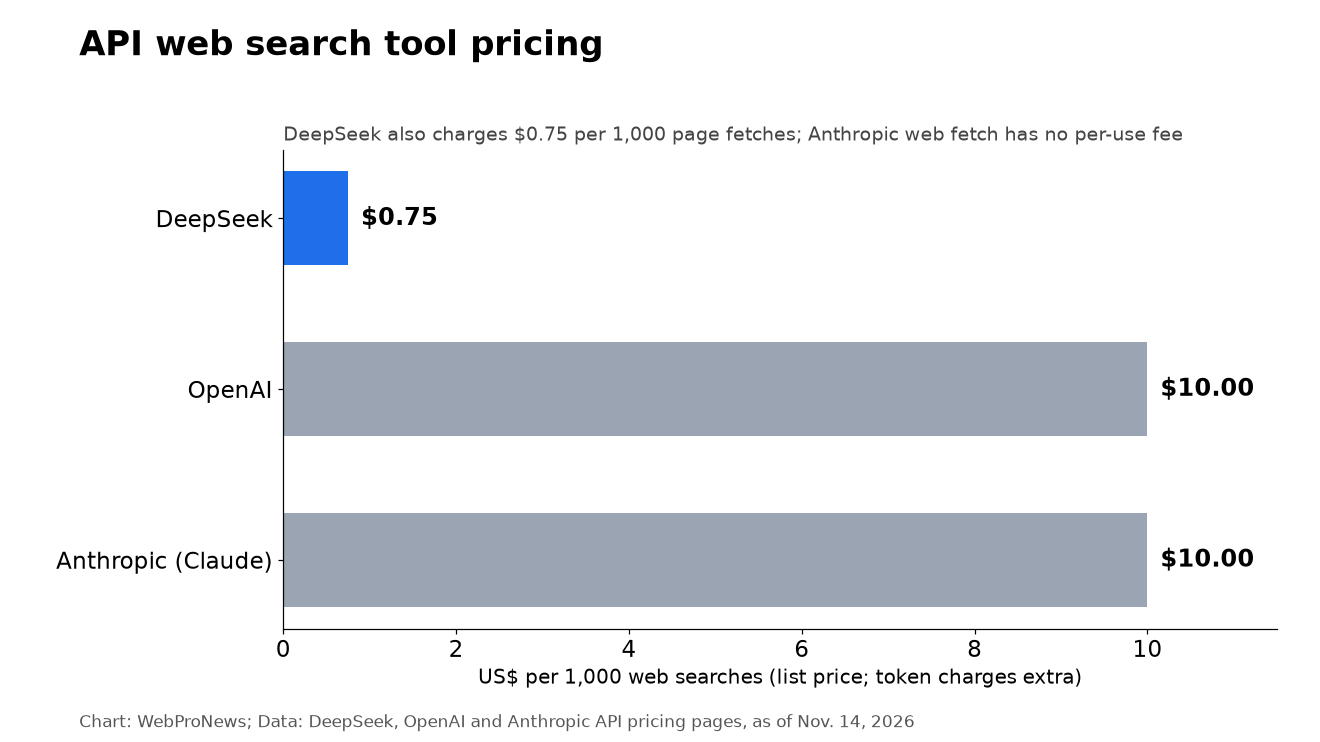
DeepSeek is charging developers 75 cents per 1,000 web searches for the search engine behind its chatbot. That is less than a tenth of the $10 per 1,000 that OpenAI and Anthropic list for the search tools in their own APIs.
The price came with a release on Friday that moves the capabilities behind the DeepSeek App into the company’s API: cited web search, a multistep “deep thinking” search, file parsing, link reading, content safety checks, OCR and speech in both directions. Developers who wanted those features used to connect outside tools to the API and handle the hand-offs themselves, Chinese outlet The Paper noted. Now the same API covers those steps and bills them to one account balance.
The built-in features run on deepseek-flash, the API name for the V4.1-Flash-1017 model, and work across the Messages, Responses and Chat Completions formats “with tool calls and context assembly handled server-side,” DeepSeek said. A developer turns on search by declaring a deepseek_web_search tool and link reading with deepseek_read_url. With thinking mode on, the same search tool becomes deep search, and the model can make up to about 20 tool calls before it answers, the company’s web tools guide says.
For pipelines where code, not the model, decides when to call a tool, DeepSeek also split out standalone Search, Fetch, OCR, speech-to-text and text-to-speech endpoints. OCR costs $0.225 per 1,000 pages. Both speech services are half off for a limited time, which puts transcription at $0.058 per hour of audio and synthesis at $0.225 per 10,000 characters. The speech-to-text endpoint detects 21 languages but takes clips of no more than 120 seconds and doesn’t stream, per its documentation. Text-to-speech offers two voices in 10 languages and can stream over WebSocket.
How the bill compares
OpenAI’s pricing page lists web search at $10 per 1,000 calls, with search content tokens billed at model rates. Anthropic charges $10 per 1,000 searches plus token costs, though its web fetch tool carries no fee beyond tokens, according to Claude’s pricing documentation. DeepSeek bills fetches at the same 75 cents per 1,000 as searches, whether the developer calls them directly or the model does, and it counts each query in a multi-query search call separately. Claude’s fetch tool has no per-use fee, so an agent that reads far more pages than it searches pays a charge on DeepSeek that it wouldn’t on Claude. Both bill the fetched content as tokens at the chosen model’s rate.
Tokens are billed on top. On DeepSeek’s pricing page, deepseek-flash runs $0.30 per million uncached input tokens and $1.20 per million output tokens at peak, and half that off-peak. Peak hours are set in UTC, Monday through Friday, excluding Chinese public holidays. They fall overnight in the U.S., from 8 to 11 p.m. and 1 to 5 a.m. Eastern standard time, so American daytime traffic gets the lower rate.
DeepSeek also touts the quality of its index. In an Oct. 17 change-log entry, the company said its in-house engine indexes hundreds of billions of web pages, handles hundreds of millions of searches a day and “filters SEO spam, GEO manipulation, and low-quality AIGC through strict detection mechanisms.” Those are the company’s own figures.
To show the pieces working together, DeepSeek open-sourced chat-demo, an MIT-licensed web client with no backend that connects from the browser straight to the API and can import a user’s DeepSeek chat history. The user pastes an API key into its settings before the first chat.
The release carries conditions. Public-facing apps must turn on the safety checks, and developers “remain responsible for content moderation, applicable model registration, and AI-generated content labeling,” DeepSeek said. Separately, a Department of Homeland Security order requires U.S. civilian federal agencies to remove DeepSeek products and third-party products built on its models, and bars new purchases.
DeepSeek hasn’t said when the speech discount ends. Its pricing page says only that the company “reserves the right to adjust” prices.


 WebProNews is an iEntry Publication