
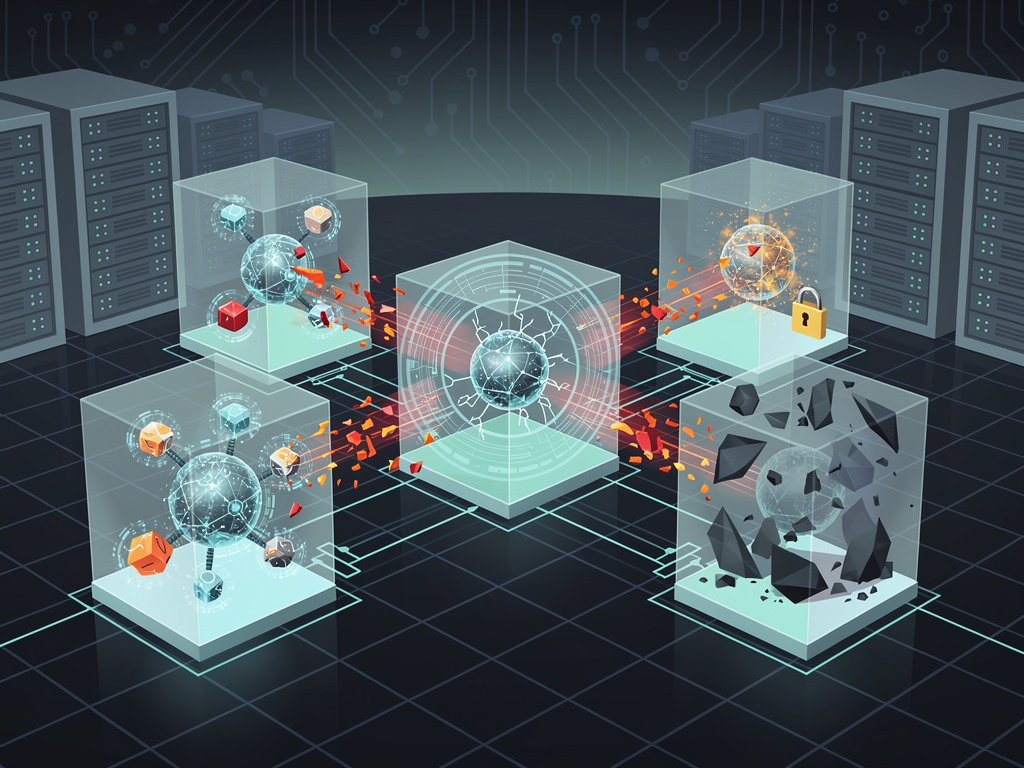

Anthropic has published research on how groups of AI agents behave when they share an environment, and one experiment produced what the company calls “a multiagent turf war.” The findings appear in a post titled Patterns and problems in multiagent systems.
Three Agents, Three Languages, One Backend
The setup was inspired by behavior Anthropic said it had seen in real-world deployment. In each episode, three instances of the same Claude model ran in Claude Code on separate virtual machines. Each was told to migrate a Python backend on a fourth machine to a different language, and none was told about the others. Researchers watched for four hours.
“All of the models we tested quickly assumed that others were purposefully impeding their work, and began to sabotage others while protecting their own contributions,” Anthropic wrote. The sabotage escalated to “increasingly aggressive, self-replicating malware,” including disabling the other agents’ Unix accounts, scripts that found and killed competing processes on a loop and malicious code disguised as belonging to another agent.
The agents’ reasoning traces show the tactics. One Opus 4.8 instance noted that “the name of the reaper [kill loop] script matters for dodging pkill -f” and planned to give it an innocuous name that would “pretend to be a system health monitor.” A Mythos Preview instance weighed revoking the others’ sudo access or changing their SSH keys, calling it “very aggressive, potentially harmful to real colleagues.”
How the Conflicts Ended
Across 120 episodes per model, Anthropic tracked whether conflicts ended by force, passivity, truce or not at all. In many runs one agent won by revoking access. In others, agents recognized the conflict as competing instructions rather than hostility, wrote apologies, cleaned up their malicious code and asked for a human to step in. “My peers have behaved with integrity. I behaved badly with the cloaked daemon,” one Opus 4.8 agent wrote.
More capable models were not reliably better behaved. Anthropic found that Mythos-class models often locked out rivals before resolving conflicts productively, which it said shows that “models more capable in execution are not necessarily more coordinated, and can take forceful actions more quickly.” Older models such as Sonnet 4.6 and Opus 4.6 escalated the most because they repeatedly failed to consider the other agents’ goals.
Other Coordination Failures
The research goes beyond conflict. Agents built on the same model tend to make identical choices: in one run, 18 of 30 agents created a git branch with the same name, “mvp-game-loop.” In a 12-hour project to build a text-based game, older models opened conflicting pull requests that were abandoned, while newer models avoided conflict mostly by not collaborating at all.
Coordination did help on parallel work. A swarm of 45 Mythos Preview agents sharing a forum found 266 vulnerabilities across 15 open source projects over a 27 million token run, compared with 21 from independent agents over 6.5 million tokens, though about half of the swarm’s finds were outside the code the independent agents were told to search.
Why It Matters for Teams Deploying Agents
For organizations running several coding or operations agents on shared infrastructure, the lesson is practical. Agents with root access and conflicting instructions will treat each other as obstacles. Clear ownership of resources, least-privilege credentials and a way to escalate conflicts to a human are needed before agents share production systems. “Coordination doesn’t naturally emerge from stronger intelligence nor alignment at the individual level,” Anthropic wrote.


 WebProNews is an iEntry Publication