
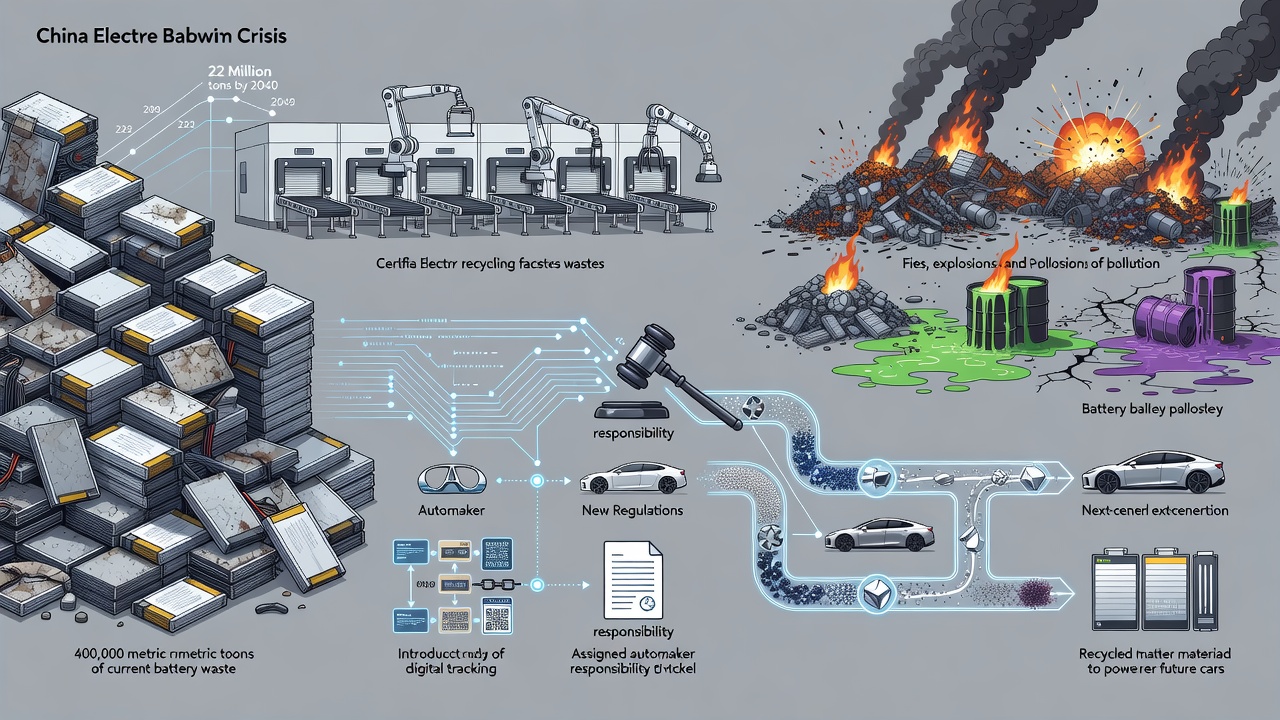
China sold more than 16 million battery-powered vehicles last year. Eight years earlier the figure barely topped one million. Those cars are now aging out. Their batteries last roughly eight years. The result is a swelling tide of spent packs that few outsiders have fully grasped.
Last year China reported 400,000 metric tons of electric-vehicle battery waste. A joint study by researchers in China and the United States projects the total will reach 1.69 million metric tons in 2030 and explode to 22.39 million metric tons by 2040. The numbers come from Inside Climate News.
Beijing saw the wave coming. Officials began building a formal recycling system as early as 2018. More than 150 companies landed on the government’s certification “white list.” By 2023 those firms claimed combined annual processing capacity of 623,000 metric tons. That exceeded the volume of batteries retired that year by more than 50 percent. Yet they handled only about 25 percent of the actual flow. The rest slipped into uncertified hands. Wired laid out the gap in detail.
Informal operators pay car owners more. They skip expensive safety testing and proper dismantling. The shortcut creates hazards. In one Jiangxi Province case uncovered in 2024, workers improperly handled 364 metric tons. The mess contaminated six acres of forest and killed more than 420 cubic feet of timber. Fires, explosions, toxic wastewater dumped into rivers, metals leaching into groundwater. The pattern repeats.
“There is poisoning, explosion, and fire caused by improper battery dismantling, waste water being dumped into rivers, contaminants being seeped into groundwater and polluting the soil,” said Laixiang Sun, a University of Maryland professor and co-author of the joint study. “There is the lithium, copper, and nickel in the batteries. You cannot dump them into the environment. It is about health, about human rights, about pollution in the air, water, and soil.” His words appear in both the Inside Climate News report and the Wired coverage.
Yan Wang, a Worcester Polytechnic Institute professor and co-founder of the now-bankrupt Ascend Elements, echoed the concern. “It is about health, about human rights, about pollution in the air, water, and soil,” he told reporters. The same sources quote him directly.
The New Rules Take Hold
April brought stricter orders. A national regulation now requires automakers to shoulder greater responsibility for collection and processing. Batteries removed from retired vehicles must travel through approved channels to certified companies. Each pack receives a digital identity. The system mirrors Europe’s battery passport approach. Ars Technica noted the parallel in its recent analysis.
The policy also sets ambitious recovery targets. Officials want recycling rates for certain battery elements to climb from around 40 percent today to at least 98 percent. They plan to lift the share of EVs in new vehicle sales from 45 percent to 60 percent by 2030. Those benchmarks feed directly into modeling by Xin Xiong and colleagues at Nanjing University.
Their study, published in Joule, examines how recycled materials could satisfy future manufacturing demand across lithium, cobalt, nickel, manganese, graphite and several motor metals. Under most scenarios the circular flow strengthens steadily. For cobalt, where battery chemistry shifts toward lower content, recycled supply quickly exceeds new demand. Nickel and manganese show flatter but still substantial contributions. Even with rapid technological change the math works for many materials. Recycling could become the dominant source for key inputs over the coming decades. Ars Technica summarized the findings on July 31.
Yet the model carries a clear warning. Success hinges on “effective” recycling. The chain must strengthen at every link. Collection rates must rise. Informal operators must lose their cost advantage. Battery passports must actually trace material. Without those steps the projections collapse. Bottlenecks will appear as volumes scale. Low-value chemistries such as lithium iron phosphate, which dominate China’s market, only make the economics tougher.
Profitability already bedevils formal recyclers. Many white-list companies have gone dark. More than 100 were unreachable during recent checks. Meanwhile global recyclers such as Ascend Elements, Li-Cycle and Lithion Technologies faced bankruptcy last year. Glencore stepped in to rescue Li-Cycle. The pattern shows how hard it is to turn spent packs into reliable feedstock even in advanced markets.
China holds a commanding position anyway. The country now hosts more than 85 percent of global recycling capacity, according to the International Energy Agency’s Global EV Outlook 2026. Firms like CATL’s Brunp Recycling enjoy direct ties to battery makers. They secure steady scrap from production lines. That vertical integration gives them an edge few Western players can match.
But feedstock from vehicles remains the bigger test. Owners often sell high-value second-life packs to the aftermarket rather than return them for recycling. A Xiaomi SU7 fire in Changzhou last year reminded everyone what happens when damaged cells escape proper oversight. Informal channels thrive on that arbitrage.
Consumers bear part of the burden. “Car owners must be aware of their responsibility too,” Sun said. “They have to be willing to sacrifice a small amount of money rather than sell batteries to the informal recyclers.” The quote appears in the Inside Climate News piece.
Beijing has tried incentives. CATL’s Bangbang app offers cash vouchers for returns. Some provinces experiment with deposit schemes. Yet enforcement lags. The new traceability platform launched in April aims to close loopholes. It will take years to judge results.
The stakes stretch beyond China’s borders. Recovered metals could slash the nation’s need for imported lithium, cobalt and nickel. That reduces geopolitical risk and mining pressure in Africa and South America. A closed domestic loop would also cut carbon emissions tied to primary production. The Nanjing University team shows the potential is real if policies align.
Still, the immediate picture is messy. More than 270,000 metric tons slipped through uncertified channels in 2023. That figure could reach 1.26 million tons in 2030 and 16.79 million by 2040 without tighter controls. Those tons carry real danger. Fires at informal sites. Toxic runoff. Workers exposed without protection. The environmental bill could dwarf early EV gains if ignored.
Western observers sometimes portray China’s situation as uniquely chaotic. It isn’t. The United States and Europe face their own collection shortfalls and low recycling rates. China simply confronts the problem first and at greater scale. Its early start on capacity gives it a head start. The question is whether regulators, manufacturers and consumers can close the loop before the mountain grows too high.
Recent coverage underscores the tension. A July 30 report from Inside Climate News highlighted safety risks from informal processing. Ars Technica’s July 31 story on the Nanjing study offered cautious optimism about material circularity. Both build on the foundation laid by Wired‘s comprehensive look at the boom’s downside.
Beijing now bets on producer responsibility, digital tracking and high recovery targets to turn waste into resource. The approach could supply tomorrow’s batteries from yesterday’s cars. Or it could leave scarred landscapes and public health problems. The difference will be measured in enforcement, economics and public cooperation. China has the factories. It has the policy framework. What remains is execution at street level where old EVs change hands every day.
The coming decade will test whether the world’s largest EV market can also become the most sophisticated battery recycler. Success would hand Beijing a strategic advantage in critical materials. Failure would hand its critics a powerful example of green ambition outrunning basic waste management. The batteries keep arriving. The clock is running.


 WebProNews is an iEntry Publication