


Cerebras Systems built its name on a chip the size of a dinner plate. Most of its revenue now comes from renting that computing power out. Cloud and other services brought in $144.9 million of the company’s $230.9 million in core revenue in the third quarter, about 63% of the total, while core hardware revenue slipped to $86 million from $96.8 million a year earlier.
Microsoft is the newest name on that cloud customer list. Cerebras said in its results release Thursday that it had signed “an important cloud deal with a top three hyperscaler,” and Chief Executive Andrew Feldman named Microsoft as the customer. The software giant signed in October, Feldman told CNBC. “We believe revenue begins to show up in Q1 ’27,” he said. Microsoft joins Amazon Web Services and Oracle, which plans to offer Cerebras inference inside Oracle Cloud Infrastructure in 2027. Cerebras gave no value or terms for the Microsoft contract and said more would come next year.
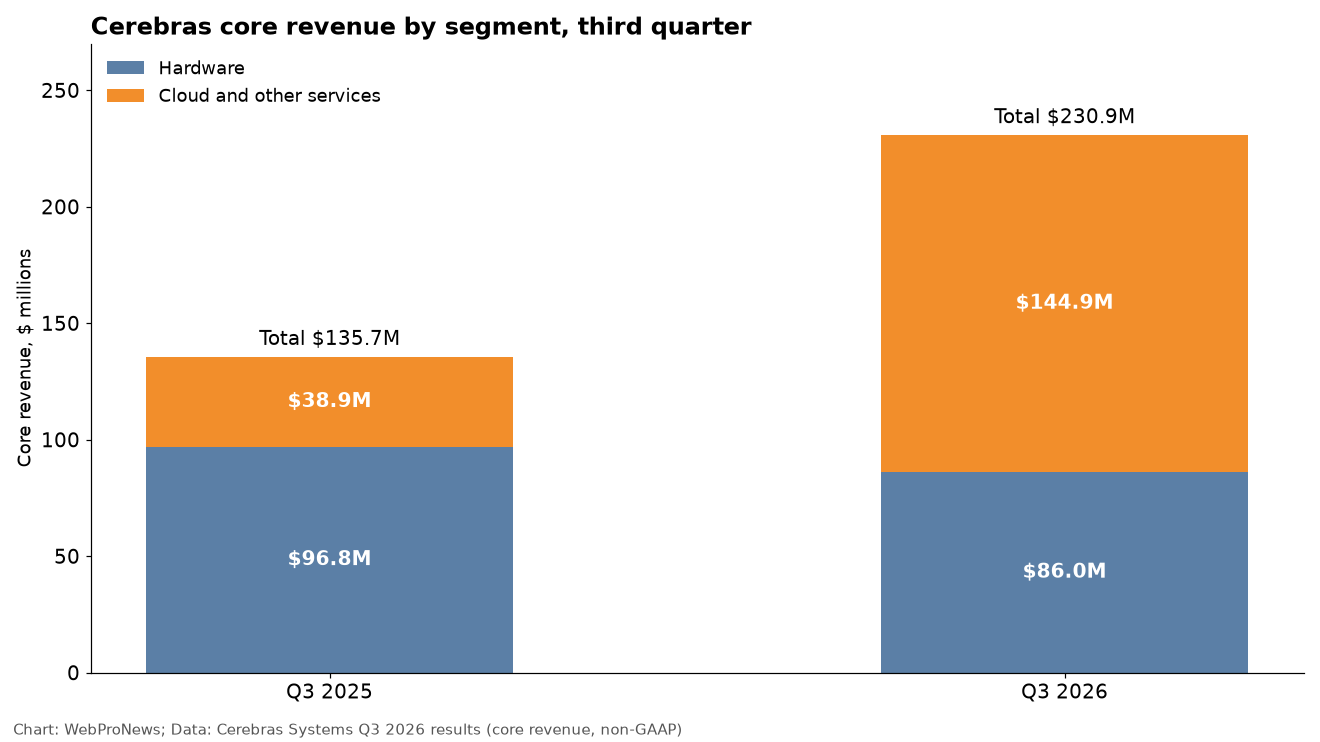
Core revenue rose 70% from a year earlier, slower than the 103% growth Cerebras posted in the second quarter but ahead of the $214.7 million analysts expected in LSEG data cited by CNBC. Core cloud revenue rose 272%. The company now expects $940 million to $960 million in core revenue for 2026, up from the $880 million to $890 million it forecast earlier, Reuters reported. Shares jumped about 17% in extended trading. They had fallen roughly 47% since the company’s May listing on Nasdaq.
“We won new marquee customers, including hyperscalers, neoclouds and large enterprises,” Chief Financial Officer Bob Komin said in the release. He added that the pipeline for high-speed AI inference grew more than tenfold in the quarter.
Profitability is closer but not there. Core gross margin was 41%, and the core operating margin was negative 14%. On a GAAP basis, which counts stock compensation and the warrants Cerebras has issued to big customers, the company lost $161.2 million. Core net income came to $29.8 million, against a loss of $10.9 million a year earlier. For the fourth quarter, Cerebras guided to $310 million to $330 million in core revenue with a core gross margin of 47% to 49%, both above analyst estimates of $271 million and 42.1%.
Capacity is the constraint. Cerebras reported $26.1 billion in remaining performance obligations, and said it has 700 megawatts of data center capacity under contract for delivery by the end of 2027, including new sites in Norway and Finland. Reuters reported that the backlog is underpinned by Cerebras’ deal to supply computing power to OpenAI, and that Feldman said on the analyst call that Cerebras lacked the capacity to support a broad rollout of OpenAI’s Ultrafast service tier. The company ended September with $7.8 billion in cash and investments plus $850 million in debt capacity, and Feldman told CNBC it is weighing financing options to keep up with demand. Fellow AI cloud provider Nebius said Thursday that it now asks customers for prepayments to cover build-out costs.
Feldman sees an opening in GPU supply. “I think there is opportunity created by, particularly on the hardware side, the sale of hardware, where long lead times in GPUs and more expense creates opportunity for us,” he told CNBC. The results landed the same day Nvidia named Colette Kress interim CEO after Jensen Huang resigned.
Cerebras expects to triple revenue in 2027. Its next-generation CS-5 system, built on the Wafer Scale Engine 5 processor now in system testing, is targeted for early summer 2027. Executives will be in front of investors again Tuesday at the TomorrowX Summit in Austin.


 WebProNews is an iEntry Publication