
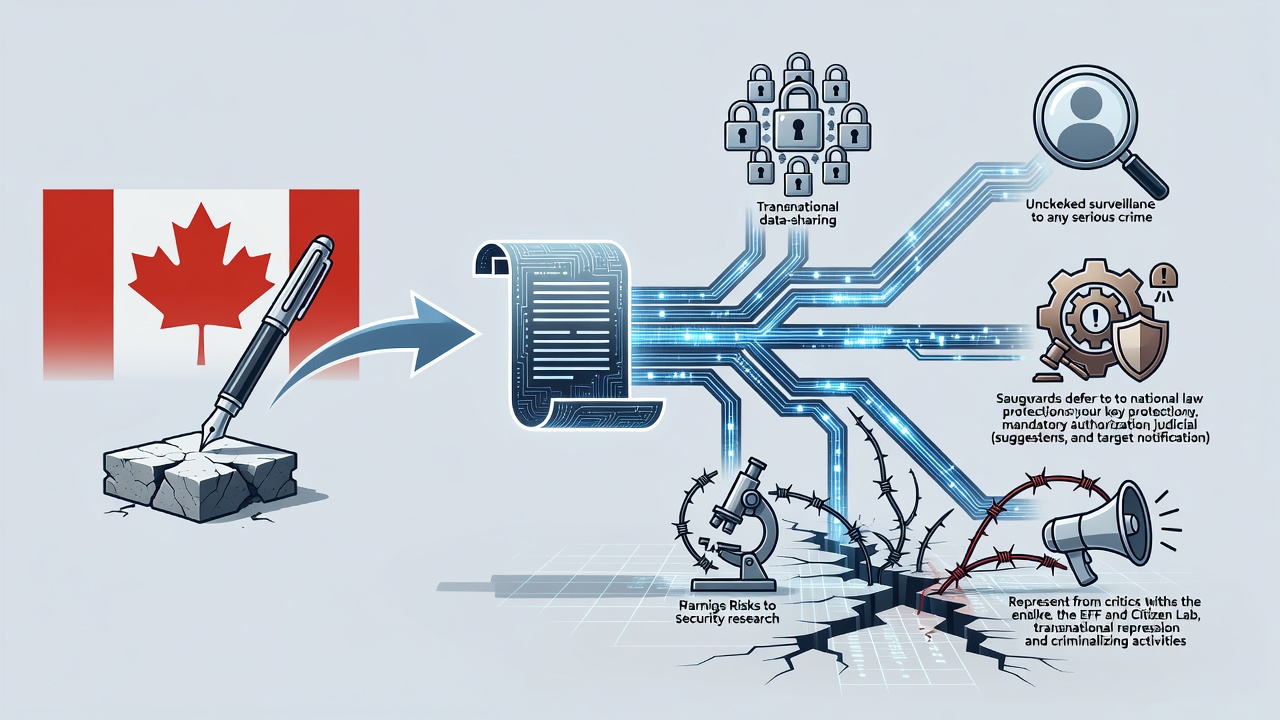
Canada slipped into the ranks of signatories to the United Nations Convention against Cybercrime in mid-July 2026. Few noticed. Parliament sat empty for the summer. No press conference. No parliamentary debate. Just a terse announcement from three ministers and a short statement filed at the signing registry.
The move caught observers off guard. Until days earlier, Canada had stood with the United States, Japan and New Zealand in refusing to sign. Russia, China and Iran had put their names down early. Now Ottawa had joined them. The Michael Geist blog called it a surveillance treaty in disguise. The description stuck.
The treaty, adopted by the UN General Assembly in December 2024 and opened for signature in Hanoi in October 2025, presents itself as a tool to fight online crime. Its text promises better cooperation on electronic evidence and harmonized criminal laws. Yet its procedural chapters reach far beyond hacking or ransomware. They create broad powers to intercept communications, seize data and compel service providers to hand over information. These powers apply not just to defined cyber offences but to any “serious crime” punishable by at least four years in prison.
That scope worries legal scholars and rights groups. Real-time collection of traffic data, device searches and orders for subscriber information become routine tools. Prior judicial authorization? Not required in every case. Notification to the target? Often prohibited under gag provisions. Political offences receive no clear exemption. The result, critics argue, is a ready-made framework for transnational repression.
The Treaty’s Design and the Safeguards That Weren’t
Article 24 of the convention nods to human rights. It speaks of proportionality and judicial review. But the language defers heavily to domestic law. Many countries lack strong independent courts or strict necessity tests. The treaty does not fill those gaps. It simply accommodates them.
Just Security examined these provisions in detail last year. The analysis found that safeguards remain optional in practice. Judicial oversight can be discretionary. Notification rights disappear behind confidentiality defaults. Cross-border data requests face few refusal grounds once a country signs. Evidence gathered through domestic mass surveillance or weakened encryption can flow freely to partners. (Just Security)
Canada’s government offered a different view. Ministers Anita Anand, Gary Anandasangaree and Sean Fraser issued a joint statement praising the treaty’s child-protection elements and claiming its human-rights language ranked “among the strongest found in an international criminal justice treaty.” The official Canadian note at the registry added that success would depend on “states’ commitment to full application of the human rights safeguards in the text.”
Yet the text itself leaves those safeguards thin. Article 6.2 states that nothing in the convention permits suppression of fundamental freedoms. The clause stands alone. It creates no enforcement mechanism and sets no minimum standards beyond what individual nations already claim to follow. Access Now, the Electronic Frontier Foundation and Human Rights Watch have repeatedly warned that such language provides cover rather than constraint. (EFF)
Kate Robertson, senior research associate at the Citizen Lab, put it bluntly on Michael Geist’s Law Bytes podcast. The treaty, she said, stands “poised to become a vehicle for complicity in the mercenary spyware trade.” Over 120 security researchers signed an open letter last December arguing that the criminal provisions could chill legitimate vulnerability research. Good-faith work that exposes flaws in widely used systems risks being cast as aiding crime.
Canada had opposed the Russian-led initiative when negotiations began in 2019. Officials worked inside the process to strengthen privacy language. They skipped the Hanoi signing ceremony. Then, without public warning or consultation, the government reversed course this summer. The timing — during parliamentary recess — drew sharp criticism from digital-rights organizations. A coalition letter from Amnesty International Canada, PEN Canada, the Criminal Lawyers’ Association, OpenMedia and others had urged Ottawa to stay out. The government signed anyway.
The convention’s origins explain some of the distrust. Russia introduced the idea to shift authority away from the Council of Europe’s Budapest Convention, which includes stronger safeguards and broader participation from democratic states. The new treaty, by contrast, opens cooperation to any signatory. That list already includes governments with documented records of using surveillance against journalists, activists and diaspora communities.
Implications stretch beyond borders. Canadian authorities could receive data requests from states seeking information on critics living in Toronto or Vancouver. Service providers might face conflicting obligations. Security researchers could hesitate before publishing findings that might later be labeled as criminal assistance under foreign law. Lawful-access legislation already moving through Parliament, such as elements of Bill C-22, would gain new international reinforcement.
Supporters inside government point to practical gains. Cross-border evidence in child-exploitation cases moves faster. Ransomware investigations benefit from standardized production orders. Yet the treaty’s breadth — any serious crime, any electronic evidence — far exceeds those narrow wins. Once powers exist, they tend to expand. History shows authoritarian regimes rarely limit themselves to the original justification.
Recent coverage reinforces the pattern. A Forbes article from 2024 captured early warnings from human-rights groups that the draft betrayed core protections. A Chatham House discussion last year featured experts describing the treaty as granting “extensive surveillance powers” for unspecified serious crimes while creating a “global surveillance dragnet.” No major reforms addressed those flaws before Canada signed. (Forbes)
UNODC, the office overseeing the treaty, describes it as the first comprehensive global instrument on cybercrime. It emphasizes prevention, evidence sharing and cooperation. The page lists nine chapters covering criminalization, procedural measures and international assistance. Entry into force requires 40 ratifications. As of May 2026, 76 states had signed and only three had ratified. Canada’s signature adds to the momentum without yet triggering full obligations. (UNODC)
Critics refuse to separate the text from its likely users. Wikipedia’s entry on the convention, updated through mid-2026, records the concerns of NGOs and academics in plain terms. The pact expands surveillance and data-collection capacity for repressive governments. It offers a veneer of legitimacy to domestic laws that punish dissent, expression or investigative reporting. Michael Geist’s analysis goes further: the convention is “not primarily a cybercrime treaty at all, but rather a sweeping cross-border surveillance and electronic evidence-sharing agreement.”
So what happens next? Ratification in Canada would require implementing legislation. That process could still invite amendments or reservations. Yet the signature itself signals acceptance of the framework. It weakens Canada’s earlier stance and aligns the country with nations whose priorities differ sharply on privacy and expression.
Industry insiders in technology, finance and critical infrastructure now face new variables. Data-residency decisions, encryption strategies and vulnerability-disclosure programs all carry heightened legal risk. Compliance teams must track how foreign requests might arrive under the treaty once it gains force. Privacy officers weigh the gap between Canadian Charter standards and the lower bar accepted by some signatories.
The government insists safeguards will hold. Rights groups counter that the treaty outsources judgment to the very states most likely to abuse it. The text, they say, contains no effective check against that outcome. And Canada’s quiet decision to sign suggests the debate never truly reached the public square.
But the risks remain visible. Expanded interception powers. Weaker notification rules. Broader data sharing. Criminal provisions that sweep in security research. A mechanism that could let one country’s political priorities become another’s enforcement priority. These are not abstract worries. They match patterns already documented in multiple jurisdictions.
Whether ratification follows quickly or stalls in Parliament, the signature marks a turning point. Canada has stepped into a treaty whose design favors state power over individual protection. The test will come when the first contentious request arrives — and when officials must decide whether the safeguards they praised on paper actually work in practice.


 WebProNews is an iEntry Publication