
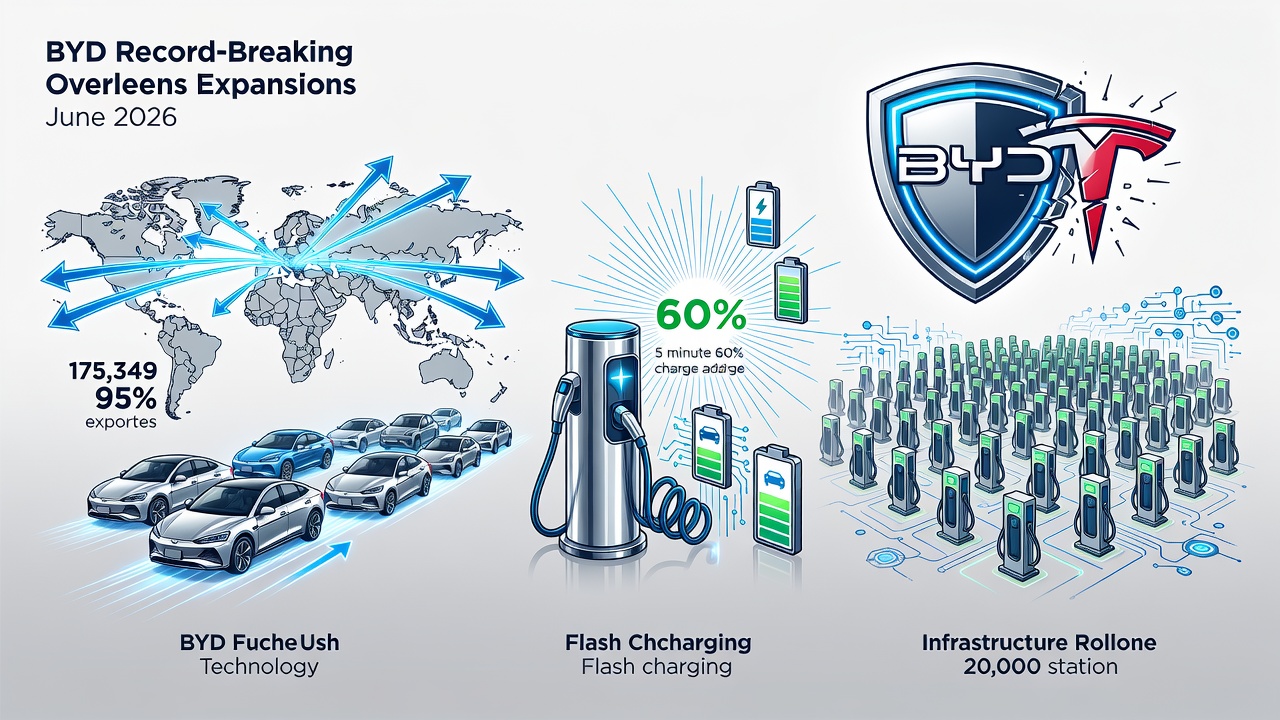
BYD keeps posting record overseas sales. In June 2026 the Chinese automaker delivered 175,349 vehicles outside its home market. That figure marked a 95 percent jump from the year before and represented 43 percent of its total sales for the month.
The numbers come as BYD pushes hard into Europe, Latin America and other regions. Its first-half overseas total reached 792,256 units, up 71 percent from the same period in 2025. Yet domestic sales continue to slide. They fell 22 percent in June to 228,123 vehicles. The contrast tells a clear story. China’s price wars and slowing demand have forced BYD to look abroad.
And the company isn’t just shipping more cars. It’s betting on a new technology that could change how drivers think about electric vehicles. The second-generation Blade Battery pairs with what BYD calls flash charging. The system can add 10 percent to 70 percent charge in five minutes. In ideal conditions it reaches nearly full in nine minutes. Fast enough to compete with a quick gas stop.
BYD rolled out the technology in China earlier this year. Orders for some models quickly topped 100,000 units. CEO Wang Chuanfu acknowledged the surge. Demand had outstripped production capacity. The shift from the first-generation Blade Battery to the new version caused delivery delays for several key models. Those bottlenecks eased in June as factories adapted.
Now BYD plans to bring the same package overseas. The Denza Z9 GT will debut the tech in Europe. Other models such as the Dolphin Surf EV and the new Dolphin G DM-i PHEV will follow. The latter offers more than 1,000 kilometers of range on the WLTP cycle and carries a starting price expected below £20,000 in the UK. “By bringing long electric range, intelligent hybrid technology and advanced digital features into an accessible compact vehicle, we are making sustainable mobility smarter, more practical and available to many more people across Europe,” said Stella Li, BYD’s executive vice president, in a statement reported by Electrek.
But selling cars is only half the battle. Range anxiety still haunts many buyers. Infrastructure gaps remain wide outside China. So BYD is building chargers at a furious pace. The company has already installed more than 7,000 flash-charge stations across 325 Chinese cities. It aims for 20,000 by the end of 2026. The initiative, launched in March under the “Flash Charge China” banner, accompanied the new battery debut at a Seal 08 event.
Expansion won’t stop at the border. Industry reports suggest BYD eyes 3,000 stations in Europe within months and as many as 6,000 overseas by March 2027. Those targets, if met, would give the company a credible network to support its 1.5 million overseas sales goal for the full year. Bloomberg first reported the target in March after a private briefing with analysts. The projection sits 15 percent above BYD’s earlier January forecast.
The approach differs from Tesla’s. Elon Musk’s company focused first on vehicles and software. Supercharger stations followed. BYD is trying to roll out both at once. The strategy carries risks. Capital spending will rise. Local regulations in Europe and the United States could slow approvals. Tariffs remain a threat. Yet early signs look promising. Overseas sales hit a new high in June according to data compiled by CnEVPost. The recovery extended a second straight month of global growth after eight months of declines.
June’s total group sales reached 403,472 NEVs, up 5.5 percent from May. First-half volume stood at 1.81 million vehicles, still down 16 percent from 2025’s first six months. The overseas piece, however, grew fast enough to offset much of the domestic weakness. PHEV sales led the way globally, rising 15 percent in June while pure battery-electric deliveries slipped slightly.
Analysts watch the premium segment too. BYD launched the Dynasty Da Tang, a D-segment flagship SUV, in mid-June. The move signals ambitions beyond mass-market models. It also diversifies the lineup as competition from Nio, XPeng, Li Auto and Xiaomi intensifies at home.
Production discipline will decide whether the flash-charging advantage lasts. The technology requires compatible stations. Drivers without access gain little from a five-minute charge promise. That’s why the station build-out matters as much as the car specs. BYD’s home network already covers hundreds of cities. Overseas plans remain sketchy but aggressive.
Executives sound confident. Bono Ge, BYD UK country manager, noted last month that high fuel prices continue to push drivers toward electric options. The comment, carried by Electrek, reflects a broader European trend. Yet price alone may not win the next phase. Convenience, speed and trust in the brand will matter more.
BYD still trails Tesla in pure brand perception in many Western markets. Its vehicles sell on value. The new battery and charging system could shift that equation. A PHEV that charges from near-empty to mostly full during a coffee break changes the math for long trips. So does a sub-£20,000 compact with 1,000-kilometer range.
Challenges remain. Raw material costs fluctuate. Supply chains for the new cells must scale without quality slips. Regulatory hurdles in the EU could limit import volumes. And Tesla itself isn’t standing still. The American maker continues to cut prices and expand its own charging network.
Still, the momentum sits with BYD on the export front. Its May overseas tally topped 160,000 units for the first time, according to Electrek. The first five months of 2026 produced more than 616,000 exported vehicles. June pushed the pace even higher. If the company hits its 1.5 million overseas target, it would represent a massive leap from prior years.
The flash-charging push adds a technical moat. Most fast chargers today deliver 150 to 350 kilowatts. BYD’s system appears capable of far higher peak rates to achieve those five-minute gains. Exact power levels remain closely held. But the performance claims have drawn attention from dealers and analysts alike.
One recent report from Just-Auto highlighted the production transition pains. Local media noted bottlenecks earlier in the year. Those appear to have eased. June deliveries rebounded. The recovery matters because overseas orders keep climbing.
BYD also continues to expand manufacturing footprints abroad. Plants in Europe, Southeast Asia and Latin America reduce tariff exposure and shorten delivery times. The combination of local production, rapid charging and aggressive pricing creates a three-pronged attack.
Investors have taken notice. BYD shares rebounded more than 20 percent in July on the back of strong export data and flash-charge progress, according to posts on X and coverage in industry outlets. Domestic weakness still weighs on the stock. But the overseas story dominates conversation.
Whether the strategy fully succeeds won’t be clear for years. Infrastructure takes time to build. Consumer habits shift slowly. Yet the early data suggest BYD has identified a genuine pain point and engineered a response. Five-minute charging isn’t marketing hype if the stations exist.
The company’s latest station count passed 7,000 in China by early July. That number grew from 5,924 in May. The pace shows commitment. Plans for Europe point to thousands more. If BYD can replicate even a fraction of that density abroad, the competitive edge could prove durable.
Tesla built its lead on innovation and scale. BYD now counters with speed, price and infrastructure investment. The global EV market may soon hinge on who charges fastest and where. For now, BYD holds the momentum in export volumes. The flash-charging network will determine if that lead turns into lasting dominance.


 WebProNews is an iEntry Publication