

Updated Oct. 24, 2026, 3:35 a.m. ET: Adds Yangwang’s confirmation that its flagship sedan, which reports have tied to BYD’s first solid-state battery, will be unveiled in the UAE.
BYD will have one model on the road next year running on its own solid-state battery, executive vice president Stella Li said, making it the company’s first car with the technology. “Talking about solid-state batteries, BYD is in the leading position,” Li said, according to Engadget. “We’re in the leading position for commercialization and technology. So to prove that, next year, we have one model that will be the first one with that technology.”
Li spoke earlier this month in Valencia, Spain, in an interview with Carwow’s Spanish outlet. She didn’t name the car or give battery specifications, a production date or performance figures, CarNewsChina noted, so for now the plan is a technology demonstration rather than a retail launch.
“You can name any battery technology, and I will guarantee you will find it in one corner of BYD R&D that we are studying,” she told Electrek. The team is working on the manufacturing process and equipment needed to mass-produce the cells as well as the chemistry itself, she said.
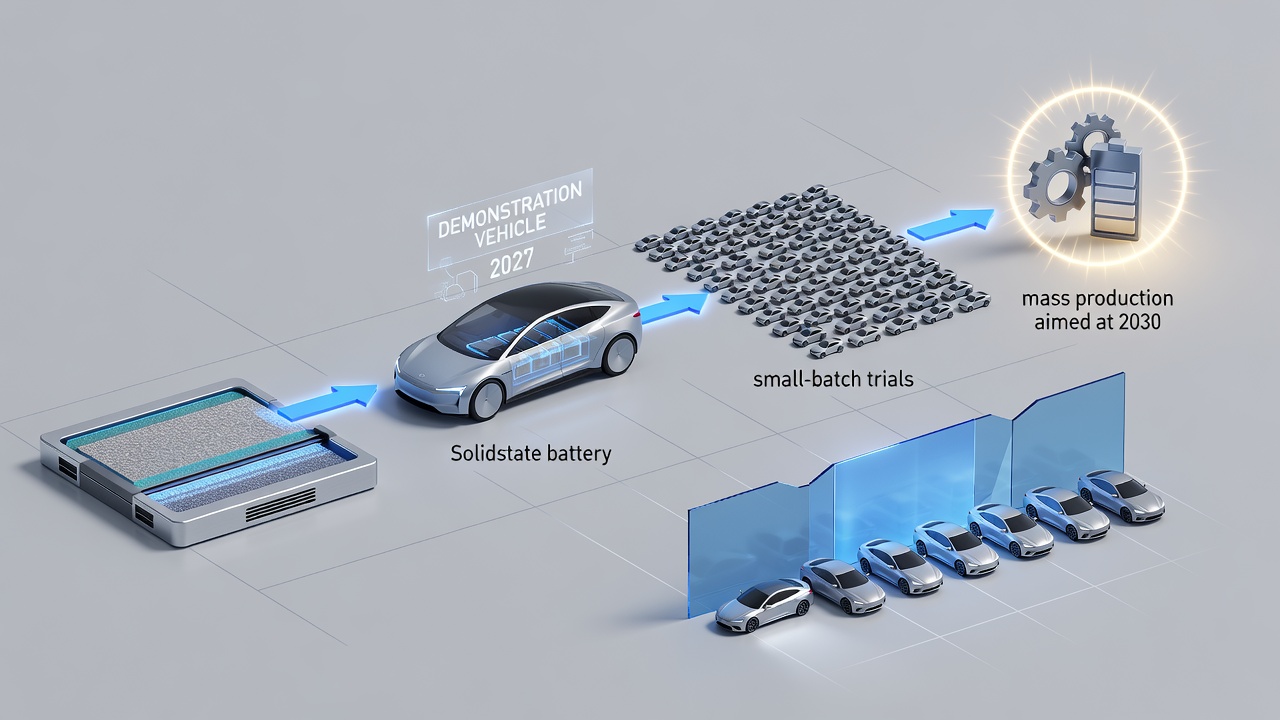
The roadmap: about 1,000 cars first, volume around 2030
Solid-state cells swap the liquid electrolyte in today’s lithium-ion batteries for a solid one made from oxides, polymers or, in BYD’s case, sulfides. That promises higher energy density, longer range, better tolerance of extreme temperatures and a much lower fire risk. Cost is the main obstacle for now, which is why the first BYD models to get the chemistry are expected to be expensive ones.
Sun Huajun, chief technology officer of BYD’s battery unit FinDreams, laid out the schedule at a battery conference in February 2025: a first demonstration and installation in 2027, then mass production around 2030. He has described small-batch trials of roughly 1,000 vehicles around 2027, with early use focused on Yangwang and flagship Denza models, where the extra cost is easier to absorb. FinDreams has built 20 Ah and 60 Ah prototype cells aimed at energy density approaching 400 Wh/kg, though cell-level figures don’t translate directly to a full pack.
BYD’s lithium iron phosphate batteries aren’t going away. “Solid-state batteries will be mainly used in high-end models, empowering each other with lithium iron phosphate batteries, and used in vehicles of different levels,” chief scientist Lian Yubo said at the same conference. He has said liquid lithium-ion and all-solid-state batteries could coexist for 15 to 20 years.
Getting solids to stay in contact
Sulfides conduct ions well, but they react with moisture and can give off hydrogen sulfide. The solvents used in conventional wet electrode processing can also react with them, so FinDreams has been working with Chinese equipment suppliers on dry electrode processes at its pilot facilities. Another challenge is that electrodes expand and contract during cycling, and solid-solid interfaces can lose contact, so some sulfide designs need sustained stack pressure built into the pack.
That contact problem is the subject of a string of BYD patents. After China’s patent office granted BYD a patent in late July on a composite cathode that pairs small-particle halide electrolytes with larger sulfide particles, the company published six more filings on the same issue, Batteries News reported. One sets a quality metric requiring at least 60% of a cathode particle’s perimeter to touch electrolyte particles, which BYD says improves charging performance, capacity and durability, according to electrive. Chinese media have reported that BYD plans small-scale production of these dual-electrolyte cells in 2027, with the first cells tested in camouflaged prototypes. BYD hasn’t officially confirmed that timeline.
The materials are still costly. Specialized sulfide precursors cost dozens of times as much as conventional liquid-electrolyte materials, CarNewsChina reported. BYD is developing the technology within China’s All-Solid-State Battery Collaborative Innovation Platform, a government-backed research effort linked to an estimated $830 million state R&D program.
BYD’s current liquid-electrolyte batteries already charge quickly. Its Blade Battery 2.0 and Flash Charging technology can take a car from 10% to 70% in five minutes, and from 20% to 97% in nine, according to Electrek.
Who else is aiming for 2027
Toyota is targeting a 2027-2028 launch for battery-electric vehicles with all-solid-state batteries through its partnership with Idemitsu Kosan, and Samsung SDI is targeting mass production in 2027. Mercedes-Benz drove a modified EQS more than 745 miles on Factorial Energy solid-state cells last fall and has said it will ship the technology before the end of the decade. Stellantis began road testing a solid-state Dodge Charger this year, and Honda signed a deal with QuantumScape to develop the batteries.
CATL, the world’s largest EV battery maker, is more cautious about timing. At the World Economic Forum’s “Summer Davos” meeting in Dalian in June, chairman Robin Zeng said the technology had reached level four on a scale of one to nine and that mass production wouldn’t begin until 2030, Electrek reported. “Even if the products are delivered, it remains to be seen whether they will be well received and become a commercial success on the market,” Zeng said, according to the South China Morning Post. CATL is still working toward small-scale all-solid-state production in 2027 with a planned 5 GWh of capacity, and has begun pilot production of 500 Wh/kg cells.
BYD’s first solid-state car will probably come from Yangwang, its ultra-luxury brand. China’s Autohome reported that a new Yangwang executive sedan, a roughly 5.5-meter car with rear-hinged coach doors that BYD is calling “HU” internally, will be the company’s first EV with solid-state batteries, Electrek reported. On Oct. 21, Yangwang sales chief Hu Xiaoqing said the sedan will be unveiled in the United Arab Emirates, without giving a date or venue, CnEVPost reported. Yangwang still hasn’t disclosed the car’s battery chemistry, according to CarNewsChina.


 WebProNews is an iEntry Publication