
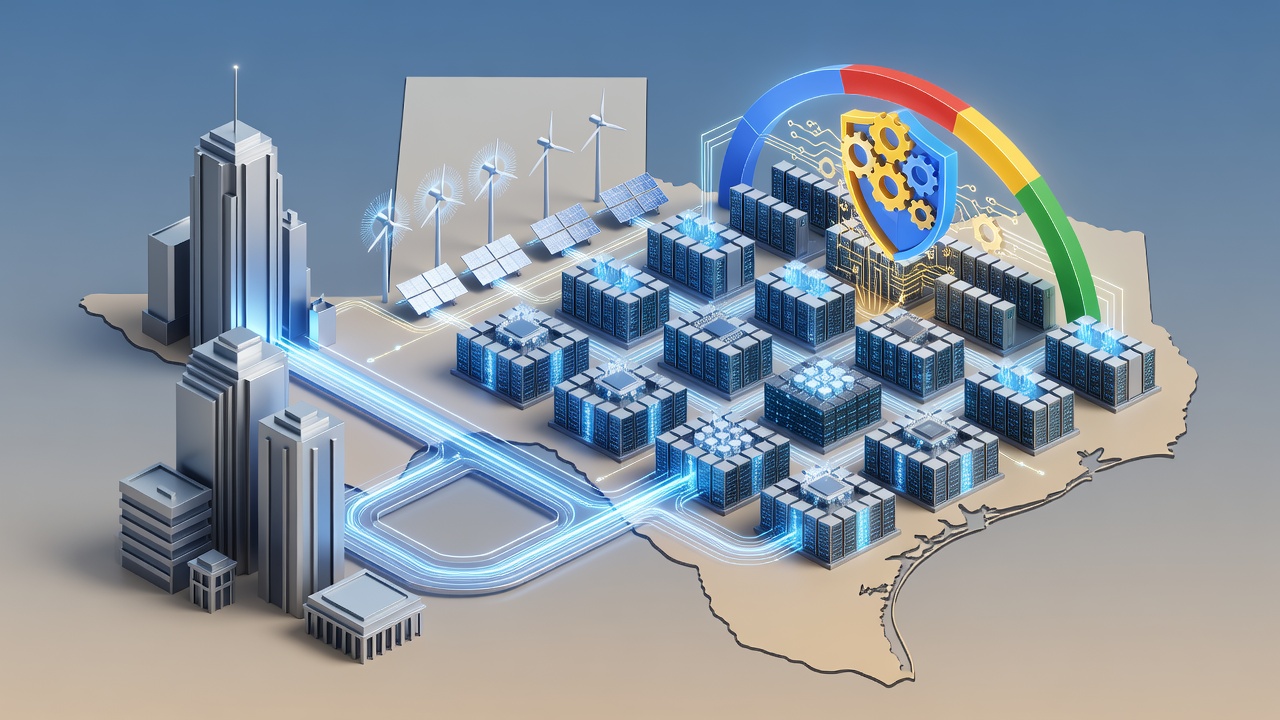
Banks stand ready to pour $15 billion into a single data-center project. The sum is enormous. Yet it fits a pattern now familiar across the industry. Demand for computing power to train and run advanced AI models has pushed developers, hyperscalers and lenders into deals once considered unthinkable.
Nexus Data Centers is in advanced talks with a group of banks led by Morgan Stanley to borrow the funds. The money would build a sprawling campus in Hubbard, Texas, complete with its own natural-gas-fired power plant capable of generating 1.6 gigawatts. The Wall Street Journal first reported the discussions, citing people familiar with the matter. Evercore acted as sole financial adviser to Nexus and arranged the financing, which could be announced as soon as this week.
Google plays a central role. The search giant, part of Alphabet, has agreed to provide financial guarantees covering billions of dollars of Anthropic’s lease and power-payment obligations should the AI startup default. In exchange, Google is expected to receive an equity stake of about 20 percent in the data-center and power project. It will also supply chips. Anthropic plans to equip the site with tensor processing units co-designed by Google and Broadcom. Separate financing from Broadcom will cover those chips.
The guarantees are carefully limited. They back four data-center leases and related power-purchase agreements. Google has committed to cover payments up to a minimum amount required by the lenders. Such credit support from a deep-pocketed hyperscaler can make or break these transactions. Without it, banks might balk at the risk tied to a relatively young company like Anthropic.
This deal arrives at a moment of intense pressure on the entire AI supply chain. Power shortages, soaring construction costs and the sheer scale of GPU clusters have forced creative financing structures. Banks have reworked existing Oracle data-center debt to free capacity for new lending. They have turned to private loan sales and risk transfers. Yahoo Finance detailed how lenders including JPMorgan, Morgan Stanley and Bank of America are distributing risk to keep pace with AI-driven demand.
Outstanding private-credit loans to AI-related companies already exceed $200 billion. Projections suggest that figure could climb to between $300 billion and $600 billion by 2030. Morgan Stanley itself has forecast that private credit could supply an additional $800 billion for data centers in the next two years alone. The numbers reflect a shift. What began as venture-style bets on model developers has become a massive bet on physical infrastructure.
And the infrastructure is hungry. A single large training run can consume electricity equivalent to that of a small city. Hyperscalers and AI labs race to secure sites with access to power, water and fiber. Texas has emerged as a favored location thanks to its deregulated energy market, available land and business-friendly policies. Hubbard sits south of Dallas-Fort Worth. The campus could span thousands of acres and scale well beyond the initial 1.6 gigawatts if demand holds.
Yet risks abound. Construction delays, higher-than-expected interest rates or slower AI adoption could leave projects underwater. Some analysts warn of overbuilding. Others point to concentrated exposure. Banks’ direct holdings in AI-adjacent sectors remain modest, around 0.8 percent of assets on average. But indirect exposure through private-credit funds and insurers runs far higher. Pension plans and even 401(k) investors are increasingly tied to these assets through alternative-investment vehicles.
Developers have responded by racing to sell stakes. Data-center operators are shopping majority equity positions worth tens of billions this summer. A potential sale of a stake in DataBank could reach $25 billion. The goal is to lock in valuations while appetite remains strong and to recycle capital into the next wave of projects.
Google’s involvement adds another layer. The company has invested billions in Anthropic directly. By guaranteeing leases and supplying its own TPUs, it deepens the partnership while hedging its exposure. The equity stake gives Google upside if the campus fills quickly and operates at high utilization. For Anthropic, the arrangement provides certainty. It can focus on model development rather than worrying about power or rent payments in a volatile market.
Still, the structure highlights how dependent the AI boom has become on a handful of players. A few hyperscalers control much of the demand. A small group of banks and private-credit funds supply the capital. Power generators, chip designers and site developers fill the remaining slots. Disruptions anywhere in that chain can ripple outward. Recent reporting has highlighted litigation risks around these complex off-balance-sheet financings. SPVs, mini-perm loans priced at 250 basis points over Treasuries and other innovations carry novel legal questions if projects underperform.
So far, the market has absorbed the growth. Lenders committed nearly $122 billion in credit facilities and bonds for data-center properties in 2025. That pace shows no sign of slowing. But the $15 billion Nexus transaction stands out for its size and its integration of power generation, tenant guarantees and equity participation in one package. It signals a maturation. Banks no longer simply finance buildings. They finance entire energy ecosystems built around specific AI workloads.
Executives at Nexus emphasize speed and self-sufficiency. The company promises hyperscale campuses with behind-the-meter power that remain grid-connected yet not grid-reliant. Its permitting expertise helps shave months off development timelines. In a sector where every quarter of delay can cost millions, such capabilities command a premium.
Broadcom’s role adds further complexity. The semiconductor firm co-designed the TPUs and is providing separate vendor financing. That arrangement keeps the core compute procurement outside the main project loan. It also ties another major technology supplier directly to the campus economics.
Observers on X reacted quickly to the news. Posts described the deal as evidence that AI infrastructure has moved beyond models to encompass power plants, custom silicon and layered financing. One trader highlighted Nexus as a bullish signal for related infrastructure plays. Another noted the structured stack of labs, hyperscalers, banks and energy assets now required for these projects.
The broader picture remains one of acceleration. AI training clusters continue to grow. Inference demand is rising even faster in some segments. Hyperscalers have signaled they will spend hundreds of billions more on capital expenditures in the coming years. Much of that money will flow through vehicles like the one now under discussion for Hubbard.
Whether this particular financing closes on the terms reported remains to be seen. Talks can still shift. But the very fact that a $15 billion loan for one campus sits within reach tells its own story. The AI build-out has reached a scale where individual projects rival the cost of major public infrastructure. And the financial system is adapting, one syndicated loan at a time.


 WebProNews is an iEntry Publication