


Baidu’s AI cloud infrastructure business nearly doubled its revenue in the third quarter, and the company’s overall sales still shrank. Total revenue fell 1% to RMB30.8 billion ($4.60 billion), the Chinese search company said Monday. Baidu’s results releases show revenue down year over year in each of the last six quarters, beginning with the second quarter of 2025, the same streak Bloomberg counted, according to Quartz. The total was in line with the RMB30.86 billion average of 15 analyst estimates compiled by LSEG, Reuters reported.
The quarter puts numbers on a business in the middle of a handoff. Revenue from AI Cloud Infra rose 94% from a year earlier to RMB8.2 billion. Online marketing services fell to RMB11.9 billion from RMB15.3 billion, while the rest of Baidu General Business, which Baidu reports as Others, rose 40% to RMB13.1 billion and overtook ads this quarter. Ads now account for 48% of Baidu General Business, the unit that holds search, cloud and apps, down from 62% a year ago. That unit’s revenue rose 1% to RMB25.0 billion and returned to year-over-year growth.
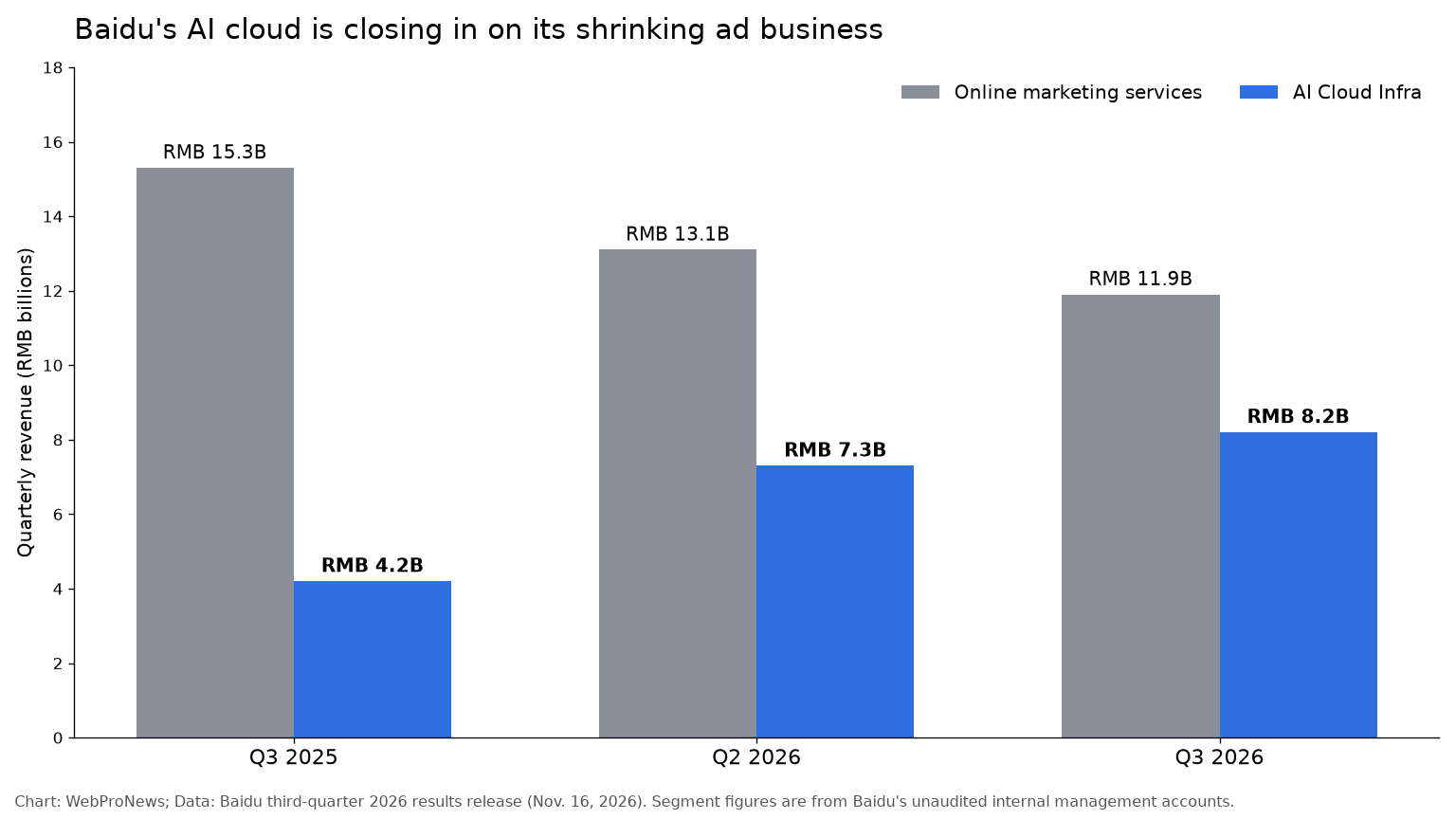
The fastest growth came from renting out AI computing. GPU Cloud revenue, which Baidu previously called subscription-based revenue from AI accelerator infrastructure, rose 191% from a year earlier and 43% from the second quarter. Revenue from outside customers’ token usage on Qianfan, Baidu’s model platform, jumped 1,159%. Baidu said demand came with a more diversified customer base, increased customer prepayments and a shift toward longer-term contracts. Other AI infrastructure providers are leaning on prepayments, too: Nebius said last week that its new deals now come with prepayments that cover build-out costs, and Australia’s Firmus is asking its biggest customers to pay up front for data centers it hasn’t built.
“AI Cloud Infra is becoming a new growth engine for Baidu, with an increasing contribution to both revenue and profit,” Haijian He, Baidu’s chief financial officer, said in the results release. Co-founder and CEO Robin Li said the company is “pleased to see our AI-first strategy yielding tangible results even as we navigate headwinds in online marketing.”
Outside the cloud, AI revenue is flat or falling
Baidu groups its AI products into a line it calls Baidu Core AI-powered Business. It brought in RMB13.2 billion, up 37%, and made up 53% of General Business revenue, compared with 39% a year earlier. The other two pieces did less. AI Applications revenue held at about RMB2.6 billion. AI-native marketing services fell 15% to RMB2.4 billion, which Baidu blamed on a challenging economy, competition and its own decision to put user experience ahead of near-term revenue while it rebuilds search around AI. Legacy businesses fell 24% to RMB9.4 billion.
Profit swung back. Net income attributable to Baidu was RMB1.4 billion ($208 million), against a loss of RMB11.2 billion a year earlier, when the company took a RMB16.2 billion impairment of long-lived assets. Operating income was RMB626 million, a 2% margin. Cost of revenue rose 9% to RMB19.9 billion on cloud costs and traffic acquisition. Non-GAAP diluted earnings were RMB6.78 ($1.01) per American depositary share.
The competitive pressure is on the model side, too. Baidu said its new ERNIE 5.5 Flash Preview ranks second among open-source models globally on the Code Arena WebDev leaderboard. Bloomberg has reported that the ERNIE series has fallen out of the top tier and trails DeepSeek and Moonshot, The Next Web noted, and Bloomberg Intelligence analysts Robert Lea and Jasmine Lyu wrote that Baidu “lacks the scale to compete with China’s tech platforms.” Rival Alibaba released its closed Qwen4-Max flagship late Sunday U.S. time.
Baidu is also building its own silicon. Its Kunlunxin M100 inference chip is expected to be ready for volume production by the end of 2026. The company has returned $373 million to shareholders through buybacks since the start of the year, and it expects to declare its first dividend before the end of 2026, subject to board approval and market conditions.


 WebProNews is an iEntry Publication