
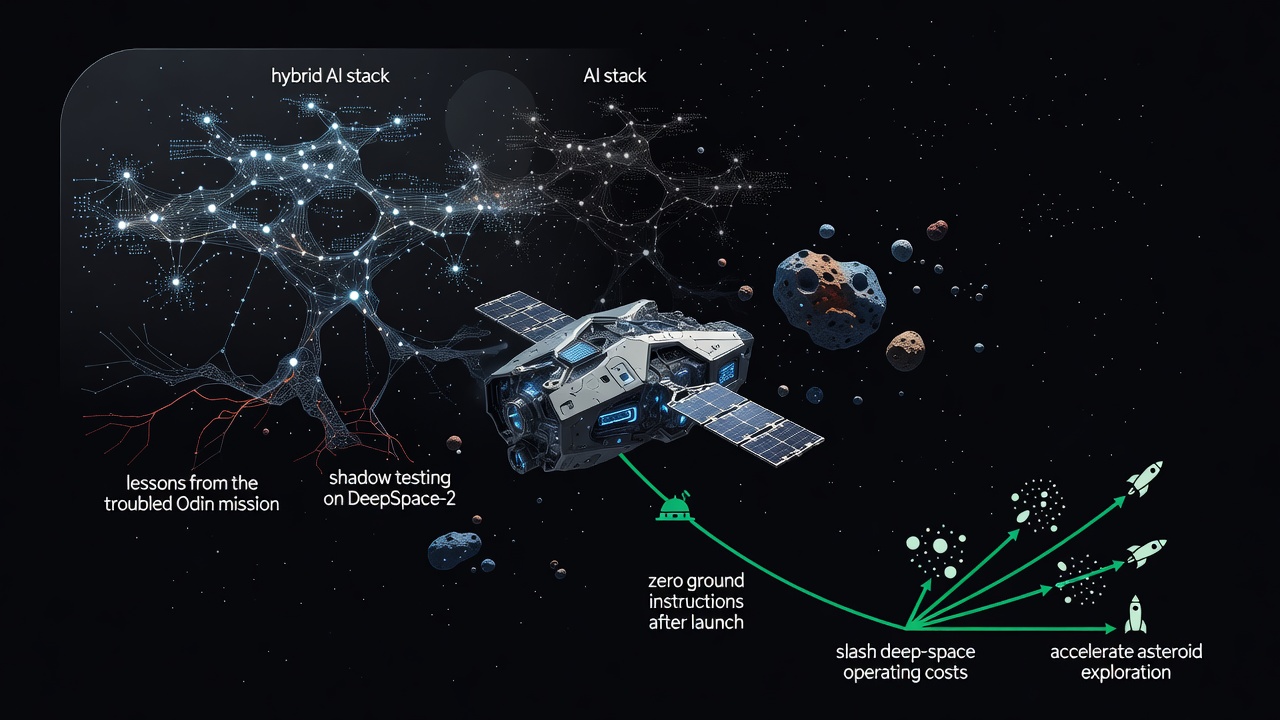

When NASA flew OSIRIS-REx to an asteroid, it had 100 operators on each eight-hour shift. Asteroid-mining startup AstroForge doesn’t have that kind of staff, so it’s handing the job to software. The company has built Solo, an in-house transformer-based model that sits at the top of an autonomous control stack and is meant to run its spacecraft, TechCrunch reported.
AstroForge plans to fly its first autonomous spacecraft, Autonomy-1, in 2027 on the first rocket launched by Stoke Space. The NASA-backed mission is expected to gather scientific data about the sun. That would be a notable first, since most spacecraft autonomy still relies on traditional control algorithms over concerns about how reliable neural networks are.
Born from a lost spacecraft
AstroForge, founded in 2022 with $56 million in venture funding, has launched two prototype spacecraft, and anomalies kept both from meeting most of their goals. Its Odin probe went to deep space in 2025 as a rideshare on Intuitive Machines’ IM-2 mission, but the team struggled to communicate with it and never gained control. Only a few antennas on Earth can reach a spacecraft that far away, and the contact windows are short.
“Would that have been recoverable with all the data on the spacecraft? I don’t know, but I can tell you nothing onboard tried it, and I would love something onboard to try if the spacecraft is unrecoverable at launch,” co-founder and CEO Matthew Gialich told TechCrunch. He described the alternative this way: “Do I go build my own ground network, which is going to cost [around] $200 million to put up five dishes around the world and then do operations on it, or do I try to remove it with a model?”
How Solo is built
Armand Awad, head of flight software, said the stack combines traditional control algorithms, models trained on test data for subsystems like power and navigation, and an overall intelligence layer trained on about 2,500 sensors on the spacecraft. Its tasks include fixing anomalies on its own. Awad gave the example of the spacecraft noticing it has lost track of its position, tying a power anomaly to its star tracker and fixing the problem, “probably turning it on and off in this case.”
“I’m not saying I’m going to make general spacecraft autonomy or general autonomy for the world,” Gialich said. “I’m making a constrained autonomy at a very low sensor input, following the basic training of a transformer model.”
Solo gets a trial run first. AstroForge’s next vehicle, DeepSpace-2, which SpaceNews reported was assembled with lessons from Odin built in, is set to launch alongside Intuitive Machines’ third moon mission by the end of 2026. Solo will fly in “shadow mode,” so engineers can see its decisions without the spacecraft acting on them.
For Autonomy-1, Gialich wants to go further. “I don’t plan on flying radios that can receive from Earth on Autonomy-1,” he said. “We have to go all in right now. The team’s probably going to talk me into it by the time we fly it. But right now, I’m telling them no radios.”


 WebProNews is an iEntry Publication