
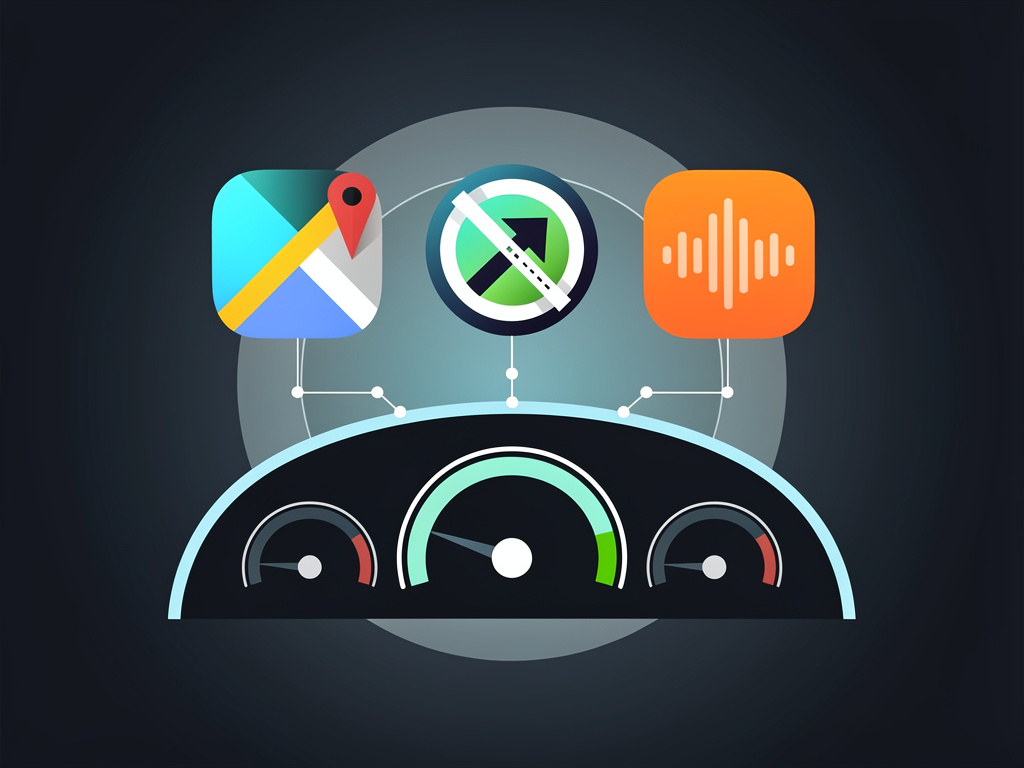
For years, the in-car software experience has been a quiet but consequential battleground between Apple and Google. On Friday, Apple made a move that reshapes the competitive dynamics of that fight: three of the most popular third-party iPhone apps — Waze, Spotify, and Google Maps — are now fully integrated into CarPlay’s latest interface, according to a report from MacRumors. The update, which rolled out as part of iOS 19.4, doesn’t just add convenience. It signals a broader strategic recalibration by Apple in how it thinks about the dashboard.
The additions matter because they address the single biggest complaint CarPlay users have lodged for years: the system’s historically tight grip on which apps could do what. Navigation, in particular, was a sore spot. Apple Maps was always front and center, while third-party alternatives like Google Maps and Waze were technically available but functionally constrained — limited in how deeply they could integrate with the CarPlay interface, unable to populate the dashboard’s instrument cluster view, and often slower to launch than Apple’s own offering.
That’s now changed.
With iOS 19.4, Waze and Google Maps can render turn-by-turn directions directly on the car’s instrument cluster — the screen behind the steering wheel that drivers actually look at most. This was previously an Apple Maps exclusive. Spotify, meanwhile, gains full integration with CarPlay’s redesigned media panel, including playback controls that persist across screens and the ability to surface personalized playlist recommendations on the CarPlay home screen without opening the app. According to MacRumors, the update also allows these apps to take advantage of CarPlay’s new widget framework, introduced last year but until now limited to first-party software.
Apple hasn’t said much publicly about the change. A brief mention appeared in the iOS 19.4 release notes, and the company’s developer documentation was updated to reflect new API access for navigation and media apps. But there was no keynote moment, no press release, no stage time. That restraint is itself telling. Apple is treating this as a technical update, not a philosophical one — even though it clearly is both.
The context here is important. Apple first announced a dramatically redesigned version of CarPlay at WWDC 2022, promising deep integration with vehicle systems including climate controls, speedometers, and fuel gauges. That vision — sometimes called “next-generation CarPlay” — was ambitious and, for a long time, largely unrealized. Automakers were slow to adopt it. Some were openly skeptical. General Motors famously pulled back from CarPlay entirely for a stretch, betting instead on its own Google-powered Ultifi platform. Porsche and Aston Martin were among the few early partners, and even their implementations were limited.
So Apple found itself in an awkward position. It had the most popular in-car software platform in the world — more than 80% of new cars sold in the U.S. support CarPlay, according to Apple’s own figures — but its next-generation vision was stalling. And meanwhile, the current version of CarPlay was losing goodwill among power users who preferred Google Maps for navigation and Spotify for music. The walls Apple had built around its own apps were becoming a liability, not a moat.
Opening the gates to Waze, Google Maps, and Spotify is a concession, but a smart one. It keeps users inside CarPlay rather than pushing them toward Android Auto, which has offered deep third-party integration for years. Google’s competing platform has long allowed Waze — which Google owns — to function as a full-featured navigation app with dashboard-level rendering. That parity gap was a real factor in car buyers’ platform preferences, particularly in markets like Europe and Southeast Asia where Android phones dominate.
The Spotify integration is arguably just as significant, even if it’s gotten less attention. Music and podcast apps are the most-used category of software in cars, ahead of navigation by a wide margin. Apple Music had a structural advantage on CarPlay for years — faster load times, better controls, priority placement. Spotify’s new access to the widget framework and persistent playback panel eliminates most of those asymmetries. For Spotify’s 615 million monthly active users, many of whom are iPhone owners, this removes one of the last friction points in choosing Spotify over Apple Music in the car.
Industry analysts see the move as part of a broader pattern. Apple has been gradually loosening its control over default apps and services across iOS, driven partly by regulatory pressure in the European Union and partly by competitive necessity. The Digital Markets Act, which took effect in 2024, forced Apple to allow alternative browser engines, third-party app stores, and default app changes on iPhones sold in the EU. While CarPlay isn’t explicitly covered by the DMA, the regulatory mood music is clear: gatekeeping is out of fashion.
And there’s a business logic beyond compliance. Apple’s services revenue — which includes Apple Music, iCloud, and Apple Maps advertising — hit $96 billion in fiscal 2025. But the company’s growth in services depends on keeping users on iPhones, and CarPlay is a significant piece of that retention strategy. If CarPlay becomes frustrating to use because it hobbles popular apps, users don’t switch to Apple Maps. They switch to Android Auto. Or they just use their phone mounted on the dashboard, bypassing the car’s infotainment system entirely.
The technical implementation is worth examining. According to Apple’s updated developer documentation, navigation apps now have access to the CarPlay Instrument Cluster API, which allows them to render map views, turn arrows, and distance-to-next-maneuver data on the secondary display. Previously, this API was restricted to Apple Maps through a private entitlement. The new access requires apps to meet specific performance benchmarks — frame rate, memory usage, launch time — to ensure they don’t degrade the driving experience. Apple is opening the door, but it’s still controlling the threshold.
For media apps, the changes center on the CarPlay Widget Kit extension, which lets apps place interactive tiles on the CarPlay home screen. Spotify can now show a “recently played” widget and a “made for you” recommendation tile, similar to what Apple Music has offered since iOS 18. The persistent playback bar — which stays visible even when the user switches to a navigation or messaging app — is also now available to third-party media apps through a new background audio rendering mode.
Waze’s integration goes a step further. The app can now display real-time traffic alerts — road closures, police sightings, hazard reports — as overlay notifications on the CarPlay dashboard, a feature that was previously limited to Apple Maps’ own incident reporting system. This is a meaningful differentiator for Waze, whose crowdsourced data has long been its primary selling point. The question is whether Apple will eventually replicate this capability in Apple Maps, as it has done with many features that first appeared in third-party apps.
Automakers are watching closely. The relationship between car companies and tech platforms has always been fraught. Automakers want control over the in-car experience — it’s one of the few touchpoints they have with customers after the sale. But they also know that buyers expect CarPlay and Android Auto support, and that vehicles without them suffer in customer satisfaction surveys. J.D. Power’s 2025 U.S. Tech Experience Index found that owner satisfaction with infotainment systems was 15% higher in vehicles with smartphone mirroring than in those relying solely on built-in systems.
Apple’s willingness to open CarPlay to third-party apps could ease some of the tension with automakers who were wary of the next-generation CarPlay vision precisely because it seemed designed to give Apple total control over the dashboard. By showing that it’s willing to let Google Maps and Waze coexist — and even thrive — within CarPlay, Apple may be signaling to OEMs that the platform can be collaborative, not just extractive.
But there’s a flip side. Every time a user opens Google Maps inside CarPlay, that’s navigation data flowing to Google, not Apple. Every Spotify stream is a stream that isn’t happening on Apple Music. Apple is trading short-term competitive advantage for long-term platform stickiness, betting that keeping users inside CarPlay matters more than keeping them inside Apple’s own apps. It’s a bet that makes sense — but it’s not without cost.
The timing of the update also coincides with rising interest in car software from companies outside the traditional auto and tech sectors. Amazon has been expanding its Alexa Auto platform. Samsung, through its Harman subsidiary, is pushing its own in-vehicle infotainment solutions. Even Xiaomi, which launched its first electric vehicle in 2024, has been developing a proprietary car software stack that integrates with its smartphone and smart home products. The competition for the dashboard is intensifying, and Apple can’t afford to be seen as the platform that restricts choice.
For developers, the update opens new possibilities. If Apple is willing to grant instrument cluster access and widget framework support to navigation and media apps, the question becomes: what’s next? Messaging apps that can render conversation threads on the dashboard? Parking apps that can display garage availability on the instrument cluster? EV charging apps that show route-optimized charger locations in real time? The API expansions in iOS 19.4 suggest Apple is building toward a more open CarPlay developer platform, though the company hasn’t publicly committed to a timeline.
Not everyone is celebrating. Some Apple Maps loyalists on forums and social media have expressed concern that the update will reduce Apple’s incentive to improve its own navigation app. Apple Maps has come a long way since its disastrous 2012 launch — it now offers detailed city models, Look Around street-level imagery, and cycling directions in hundreds of cities — but it still trails Google Maps in point-of-interest accuracy and real-time traffic data in many regions. If Apple can simply let Google Maps fill the gap inside CarPlay, the argument goes, why invest in closing it?
That concern may be overblown. Apple has poured significant resources into Maps in recent years, including a ground-up rebuild of its mapping data using first-party street-level imagery collected by Apple’s own fleet of sensor-equipped vehicles. The company’s investment in Maps is driven by more than just CarPlay — it underpins location services across the iPhone, Apple Watch, Vision Pro, and the company’s advertising business. Letting Google Maps onto the CarPlay instrument cluster doesn’t mean Apple is giving up on its own maps. It means Apple is confident enough in its platform to compete on merit rather than exclusivity.
So where does this leave the average driver? In a better place than six months ago. If you prefer Waze’s crowdsourced traffic alerts, you can now see them on your instrument cluster without leaving CarPlay. If Spotify is your music app of choice, it now works as well in your car as Apple Music does. And if you like Apple Maps and Apple Music, nothing has changed for you — those apps still work exactly as before, with all the same integrations.
The real significance of this update isn’t about any single app. It’s about Apple acknowledging, implicitly, that the best car software platform isn’t the one that forces you to use certain apps. It’s the one that works with the apps you already use. That’s a lesson Apple has been slow to learn in other areas — the App Store, default browsers, payment systems — and it’s one that regulators have sometimes had to teach by force. In CarPlay, at least, Apple seems to have arrived at the conclusion on its own.
Whether this openness extends to the next-generation CarPlay platform, which Apple is expected to discuss at WWDC 2026 in June, remains to be seen. But the direction is clear. And for the millions of drivers who rely on CarPlay every day, it’s a welcome one.


 WebProNews is an iEntry Publication