
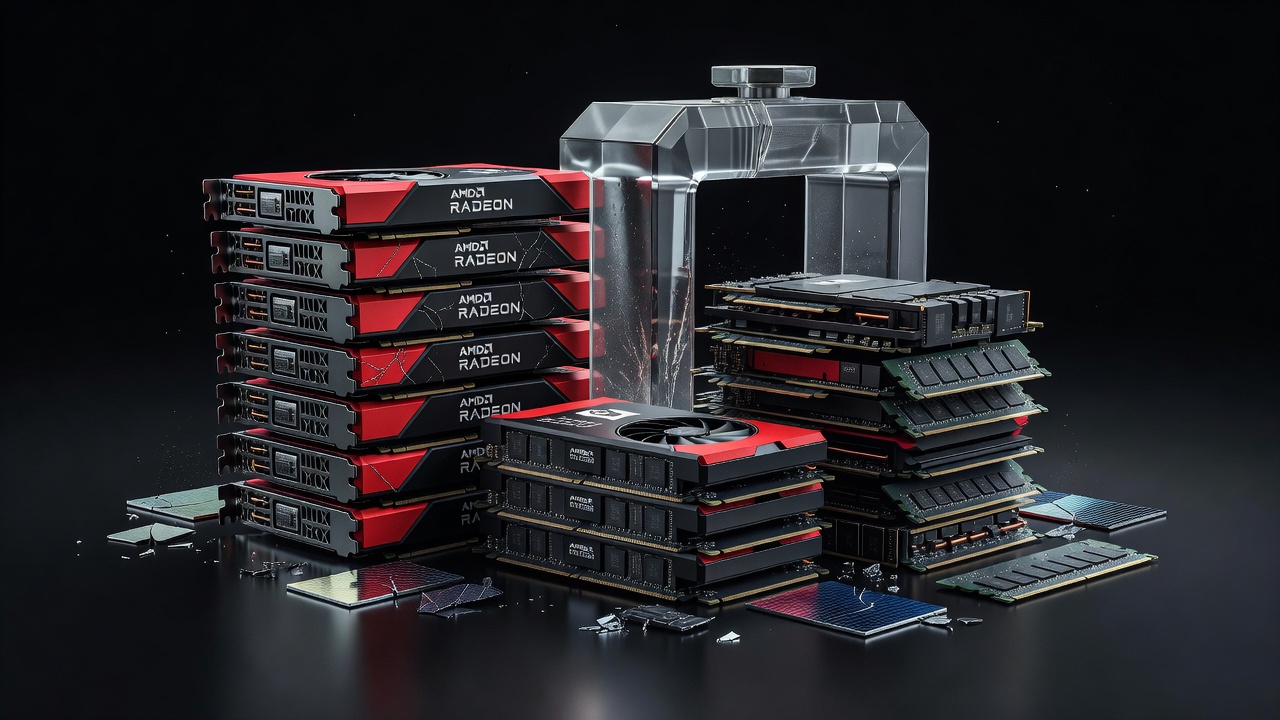
Graphics card buyers already reeling from months of rising costs just received more unwelcome news. AMD has told its add-in-board partners it will raise prices on Radeon GPU and memory kits by at least 10 percent starting in August. The timing is no coincidence. It follows NVIDIA’s own recent increases on GDDR6 and GDDR7 bundles for the RTX 50 series and older cards alike.
The move comes directly after NVIDIA pushed through higher component pricing. AMD had prepared the increase earlier but held off. Demand for consumer graphics cards stayed soft through much of the first half of 2026. Once NVIDIA acted, AMD moved to protect margins. Both companies now march in step. Their customers pay the bill.
Digital Trends first flagged the AMD decision, citing a leak from Chinese supply-chain account ChannelGate on Weibo that was amplified by VideoCardz. The report landed just days after similar coverage of NVIDIA’s actions. And the numbers tell a consistent story. Street prices for new Radeon models already sit well above suggested figures. An RX 9050 listed at $279 rarely appears for less than $450. Some partner cards from XFX and Gigabyte push past $500.
Shortages of GDDR memory sit at the heart of the problem. AI data-center demand continues to pull huge volumes of high-speed DRAM away from the graphics market. Suppliers cannot ramp production fast enough. Costs climb. Those costs flow downstream. First to board partners. Then to retail shelves. Neither AMD nor NVIDIA appears willing to absorb the hit.
Recent coverage confirms the breadth of the pressure. Wccftech reported on July 31 that AMD’s second increase of the year targets GPU-plus-memory bundles. The first 10 percent bump hit in July. A further round now lands in August. NVIDIA’s adjustments cover both new GDDR7-based RTX 50 cards and revived older products such as the RTX 3060 12GB. The entire stack moves higher.
Industry trackers have watched the ripple effects for months. TechPowerUp noted the initial AMD kit increase back in late June. By early 2026 multiple outlets warned of phased hikes. A South Korean report from Newsis, picked up by Vice in January, predicted AMD would move first in January or February followed by NVIDIA. Reality stretched the schedule. Yet the direction never changed.
Market data through the first quarter of 2026 shows the impact on shelves. TechSpot’s Q1 2026 pricing survey found NVIDIA RTX 50-series cards up 15 percent on average in some regions. AMD’s RX 9000 series posted more modest but still noticeable gains. The RX 9060 XT 8GB version rose 13 percent. The 16GB variant climbed 14 percent. RX 9070 and 9070 XT models added roughly 7 percent at retail, or about $40 to $50 per card. These figures reflect component costs passed straight to buyers.
Analysts point to structural forces that will not ease soon. Global memory production capacity remains constrained. AI server build-outs show no sign of slowing. Forecasts suggest the squeeze could persist into 2027 or even 2028. One supply-chain note obtained by TrendForce and referenced across multiple reports tied the July AMD move explicitly to “the ongoing global shortage of GDDR memory.” NVIDIA’s subsequent action on both GDDR6 and GDDR7 kits followed the same logic.
PC gamers notice the difference immediately. A midrange card that once fit comfortably inside a $1,200 build now pushes budgets higher. Enthusiasts who waited for post-launch discounts find fewer bargains. Even budget-conscious buyers eyeing the revived 4GB RX 9050 discover real-world prices erase most of the advertised savings. The pattern repeats higher up the stack. NVIDIA’s RTX 5060 Ti has been spotted at levels approaching $760 in some markets. The RTX 5070 Ti pushes toward $1,400. AMD cards now trend to close the gap rather than undercut.
Board partners face their own calculations. Higher kit prices compress margins unless retail tags rise. Many have already adjusted. Others wait for inventory to clear before passing costs along. The result is a staggered but unmistakable upward drift. And the console market offers little relief. Recent price jumps on Xbox Series X to $799.99 and an upcoming Nintendo Switch 2 at $499.99 remove affordable alternatives for many households.
Company executives have stayed quiet in public. No official statements accompanied the partner notifications. Yet the pattern matches past cycles when component costs spiked. Memory prices surged in 2021 and 2022 under similar AI and crypto demand. This time the driver is almost entirely data-center AI. Consumer graphics cards have become the marginal buyer. They absorb the volatility.
Longer term the situation may stabilize only after new fabrication capacity comes online. Memory makers have announced expansions. Those facilities take years to reach volume. In the meantime pricing power rests with suppliers. GPU vendors pass the expense forward. Gamers postpone upgrades or settle for last-generation hardware. The market fragments between those who can pay and those who cannot.
Recent social conversation reflects the frustration. On X, users noted AMD deliberately waited for NVIDIA to move first. One post observed, “Waiting for Nvidia to raise prices first is such a perfect GPU industry detail.” Another highlighted the memory shortage as the root cause, writing that “AI servers are driving DRAM costs sky high.” The tone mixes resignation with irritation. Prices climb. Performance gains feel smaller. The cost of entry keeps rising.
Industry observers expect further adjustments through the rest of 2026. Additional memory cost increases remain possible. New product launches may carry higher MSRPs from the start. The brief period when AMD cards appeared as the relative value option has closed. Both vendors now operate under the same cost umbrella. Their pricing strategies converge.
Buyers weighing a new graphics card confront a narrower set of choices. Pay more. Accept less VRAM. Or delay. None of the options appeals. Yet the data from supply chains, retail trackers, and partner notifications all point the same direction. The era of steadily falling GPU prices has ended. A new baseline is forming. And it sits noticeably higher than before.


 WebProNews is an iEntry Publication