

Server makers have committed more than 240 platforms to AMD’s sixth-generation EPYC processors, 20% more than for Turin, and the first of those machines are now shipping. AMD put the chips on general sale Tuesday, wagering that the spread of AI agents will turn the data-center CPU back into a growth engine.
The logic runs like this. GPUs run the models, but agents also spin up sandboxes, call tools, query databases and feed data to accelerators, and that work lands on CPUs. Lisa Su, AMD’s chair and chief executive, told analysts last week that agents “are quickly becoming the next killer app for CPUs in the cloud.” She added that early demand for the new chips, code-named Venice, “is the strongest we have seen for any new EPYC generation,” according to AMD’s prepared remarks for its third-quarter call.
The first family to ship, the EPYC 9006 SP7, is built on the Zen 6 architecture and tops out at 256 cores and 512 threads per socket. A 96-core part runs as fast as 5.3 GHz. The platform adds PCIe Gen 6 and supports MRDIMM-12800 memory at up to 1.6 terabytes per second per socket, the company said in a product blog post. Three more lines, the SP8, the 9006X and a low-power 9006 LP, are still to come. Data Center Knowledge reported that AMD expects those in 2027.
Taking aim at Nvidia and Intel
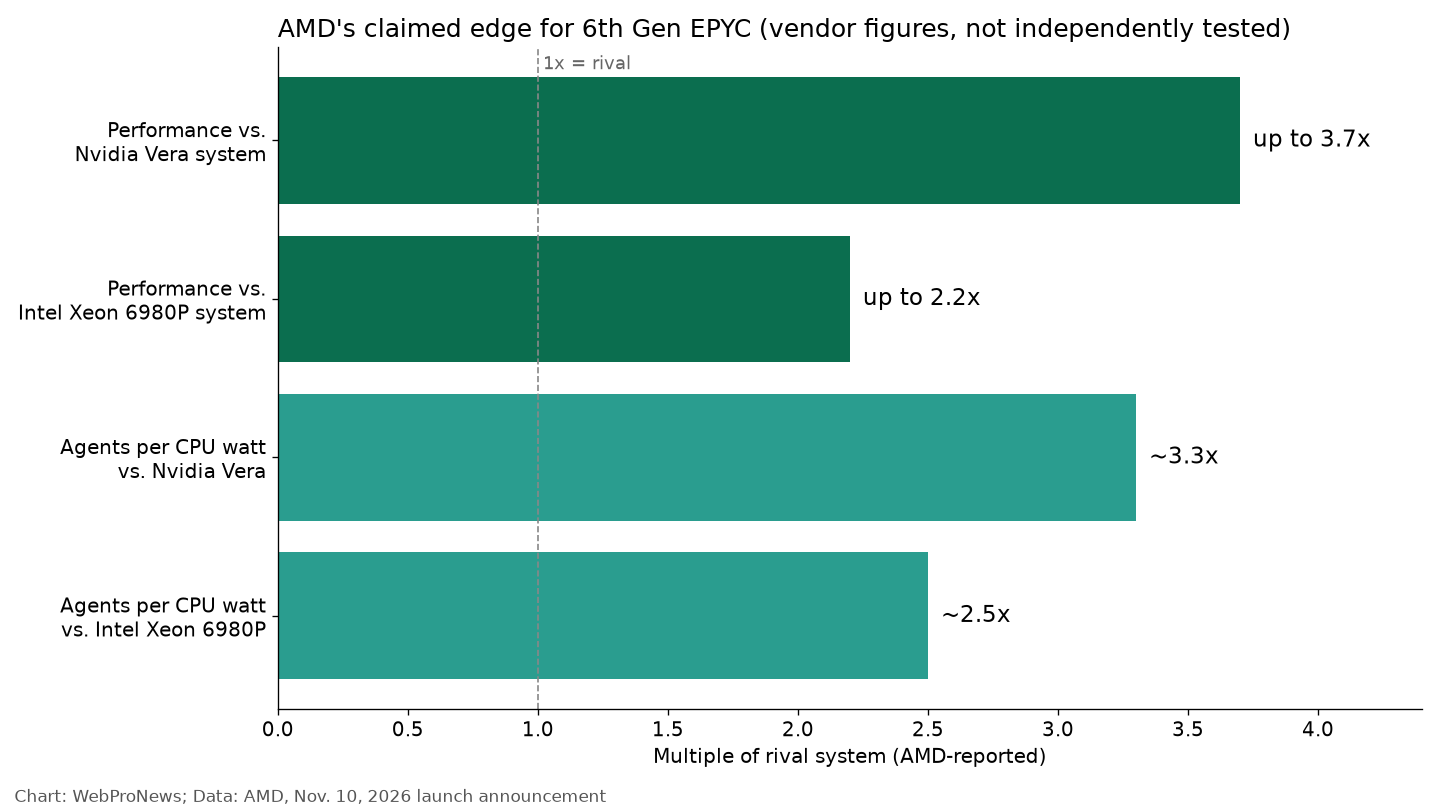
AMD is pitching the launch directly against Nvidia’s Vera CPU and Intel’s Xeon. A system built on its top-end EPYC 9996 delivers up to 3.7 times the performance of a Vera-based system and up to 2.2 times that of an Intel Xeon 6980P system, with twice the performance per dollar of the Intel machine, AMD said in its launch announcement. For agent sandboxes, it claims roughly 3.3 times as many agents per CPU watt as Vera and 2.5 times as many as the Xeon 6980P. Those are vendor figures, not independent tests.
“AI is significantly expanding the role of the CPU across every layer of the data center,” said Dan McNamara, who runs AMD’s compute and enterprise AI business. The rivals see the same opening. Nvidia now sells its own data-center CPU, and Arm has published tests putting its AGI CPU ahead of EPYC on agentic workloads.
Meta is the lead customer and has been validating Venice platforms ahead of a large-scale rollout. Microsoft opened a preview of Azure HDv2 virtual machines, the first cloud platform on the new chips. “Azure is where much of the most advanced Frontier AI model development happens, and that requires extraordinary amounts of CPU infrastructure to process the data used to train those models,” said Ananth Sankaranarayanan, Microsoft’s vice president of AI infrastructure. Oracle plans OCI Compute E7 instances on the processors, and Dell, HPE, Lenovo and Supermicro are shipping servers. HPE alone added four ProLiant Gen13 models.
6th Gen AMD EPYC SP7 processors are now available.
Built on the new “Zen 6” architecture, these CPUs provide the performance and flexibility to support growing agentic AI deployments as well as demanding enterprise, cloud and HPC workloads.
Systems are shipping from server… pic.twitter.com/482aI7VsnY
— AMD (@AMD) November 10, 2026
Post: AMD on X
A bigger slice of AMD’s business
The stakes for AMD are rising. Data-center revenue jumped 97% to a record $8.5 billion in the third quarter and made up 64% of total sales, up from 47% a year earlier, as WebProNews reported last week. Su said cloud and enterprise server sales each more than doubled. She also said she expects the server market to reach about $220 billion by 2030.
Matt Kimball, vice president and principal analyst at Moor Insights & Strategy, told Data Center Knowledge that the core counts let CIOs with fixed power budgets run existing workloads on fewer servers and free space for AI. “It’s huge for those enterprise organizations that are in the beginning stages of the AI-ification of their business,” he said.
AMD is also selling the chips by the rack. Its Helion design, introduced in October, comes in two CPU-only versions, one liquid-cooled and one air-cooled, plus an air-cooled model that pairs CPUs with GPUs for local inference. The densest setup holds up to 144 Venice processors and nearly 74,000 threads. Su said the first Helion systems ship this quarter, and cloud providers are installing Venice now ahead of instance rollouts planned for early 2027.


 WebProNews is an iEntry Publication