
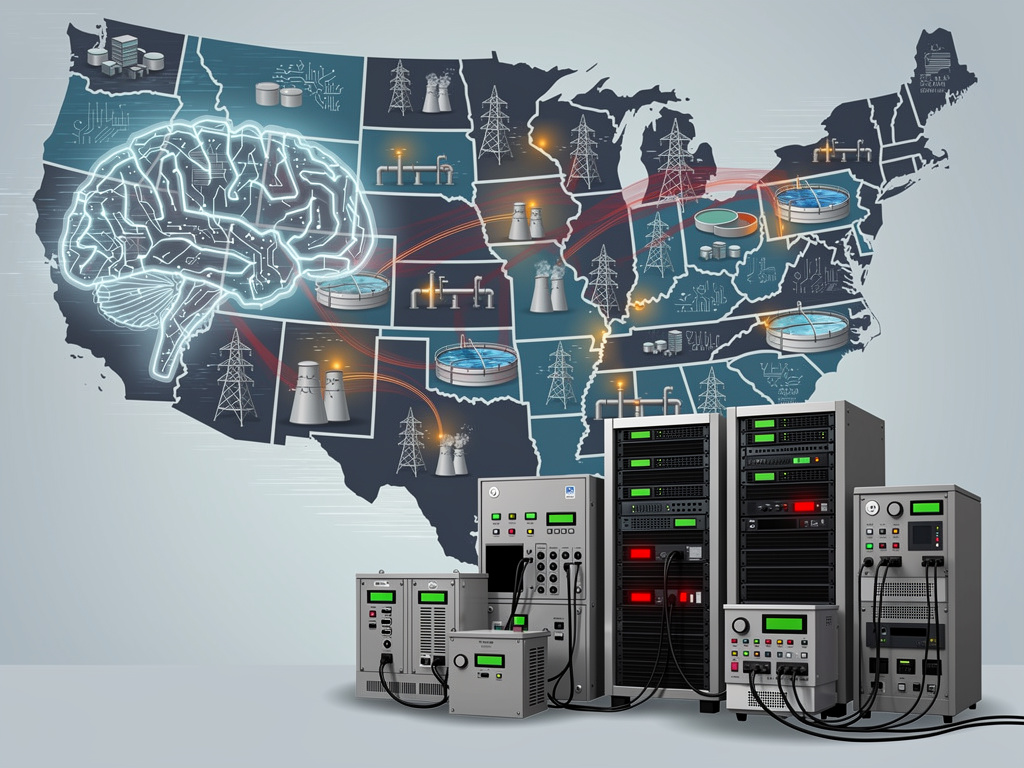

A joint advisory from five U.S. agencies says attackers are using AI to build exploit scripts for Siemens industrial controllers used in water, energy and food systems. The advisory, AA26-231A, was published Aug. 19-20 by the NSA, CISA, the FBI, the Department of Energy and the EPA, according to a detailed breakdown by Alex Goryachev, who advises the California State University system’s AI Working Group on AI governance.
It names Siemens S7-200, S7-300, S7-400, S7-1200 and S7-1500 programmable logic controllers, plus F-series safety controllers. Attackers pair the open-source snap7.dll and python-snap7 libraries with AI-assisted scripting to read and write PLC memory, configuration data and ladder logic over the S7comm protocol, and they disguise the tools as legitimate OT monitoring software. Sectors named include critical manufacturing, energy, water and wastewater, chemical, food and agriculture, and commercial facilities.
The advisory’s key finding is that AI is dramatically reducing the technical expertise needed to build these tools. Goryachev places it alongside two earlier incidents: Iranian-linked hackers targeting Rockwell Automation Allen-Bradley PLCs in April, and a July attack that caused equipment malfunctions at more than 30 Minnesota water utilities.
Old equipment, slow patch cycles
Much of the energy grid’s operational technology was never designed to connect to the internet, and power plants typically run for decades, The Verge reported. Some equipment makers have gone out of business, leaving no one to patch orphaned devices, and OT systems may be designed to take updates only quarterly or yearly. Smaller utilities often lack the staff and resources to keep up.
Experts interviewed by The Verge were more concerned about people using generative AI than about rogue agents. “It’s literally any sociopath that wants to [attack] is now more powerful than they used to be,” said Joshua Corman, executive in residence for public safety and resilience at the Institute for Security and Technology. “This has been a force multiplier and continues to grow.” Corman added that attackers may not know OT protocols, but “the LLM has read the manuals and does know what to do.”
“The true difference from AI is that it’s letting adversaries move more quickly — but it’s very challenging for those defending the infrastructure to match that pace,” said Sophie McDowall of the Foundation for Defense of Democracies’ Center on Cyber and Technology Innovation.
What defenders can do
Rob Denaburg, cybersecurity program senior manager at the American Public Power Association, told The Verge that standard defenses still apply. “AI or not, it is at the end of the day, still a cyberattack,” he said. “As long as you can stop them in one spot, they can’t carry out that attack.” Recommended steps include being able to switch to manual operations and reducing how interconnected systems are. In Corman’s words, utilities are realizing “if we can’t protect it, disconnect it.”
Goryachev suggests a practical first move. Utilities can run the same Censys and ZoomEye searches attackers use against their own public IP ranges, and any S7comm-capable device that answers from outside the plant network, especially one with default or weak credentials, should be the first thing pulled behind a firewall.
AI developers are also putting money toward defense. OpenAI pledged $1 billion on Sept. 3 to subsidize training and access to models meant to help defend critical infrastructure. Corman cautioned against introducing too much change too quickly in OT environments, though, warning of “an AI bull fighting another AI bull in an OT china shop.”


 WebProNews is an iEntry Publication